Indo-Pacific bottlenose dolphin population under threat... five deaths estimated last year
- Input
- 2026-05-07 09:11:07
- Updated
- 2026-05-07 09:11:07
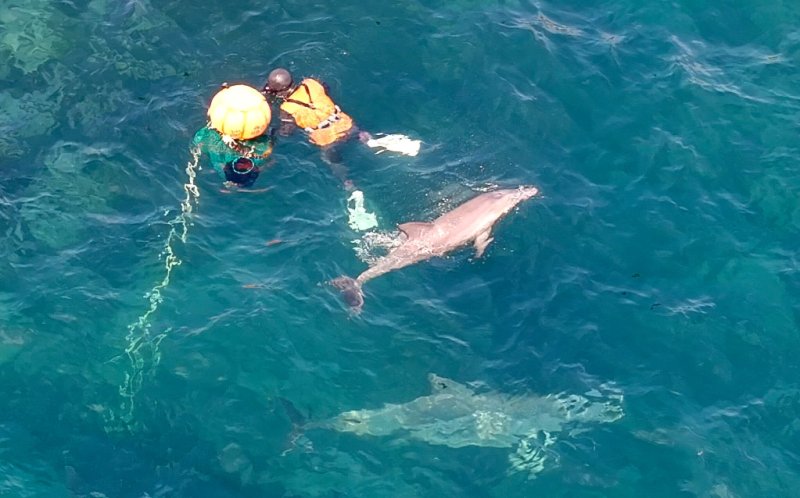
[Financial News, Jeju = Reporter Jeong Yong-bok] Discussions on how to protect the roughly 120 Indo-Pacific bottlenose dolphins remaining along the coast of Jeju are moving into the policy arena. The push to reduce dolphin-watching tours that follow the animals by boat and instead shift to land-based observation is now intertwined with debate over an 'ecological legal person' that would legally represent the dolphins' habitat rights.
Jeju Special Self-Governing Province is raising 200 million won through a designated donation project under the Hometown Love Donation Program to support dolphin protection. The funds will be used to build a dolphin observation deck and an eco-tourism photo zone. The goal is to create a land-based eco-tourism infrastructure that allows people to observe the dolphins without disturbing their habitat.
Jeju's Indo-Pacific bottlenose dolphin is a marine protected species found only along the coast of Jeju Special Self-Governing Province. The Ministry of Oceans and Fisheries (MOF) designated a 2.36-square-kilometer area off Shindori, Daejeong-eup, Seogwipo City, as a Marine Protected Area for the dolphins on April 11, 2025. It is the first such designation in South Korea for a dolphin habitat.
The warning signs are clear. In 2024, 16 dolphin deaths were recorded in Jeju, the highest number in the past decade. A separate survey also found that five young dolphins born in Jeju waters in 2025 are believed to have died. After the carcass of a calf entangled in abandoned fishing gear was found, the impact of coastal pollution, fishing activity and boat-based tourism on dolphin survival has again become a major issue.
■ Even after designation as a protected area, on-site risks remain
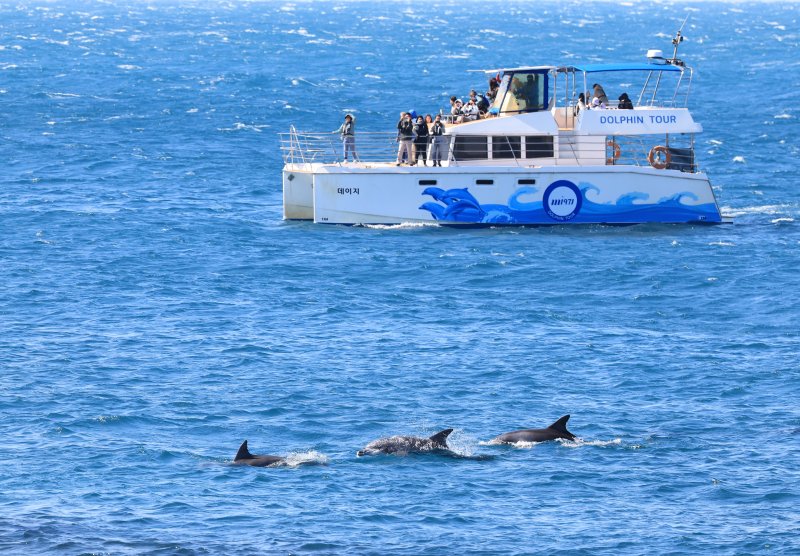
Rules for observing the dolphins are already in place. Under the Enforcement Rules of the Act on the Conservation and Management of Marine Ecosystems, vessels are prohibited from approaching dolphins within 50 meters. No more than three vessels may approach within 300 meters at the same time. Drone observation is also restricted, with low-altitude flight below 30 meters above the sea surface banned.
There are also speed limits by distance. Vessels must slow to 10 knots or less between 750 meters and 1.5 kilometers from the dolphins, and to 5 knots or less between 300 and 750 meters. Within 300 meters, the propeller must be stopped. Touching or feeding the dolphins is also prohibited.
The problem is enforcement on the ground. MOF has said it is difficult to impose fines because violations are not easy to prove clearly using photos or video alone. Even with rules in place, the protective effect will remain limited if tourism vessels keep approaching, marine waste and abandoned fishing gear continue to accumulate, and pressure from coastal development persists.
The ecological legal person debate begins at this gap. A protected area defines 'what to protect' and where, while an ecological legal person is a mechanism that defines 'in whose name' and 'for what purpose' protection should be carried out. Because the dolphins cannot directly speak to administrative agencies or appear in court, the idea is to have a legally designated representative and guardianship body demand habitat conservation and damage prevention in their name.
An ecological legal person does not mean granting dolphins the same rights as humans. It is a system designed to recognize, in a limited way, rights related to survival, habitat, migration, reproduction and a healthy marine environment, while creating a public mechanism to exercise those rights on their behalf. Legal grounds are needed if emotional conservation campaigns are to be turned into a permanent management system.
The first hurdle is revising the Jeju Special Act. Local ordinances can support conservation campaigns and aid projects. But legal grounds are needed to give the dolphins legal standing and recognize rights to participate in administrative procedures or to be represented in lawsuits. The law must spell out the designated subject, scope of rights, representative body, funding, information disclosure and accountability structure.
Experts also say the ecological legal person should be viewed as an operating framework for law and administration, not just a conservation slogan. Researcher Jin Hee-jong said, "The ecological legal person for the Indo-Pacific bottlenose dolphin must not remain a symbolic declaration," adding, "It can function on the ground only if a guardianship body, scientific monitoring, resident and fisher participation, and transparent fund management are all designed together."
■ Panama turns to the UN, Mexico to the courts
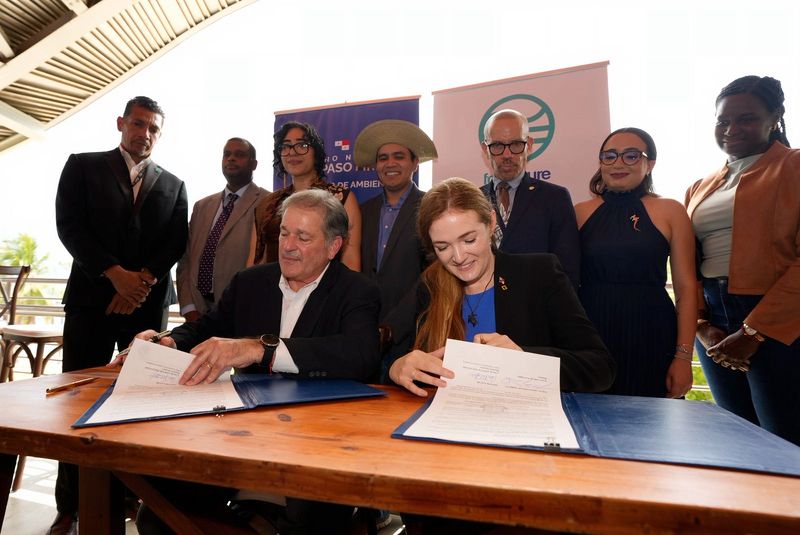
Overseas, the trend of addressing the rights of nature through law and institutions is accelerating. On April 10, the Panamanian government and the international group For Nature announced that they had signed a memorandum of understanding to promote adoption of a 'Universal Declaration of the Rights of Nature' at the UN General Assembly. The move aims to create an international framework recognizing the right of ecosystems, species and natural systems to exist, persist and recover.
Panama is already a country that recognizes nature as a rights-bearing subject under its domestic law. The latest agreement is significant because it expands rights-of-nature discussions, which had remained within national legal systems, onto the stage of multilateral diplomacy. The ecological legal person is moving beyond an environmental campaign slogan and into the realm of international norms and legal procedures.
In Mexico, there has been a case in which whales were treated almost as a party to a legal dispute. According to Mexico News Daily, a lawsuit was filed on behalf of whales in the Gulf of California over a liquefied natural gas export project linking the United States and Mexico. A federal judge in Baja California ordered a suspension blocking the operation of ultra-large vessels longer than 300 meters until a final ruling is made. The suit argued that whales have a legal right to a safe and livable habitat.
These cases cannot be transferred directly to Jeju. Panama is combining national rights-of-nature legislation with UN diplomacy. The Mexican case involved a clash between large-vessel operations and marine mammal habitat protection. Jeju's Indo-Pacific bottlenose dolphin issue is a local one shaped by coastal fishing, tourism vessels, village communities and the special self-governing system.
The common thread is clear. The rights of nature are no longer an abstract idea; they are beginning to function through diplomatic agreements, court rulings and mechanisms that can halt development projects. If Jeju is to discuss an ecological legal person, it must draw on the legal reasoning of overseas cases while building an operating model suited to the island's coastal economy, tourism structure and fishing realities.
■ Without a guardianship body and resident participation, it will be hard to make it work

The success of an ecological legal person depends on the guardianship body. The dolphins cannot attend meetings themselves. The key question is who will speak on their behalf and by what standards that authority will be exercised.
A guardianship body will have limits if it is organized only around the government. A structure is needed in which Jeju Special Self-Governing Province, the central government, marine ecology experts, lawyers, veterinary and rescue specialists, fishers, local residents and civic groups all take part. The administration should handle enforcement, while experts provide scientific judgment. Residents and fishers can contribute field knowledge, and civil society can take on monitoring and public discussion.
Its authority must also be clear. The guardianship body should be able to voice opinions on development projects or marine tourism projects that could affect dolphin habitats. It also needs the authority to demand investigations and corrective measures when violations of vessel approach rules or damage from abandoned fishing gear recur. It should even be considered whether it can file administrative appeals or lawsuits when necessary.
Accountability mechanisms must be built in as well. Meeting minutes, annual reports, fund usage, external audits and scientific data disclosure should all be part of the system. If the people exercising the rights of nature are not held accountable, trust in the system will erode.
An ecological legal person that excludes residents and fishers will be difficult to root in the field. If dolphin protection is seen only as a restriction on livelihoods, backlash will inevitably grow. Fishers can become frontline monitors who observe dolphin movement and damage from abandoned fishing gear. If village fishing cooperatives, haenyeo divers and coastal fishers are included in observation and reporting systems, administrative blind spots can be reduced.
The tourism industry must also be brought into the system. Rather than an outright ban on boat tours, a more realistic approach would combine a shift to land-based observation, certification, compliance with limited navigation rules, guide training and sanctions for violators. Companies that follow the rules should receive certification and promotional opportunities, while repeat offenders should face tougher penalties.
The Hometown Love Donation Program will be used as funding to shift boat-based tourism toward land-based eco-tourism. Building observation decks and photo zones is meant to create an environment where visitors can watch the dolphins without getting too close. It also sets a behavioral standard that changes tourism from chasing dolphins to waiting and observing them.
However, donations alone cannot sustain an ecological legal person. Population surveys, abandoned gear response, rescue and treatment, tourism vessel management, legal advice, resident consultations and education programs all require stable funding. National funds should cover basic surveys and system operations, while Jeju's budget should be allocated to on-site management and resident cooperation projects. It would also be worth considering a system that channels part of eco-tourism revenue back into a protection fund.
For Jeju's ecological legal person to work on the ground, the Jeju Special Act amendment must include the designated subject, scope of rights, authority of the guardianship body and funding mechanism. Later, ordinances and enforcement rules should flesh out standards for tourism vessel management, abandoned gear response, rescue and treatment, resident support and fund operation.
The ecological legal person for the Indo-Pacific bottlenose dolphin is not a system for putting a name tag on the dolphins. It is a standard for deciding whether Jeju's sea will be used only as a tourism resource or protected together with a living ecological subject. If Jeju's sea is healthy, the dolphins can live; if the dolphins live, the vitality of Jeju's sea will also be revealed.
Kim Jong-soo, director of the Oceans and Fisheries Bureau of Jeju Special Self-Governing Province, said, "We will work with residents to protect the Indo-Pacific bottlenose dolphin and build a sustainable eco-tourism model," adding, "We will expand the foundation for preserving the ecological value of Jeju's sea."
[email protected] Reporter Jeong Yong-bok Reporter