KF-21 Fighter Receives Final Combat Suitability Approval, Marking the Start of the 'Air Sovereignty' Era After Passing 13,000 Tests
- Input
- 2026-05-07 10:03:00
- Updated
- 2026-05-07 10:03:00
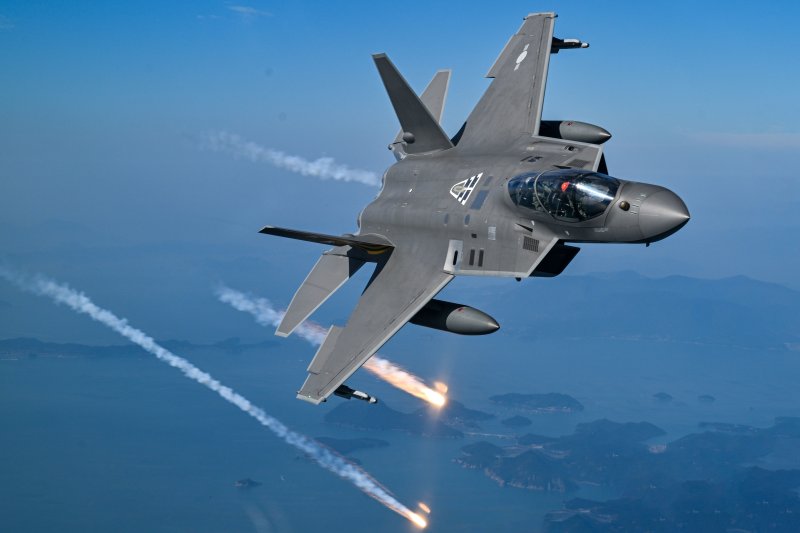
The approval confirms all performance capabilities of the KF-21 Block I, which covers basic performance and air-to-air capability. With system development set to conclude in June this year, the first mass-produced aircraft is expected to be delivered to the Air Force in the second half of the year. It will then be deployed in stages and is expected to become a core asset in air defense.
The KF-21's design philosophy is forward-looking. In the Block I phase, it adopted a semi-conformal configuration that places weapons on the lower exterior of the fuselage, but the aircraft was reportedly designed with a fifth-generation stealth fighter concept in mind, allowing for future full internal weapons carriage. This evolutionary approach has helped position the KF-21 as more than just a 4.5-generation fighter. It is seen as a growth platform that can be upgraded into a fully stealth-capable aircraft suited to future battlefield conditions through internal weapons integration.■ Block II, the 'fully realized' version, faces challenges including supersonic air-to-ship missile developmentForeign military research institutes say the true strategic value of the KF-21 will depend on the expanded weapons integration and multi-role capabilities of the Block II version that follows the success of Block I. They also assess that, given South Korea's geopolitical conditions, securing long-range asymmetric strike capabilities to counter the naval buildup of neighboring countries is essential.
Janes, a British defense publication, has highlighted the integration of the supersonic air-to-ship missile currently under development in South Korea. The International Institute for Strategic Studies (IISS) recently noted that if the KF-21 is to establish itself as a truly independent platform, it must prove its software sovereignty by freely integrating the most effective strategic weapons without diplomatic or non-military constraints. Analysts say this is a key requirement for the aircraft to become a meaningful factor in the regional balance of power.
Experts say that if a supersonic missile capable of disabling an enemy fleet's air defenses at speeds above Mach 3 is combined with the independent KF-21 platform, it could create a powerful anti-access/area-denial (A2/AD) zone around the waters near the Korean Peninsula. That would represent an advanced version of the 'porcupine strategy,' which seeks asymmetric advantage against the naval expansion of neighboring powers. In other words, it could become the backbone of sea-denial capabilities that force a deadly survival risk on enemy large surface vessels simply by deploying them near South Korean waters.■ An alternative in the global fighter market, and a new platform for K-Defense Industry exportsThe arrival of the KF-21 is also expected to reshape the global fighter jet market. For countries that find the introduction of high-end stealth fighters too costly, the KF-21 is emerging as a strong competitor to European 4.5-generation fighters such as the Dassault Rafale and the Eurofighter Typhoon.
Analysts in the global defense market are paying attention to the KF-21's strong price competitiveness and advanced avionics, calling it a high-efficiency, high-end aircraft. In particular, the flexible technology transfer negotiations made possible by having an independent platform are expected to make it an attractive alternative to European fighters for countries in Southeast Asia, the Middle East, and Eastern Europe that want to develop their own aviation industries.
Noh Ji-man, head of the Korean Fighter Program Project Group, emphasized that "this approval is the result of close cooperation among the public, private, and military sectors, and a symbolic achievement that shows South Korea has fully secured its own fighter development capability." The KF-21 is expected to further gain air-to-ground capability through additional weapons testing and to lead South Korea's rise as one of the world's four major defense powers.
[email protected] Lee Jong-yoon Reporter