KOSPI Composite Index Breaks Through the Ceiling; "8,600 by Year-End" Seen as Possible ... Laying the Groundwork for a 10,000 Milestone [The Dawn of the 7,000 Era]
- Input
- 2026-05-06 18:34:20
- Updated
- 2026-05-06 18:34:20
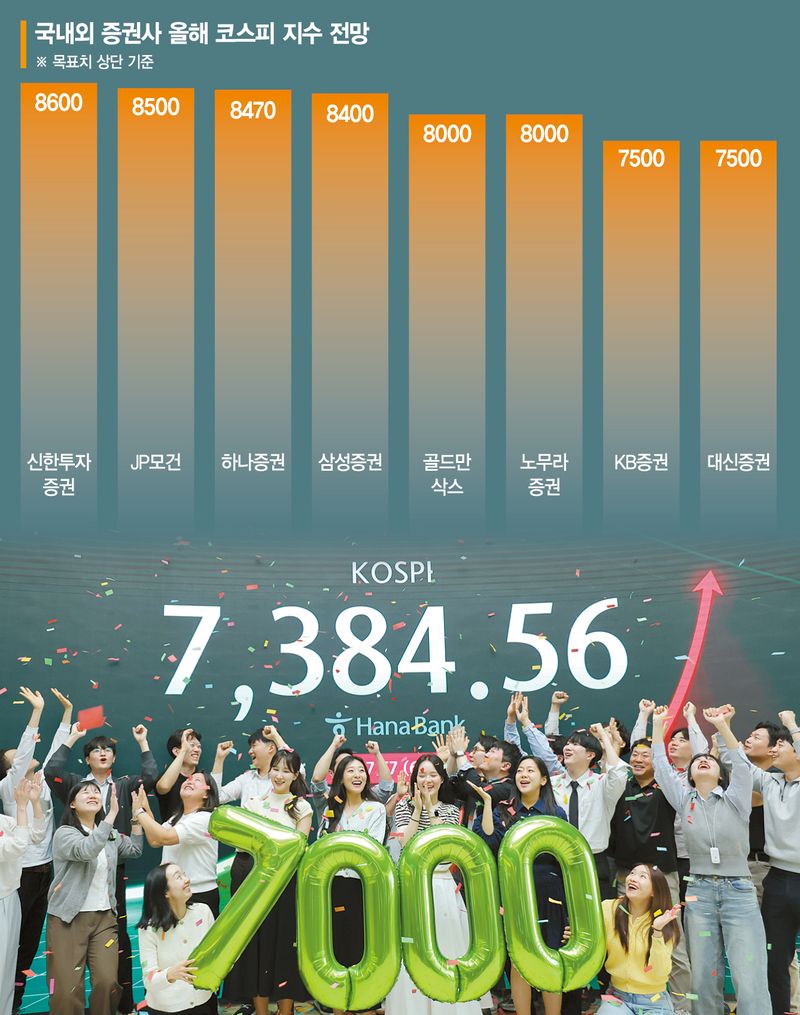
According to the financial investment industry on the 6th, forecasts that the KOSPI Composite Index could top 8,000 within this year are coming in one after another. Among domestic brokerages, Shinhan Securities gave the highest annual forecast, saying the index could rise to 8,600 by year-end. It cited explosive earnings growth led by Samsung Electronics Co., Ltd. and SK hynix as the basis for its higher target. Yoon Chang-yong, head of the Research Center at Shinhan Securities, said, "The reason for raising the upper end of the index range is not multiple expansion, but a structural upward revision in earnings per share (EPS) centered on semiconductors." He added, "The key question is not the index level itself, but whether the earnings path can be sustained."
Brokerages that issued annual KOSPI forecasts generally placed this year's upper range between 7,500 and 8,400. Hana Securities said the index could rise as high as 8,470 this year. That scenario assumes the Federal Reserve System (Fed) cuts its benchmark rate once or twice this year and that the price-to-earnings ratio (PER) for the semiconductor sector rises to 8.0 times. Hwang Seung-taek, head of the Research Center at Hana Securities, said, "Many investment banks are currently raising their earnings estimates for Samsung Electronics." He added, "Unless something happens that could break this structure, the semiconductor boom will continue."
Samsung Securities raised its KOSPI target for this year from 7,200 to 8,400, citing continued strength in the semiconductor industry. Seokmo Yoon, head of the Research Center at Samsung Securities, said, "It is true that earnings momentum is emerging around semiconductors, but earnings momentum is also solid globally in capital goods, materials and information technology (IT) hardware." He added, "The Korean stock market also has a meaningful share of capital goods, and consumer stocks could be re-rated as domestic demand improves."
KB Securities and Daishin Securities both set their targets at 7,500. Korea Investment & Securities Co., Ltd. is projecting an upper range of around 7,250 by year-end. However, with the KOSPI Composite Index closing at 7,384.56 on the day, some brokerages are likely to revise their upper-end forecasts higher.
Kim Dong-won, head of the Research Center at KB Securities, said, "The KOSPI Composite Index's current 12-month forward PER is 7.6 times, and even taking into account Korea's large exposure to cyclical industries, that is very low."
In the long run, some say a move to 10,000 is not impossible. Lee Seung-hoon, head of the Research Center at IBK Securities, said, "If AI and semiconductor momentum expand further in the future and Physical AI is revalued more strongly, leading to a bubble market, then a 10,000 KOSPI cannot be ruled out."
Foreign brokerages are unanimously expecting the KOSPI Composite Index to break above 8,000 within the year. JPMorgan Chase gave the highest forecast at 8,500, while Goldman Sachs and Nomura Securities, both at 8,000, also backed the view that reaching the "dream 8,000" is not a far-fetched goal. They pointed to upward revisions in this year's KOSPI earnings estimates, led by memory semiconductors.
Another factor boosting global market participants' expectations is the fact that foreign individual investors can now directly invest in Korean stocks. Since the 28th of last month, Samsung Securities has been running a pilot foreign omnibus account service in the U.S. with Interactive Brokers (IBKR), which has about 4.6 million global customer accounts. As a result, foreign investors can now buy and settle Korean stocks in bulk through accounts under the name of overseas brokerages, without opening a separate domestic account.
Yoon Yoo-dong, a researcher at NH Investment & Securities, said, "Samsung Securities and other major firms are also preparing to launch the service." He added, "As trading procedures for foreign individual investors become simpler, global liquidity in the Korean stock market will expand, and capital market vitality will be further strengthened."
[email protected] Park Ji-yeon Reporter