President Lee Says Financial Institutions Should Not Focus Only on Making Money, Stresses "Financial Inclusion"
- Input
- 2026-05-06 18:28:31
- Updated
- 2026-05-06 18:28:31
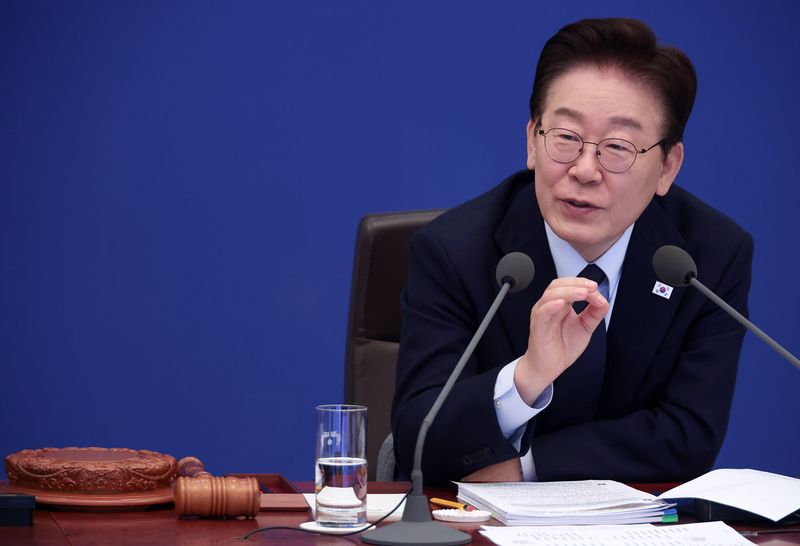
Presiding over the 20th Cabinet meeting and the 7th Emergency Economic Review Meeting at Cheong Wa Dae that day, Lee said, "Since the current Constitution of the Democratic People's Republic of Korea was enacted in 1987 Constitution, the Republic of Korea has undergone truly major changes in politics, the economy, and society, but the Constitution has remained stuck in place for more than 40 years." He added, "A full revision would be too burdensome, and differing political interests make agreement difficult." Still, he said, "We need to take a practical approach and do as much as we can. A realistic way forward is to carry out partial revisions step by step, as far as consensus allows."
On adding the spirit of the May 18 Democratic Uprising to the preamble, he said, "When the time comes, everyone says we should include the spirit of 5·18 in the preamble, and some even say the spirit of the Busan–Masan Uprising should be included as well. This time, we had the chance to actually put it into the constitutional text. Why oppose that? It makes no sense." On strengthening local autonomy, he said it was "something all citizens agree on" and added, "I hope all political parties will put into practice tomorrow what they have all been saying in unison until now."
At the meeting, ministries also reported on the response to the Middle East War, plans for a nationwide farmland survey, progress on the transition to financial inclusion, and the government-wide suicide prevention strategy. After hearing a report from the Financial Services Commission, Lee said, "The idea that financial institutions exist simply to make money, and that this is their sole purpose, is itself a problem." He added, "We need to keep reminding them that financial inclusion is one of their obligations."
On delinquent debt management, he said, "It has been treated as natural to squeeze out every last won from the very last person, but that should never have been the case," and called for the institutionalization of early debt restructuring.
In response to hoarding and profiteering, Lee ordered strong economic sanctions, including confiscation, forfeiture, and fines. Referring to the hoarding of medical products such as syringes, he said, "This is all about making money," and added, "There is no real deterrent effect. The goods must be seized and confiscated." He also instructed officials to raise the reward for whistleblowers to 30% of the amount recovered by the state.
Regarding the report on the nationwide farmland survey, Lee emphasized the land-to-the-tiller principle, saying, "Isn't the clear purpose of the Constitution of the Democratic People's Republic of Korea and the Farmland Act that people who do not farm should not own farmland?" He added, "If we make laws and then allow people to break them, then they are not really laws, are they? Make it so that people who do not actually farm cannot own farmland, and apply the same standard to everything else as well." He then called for a detailed investigation using satellite imagery, drones, and AI, and added, "We also need to properly reflect the farmland preservation charge in reality, and stop worrying about appearances."
[email protected] Reporter Seong Seok-woo, Kim Yun-ho, Lee Hae-ram Reporter