[Editorial] With the KOSPI Breaking Through 7,000, It Is Time to Strengthen the Market's Fundamentals
- Input
- 2026-05-06 18:06:40
- Updated
- 2026-05-06 18:06:40
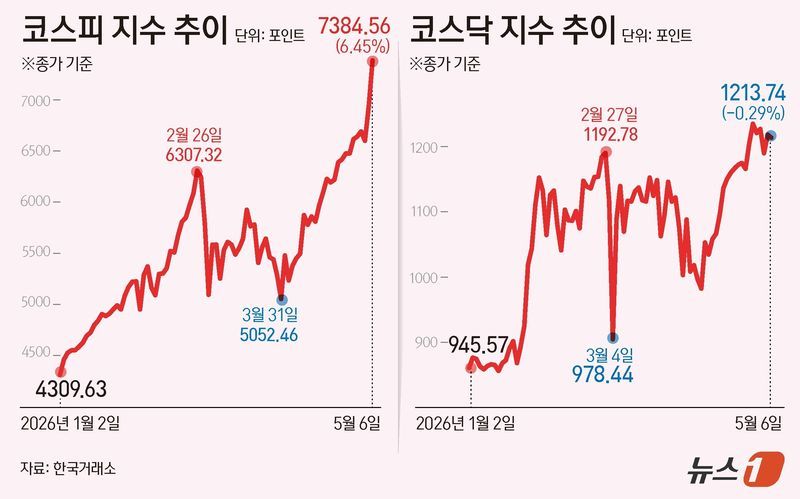
The market rally is the result of several factors coming together. A semiconductor boom driven by Artificial Intelligence (AI), the South Korean government's Corporate Value-up Policy, and stronger buying by foreign investors have all played a role. Samsung Electronics and SK hynix also rose sharply that day, helping drive the surge. Foreign investors, who were cold toward the domestic market earlier this year, have recently emerged as the main force behind the buying spree.
If liquidity flows into the stock market, it can create a virtuous cycle, including support for companies. A reassessment of South Korea by global investors would also greatly help market vitality. The problem is that the economic environment surrounding the stock market is far from easy. The pace of the rise is also a significant burden. That is why it is necessary to revisit rational investment principles based on fundamentals. If investors borrow money and rush into aggressive chase buying, they could become the biggest victims when the market corrects. Already, margin loan balances for individual investors have reached a record 34 trillion won.
The market's underlying strength will improve only if its vulnerability to a handful of semiconductor stocks is overcome. Samsung Electronics and SK hynix together account for more than 40% of the KOSPI's market capitalization. Most of this year's increase in KOSPI earnings has also come from those two companies. The trend in a particular industry may not change overnight, but excessive concentration can deal a fatal blow to the stock market and the broader economy in an emergency. Institutional and structural reforms should be accelerated so that the competitiveness of Korean companies as a whole, including those that have been left behind, can improve evenly. The South Korean government should strategically identify and nurture new growth engines that can become the second and third semiconductor seeds.
High inflation driven by the Middle East is also becoming a reality. According to the Ministry of Data and Statistics' announcement on the 7th, consumer prices rose 2.6% last month, the sharpest increase in one year and nine months. Petroleum products jumped more than 20%, pushing up overall inflation. Industrial goods also rose by nearly 4%, marking the fastest increase in three years and two months. If prices keep rising, interest rates will go up and the stock market will also be shaken.
A Deputy Governor of the Bank of Korea recently said, "It is time to think about stopping base rate cuts and even considering hikes." The remark reflected growing concern over inflation. Several overseas institutions have slightly raised their forecasts for South Korea's growth rate thanks to the semiconductor boom, but they have also lifted their inflation outlooks. The effect of price controls has clear limits. The South Korean government will need to find fundamental ways to stabilize prices. If the South Korean stock market is not to end as a temporary bull run, the basic foundation of the economy must become much stronger.