A Generation That Once Chanted Fairness Turns Into a Bonus-Hungry Union ... "It Is Time for the Government to Step In" [Labor Strikes Threatening Business (3)]
- Input
- 2026-05-05 18:54:13
- Updated
- 2026-05-05 18:54:13
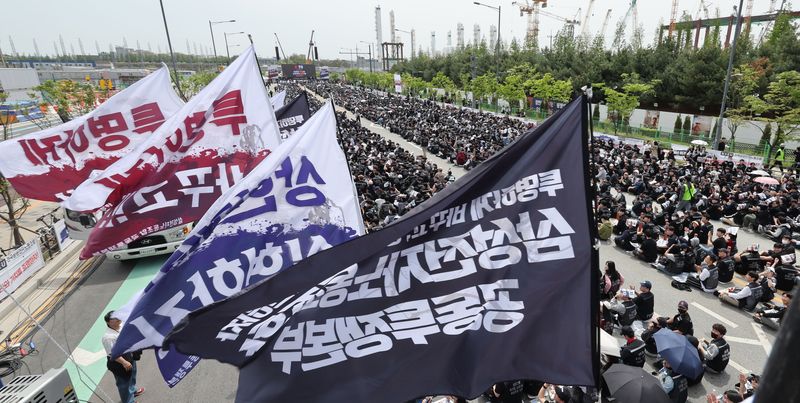
At a rally held on the 23rd of last month at Samsung Electronics Pyeongtaek Campus in Godeok-dong, Pyeongtaek, Gyeonggi Province, members of the Samsung Electronics labor union joint struggle committee shouted slogans. News1
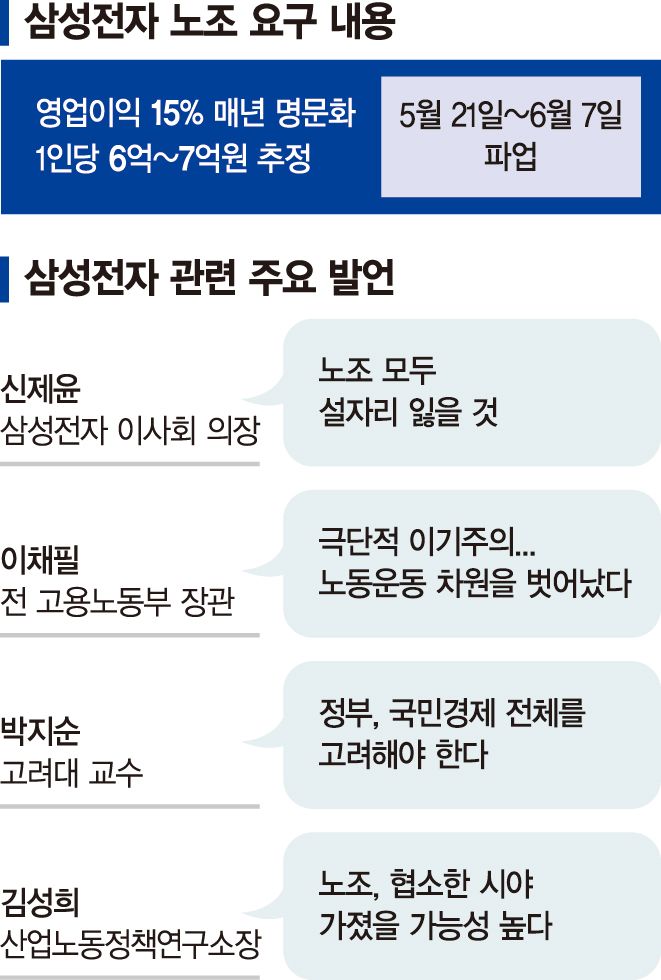
"This is extreme selfishness. They have lost the basic spirit of the labor movement," said former Labor Minister Lee Chae-pil.
"They claim to value fairness, but their view of union activities is narrow," said Kim Sung-hee, head of the Industrial Labor Policy Research Institute.
The Samsung Electronics union, led largely by workers in their 30s, is preparing to launch a general strike on the 21st, demanding bonus payments of about 600 million to 700 million won per person. A decade ago, this was the same generation that took to the streets with candles in hand over the Chung Yoo-ra Ewha Womans University admissions scandal, citing fairness in college admissions. More than any other generation, these Gen Z labor activists have emphasized fairness and are often seen as highly individualistic. Now, they are pressuring management day after day, using SK hynix's compensation system as a benchmark and demanding "that a bonus payment equal to 15% of operating profit be written into the rules."
They have sent a protest letter to the minister in charge of the semiconductor industry, Kim Jung-kwan, arguing that "Samsung Electronics' record performance does not belong to the union alone." They have also ignored public opinion that says a bonus fight and a general strike are inappropriate. After warning that a general strike could cause losses of about 30 trillion won, they quietly left for Southeast Asia on annual leave during the back-channel talks. They say using annual leave is also a legitimate right. In effect, it is a straight push with no compromise. Fears are growing that a general strike could lead to an unavoidable disaster.
■ Fairness as an identity turns into self-obsession
On the 5th, several labor and labor-management experts told this paper in interviews that the bonus and general strike campaign led by Samsung Electronics' semiconductor division amounts to a "bonus windfall mentality" that ignores the special nature of the semiconductor industry, which requires massive investment. Former Labor Minister Lee Chae-pil said in an interview that the bonus fight at Samsung Electronics and Samsung Biologics was "an expression of extreme self-love" and a behavior that "deviates significantly from the mainstream of the labor movement, which has long stood in solidarity to improve the rights of disadvantaged groups."
Management proposed paying bonuses this year at a level equal to 13% of operating profit, or about 53 million won per person, but the union is refusing to back down from its demand that 15% be written into the agreement every year. If the union's demand is accepted, Samsung Electronics would have to pay about 45 trillion won in bonuses this year, or roughly 600 million won per person. That is four times the company's 2025 shareholder dividend payout of about 11 trillion won, and it also exceeds last year's research and development spending of about 37 trillion won.
Park Ji-soon, a professor at Korea University School of Law, said, "They operate independently, free from the control or influence of the established two major unions, the KCTU and the FKTU. They are relatively free from ideology or bloc politics, and unlike traditional unions, they are also less conscious of public sentiment or public opinion." He added, "It is especially disappointing that there is no sign of a spirit of dialogue and compromise."
■ The disappearance of dialogue and compromise
The government, Samsung Electronics management, and shareholder groups have been urging restraint on the strike every day, but no breakthrough has been found.
Apparently aware of the tense atmosphere, Je-Yoon Shin, chairman of the board of Samsung Electronics, appealed through the company's internal network on the day, saying, "If the worst-case scenario occurs, both labor and management will lose their place." He added, "It will not only weaken business competitiveness, but also damage customer trust and cause losses for shareholders and investors, seriously harming the national economy." The estimated damage from a general strike ranges from 18 trillion won to 30 trillion won. That would be direct economic loss alone. If indirect damage is added, including disruption to the global semiconductor supply chain, harm to suppliers, and a decline in Samsung's brand value and customer trust, the company could fall into a state of irreversible damage.
There are calls for both labor and management to "learn, through experience, the value of dialogue and compromise" in order to prevent a disastrous general strike this month. The task is to build a profit-sharing model that benefits both the company and its workers. Professor Park said, "The union is currently in a situation where it values immediate conditions, as if it must strike while the iron is hot." He stressed that, along with continued efforts to explain the company's management situation, the government must also make it clear that the union's behavior is placing a burden on the national economy as a whole. Former Minister Lee said, "The government's pro-union policy has raised expectations in the labor sector," adding that "ministers and officials in charge of labor-management issues must step forward actively." Jo Eun-hyo, Lee Dong-hyuk