"We Want 30% of Net Profit"... Hyundai Motor Company and Kia Face a 'Performance Bonus Bill' That Could Block AI and Robot Adoption
- Input
- 2026-05-05 18:53:57
- Updated
- 2026-05-05 18:53:57
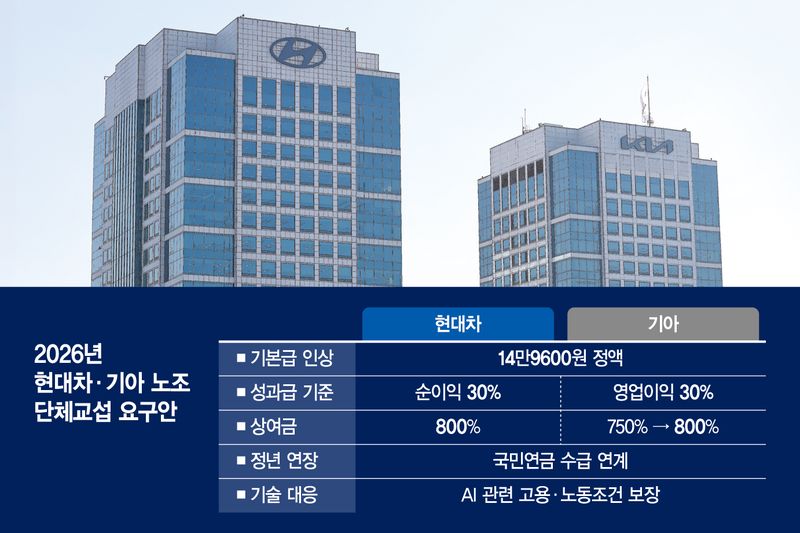
The union is also pushing for a full monthly salary system, under which workers would receive fixed pay every month regardless of production volume or working hours. The move appears aimed at preemptively preventing wage declines caused by shorter working hours after robots are introduced. Kia labor union has also demanded mandatory consultations with the union whenever new technologies or machines, such as automation, are introduced, along with guarantees of total employment.
According to industry sources on the 5th, the Hyundai Motor Branch of the Korean Metal Workers’ Union included in this year’s wage and collective bargaining demands a monthly base pay increase of 149,600 won, excluding seniority-based raises, as well as a performance bonus equal to 30% of last year’s net profit.
Based on Hyundai Motor Company’s net profit of 10.3648 trillion won last year, the performance bonus alone would amount to 3.11 trillion won. That figure is far above the company’s operating profit of 2.5147 trillion won in the first quarter of this year.
Kia labor union followed the same line, demanding 30% of operating profit. Kia posted operating profit of 9.0781 trillion won last year, meaning the union’s demand would amount to 2.72 trillion won. That is also higher than Kia’s operating profit of 2.2051 trillion won in the first quarter of this year.
The union’s demands also include raising bonuses from 750% to 800%, extending the retirement age in line with the timing of national pension eligibility, abolishing the wage peak system, replacing naturally reduced staff with regular employees, and reinstating dismissed workers to their original posts. The package also includes demands related to AI and humanoid robot development.
Industry observers warn that the demands could directly damage Hyundai Motor Company and Kia’s future competitiveness.
Hyundai Motor Group plans to invest $26 billion in the U.S. market by 2028 and 125 trillion won in South Korea over the next five years. A significant portion of that spending is focused on future businesses such as AI, self-driving, robotics, and electrification.
Business leaders say that if labor costs rise sharply, those investment plans could be disrupted.
A business community official said, "If the current performance bonus standards demanded by labor and management become entrenched, it could become difficult for companies to respond flexibly when the economy turns or business conditions worsen." The official added, "We need a reasonable agreement that takes into account both the company’s long-term investment capacity and sustainable growth."
If a strike becomes reality, the damage would extend far beyond the union’s roughly 50,000 members and spread across the entire industrial ecosystem. If Hyundai Motor Company’s plants in Ulsan, Asan, and Jeonju stop operating, first-, second-, and third-tier suppliers would all be hit in succession. If Kia’s three domestic plants in Gwangmyeong-si, Hwaseong, and Gwangju Metropolitan City were to shut down at the same time, production of key models such as the Kia Sorento, Kia Carnival, and Kia EV6 would be directly disrupted.
An industry source said, "Automation and the shift to AI are trends across the entire industry, so it is necessary for labor and management to discuss the employment impact that may arise in the process." The source added, "Given the high level of uncertainty at home and abroad this year, negotiations should end with a practical agreement rather than a prolonged conflict."
eastcold@fnnews.com Kim Dong-chan Reporter