"Even with South Korea's strong semiconductor sector, high oil prices would be a major blow"... ADB sees 0.9 percentage point cut to this year's growth forecast
- Input
- 2026-05-05 12:00:00
- Updated
- 2026-05-05 12:00:00
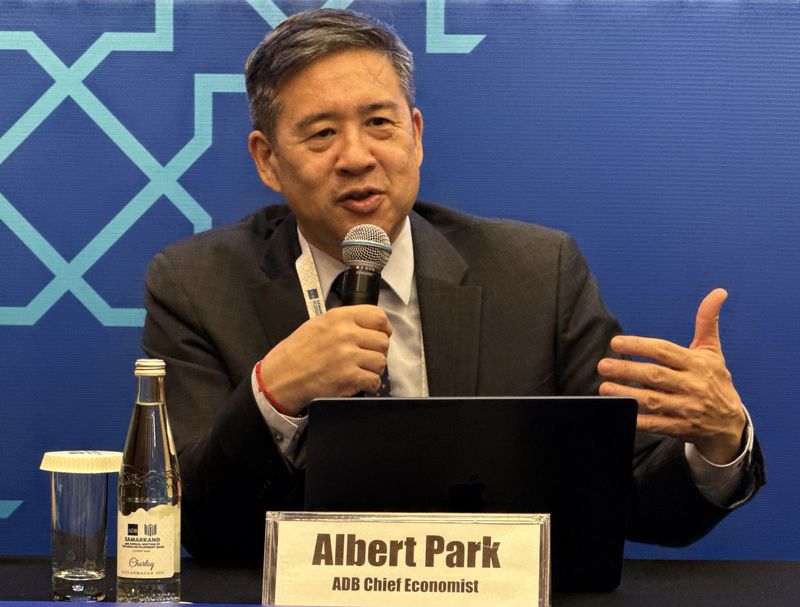
Albert Park, ADB's chief economist and secretary general, said on the 4th local time in Samarkand, Uzbekistan, during a meeting with reporters covering the ADB Annual Meeting, that "oil prices are expected to remain elevated for some time even if the Middle East crisis ends." He added that "South Korea relies more heavily on oil and gas imports than other countries in the region, and growth could slow if inflation rises and the benchmark interest rate is raised." He also noted that a downward revision is likely even after factoring in the strong performance of semiconductors.
Park said that if the conditions assumed by the ADB are met, South Korea's economic growth rate this year would fall 0.9 percentage point below the estimate of 1.9%. He forecast that next year's figure could also drop by 0.5 percentage point from the current 1.9%. The scenario he presented assumes average international oil prices of $96 per barrel this year and $80 next year, with a peak of $116 during the period.
He also mentioned a severe downside scenario in which average international oil prices would reach $150 this year and $140 next year, with a peak of $200. In that case, the downgrade to growth would likely widen sharply. Park said, "I hope that scenario remains unlikely," but warned that "the war in the Middle East is destroying not only energy transport but also production capacity."
He said the impact would be especially severe in regions with limited fiscal room. Park explained that "countries with weak public finances will struggle to protect consumers from price increases." On South Korea's supplementary budget, he said that focusing on the bottom 70% of income earners was "the right direction."
He remained optimistic about the semiconductor cycle itself. Park said, "The semiconductor cycle tends to repeat periodically, but this time it is different because it is being driven by Artificial Intelligence (AI)." He added that while there are concerns about overinvestment in data centers and other areas, the sector offers productivity gains and could continue for some time, putting South Korea in a favorable position to benefit.
taeil0808@fnnews.com Reporter