Will bond prices fall further? Betting on declines is spreading
- Input
- 2026-05-05 18:38:54
- Updated
- 2026-05-05 18:38:54
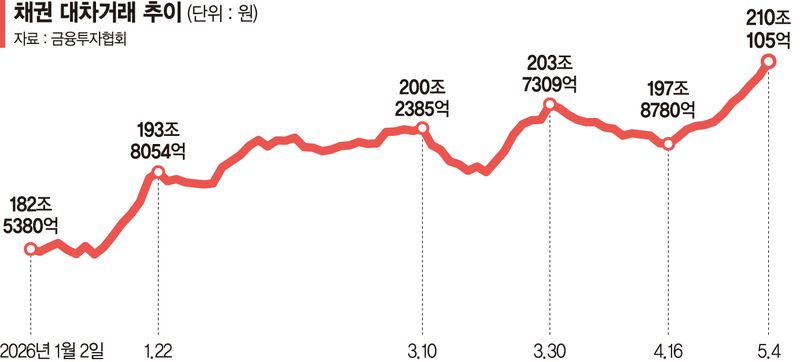
According to the Korea Financial Investment Association (KOFIA) on the 5th, bond lending balances stood at 210.0105 trillion won as of the 4th, the highest level on record. The figure has climbed for 11 straight trading days since March 16, rising by 12.1325 trillion won over that period. At the beginning of January, the balance was around 180 trillion won, but it has steadily increased since then. It topped 200 trillion won for the first time on March 6, and after briefly leveling off, it has recently risen sharply again.
Bond lending is often called "bond short-selling." When investors expect bond prices to fall, they borrow bonds in advance, sell them, and later buy them back at a lower price to profit. Institutions typically use it to hedge against losses in bond prices. As balances rise, it is generally interpreted as a bet on falling bond prices, or rising yields.
Foreign investors are also stepping up net selling of government bond futures. According to Koscom Corporation's Check service, foreigners sold a net 7.7 trillion won worth of government bonds last month alone. From the start of the year through last month, they sold a net 20.8 trillion won, far exceeding the 14 trillion won in net selling of government bond futures by foreigners over all of last year.
Government bond futures are contracts that promise to buy or sell a set amount of government bonds at a fixed price at a future date. A short position generates profits when futures prices fall, so it amounts to a bet on lower prices.
These strategies by institutions and foreign investors are seen as a way to reduce losses from falling prices, as Treasury Bond yields remain elevated and expectations for rate hikes gain momentum.
Treasury Bond yields, which peaked for the year at the end of March, eased briefly before turning higher again. As of the 4th, the yield on the three-year Treasury Bond stood at 3.615%, just below the year-to-date high of 3.617%. The five-year yield was 3.797%, and the 20-year yield was 3.906%, both near their annual highs. The 10-year and 30-year yields hit year-to-date highs of 3.932% and 3.815%, respectively.
Korea Investment & Securities Co., Ltd. forecast that the Bank of Korea (BOK) will raise its benchmark interest rate twice in the second half of this year to respond to inflation. Under that scenario, the current benchmark rate of 2.5% would reach 3.0% by year-end.
Choi Ji-wook, a researcher at Korea Investment & Securities Co., Ltd., said, "Given that the output gap is positive, meaning actual GDP is above potential GDP, and financial conditions remain accommodative, it is hard to see two rate hikes as enough to tighten the real economy or financial conditions." He added, "The Bank of Korea will likely prioritize price stability and respond with two hikes in the second half."
However, some expect only one rate hike in the second half. Kong Dong-rak, a researcher at Daishin Securities, said, "The deputy governor of the Bank of Korea hinted at the possibility of a rate hike in the second half, but it is difficult to interpret that as meaning 'more than two hikes this year.'" He added, "With uncertainty still lingering across the economy, more than two hikes would be a heavy burden."
jisseo@fnnews.com Seo Min-ji Kim Hyeong-jeong Reporter