"Selling Homes to Give Cash Gifts": Baby Boomers Push Seoul Home Sale Share Above 40% [Real Estate Atoz]
- Input
- 2026-05-05 18:29:24
- Updated
- 2026-05-05 18:29:24
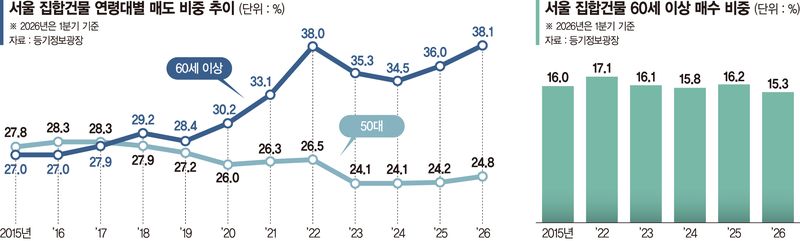
Market watchers say Baby boomers are moving to cash out their real estate and pass it on before tighter regulations push taxes even higher. As the housing market undergoes a generational shift, money moving out of property is also playing a role.
An analysis by The Financial News on the 5th of seller age groups in ownership transfer registrations for apartment and other collective buildings in Seoul, based on data from the Court Registry Information Plaza, showed that people aged 60 and older accounted for 38.1% in the first quarter of this year. In April, the share for those in their 60s and 70s rose to 41.5%.
Statistics on the share of sellers of collective buildings by age group have been available since 2010. On an annual basis, the highest figure from 2010 to 2025 was 38.0% in 2022. Although annual data cannot be directly compared with this year's first-quarter and April figures, the latest numbers are the highest on record.
Looking at Seoul's collective-building sellers by age group, those in their 60s and 70s moved into first place in 2018. At the time, the share of sellers aged 60 and older stood at 29.2%, ahead of those in their 50s at 27.9% and those in their 40s at 26.5%. Since then, the 60s and 70s group has remained the top seller group.
Their share has also been rising. In 2010, sellers in their 60s and 70s accounted for just 21.5%. The figure first surpassed 30% in 2020, when it reached 30.2%. It continued to trend upward, hitting 36.0% in 2025.
By contrast, the share of sellers in their 50s, who are approaching retirement, has barely changed from 2010 to the present. After standing at 24.8% in 2010, it rose slightly to 28.3% in 2017, but it still remains in the mid-20% range. The share of sellers in their 40s has also stayed in the mid-20% range since 2010.
Kim Kwang-seok, CEO of Real House, said, "If you look at the share of sellers of collective buildings by age group, the 50s and 40s have remained largely unchanged, while only those in their 60s and 70s have increased recently."
What stands out is that the number of people in their 60s and 70s moving from one apartment to another in Seoul is not increasing either. The data show that the share of buyers in this age group has fluctuated only slightly, staying around 15% to 16% from 2015 to the present.
The market offers a range of explanations for this trend. Ko Jun-seok, a professor at the Sangnam Institute of Management, Yonsei University, said, "As home prices keep rising, the market expects real estate-related taxes to increase significantly, especially for higher-priced homes." He added, "As a result, the burden of passing on real estate in kind is not small." He went on to say, "It seems that a considerable number of wealthy people are cashing out property and giving it as cash gifts." He also noted that the move by multi-home owners in their 60s and 70s to sell down to a single home may be contributing to the trend.
Park Won-gap, chief real estate expert commissioner at KB Kookmin Bank, said, "Retirees are more sensitive to taxes, so they seem to be selling before they go up further." He added, "This can also be interpreted as part of a generational shift, as the center of the housing market is moving from middle-aged buyers in the past to people in their 30s." He also said, "On top of that, the money move from real estate to financial assets appears to be one reason older people are moving away from property."
[email protected] Lee Jong-bae Reporter