Koo Yun-cheol: "We will closely monitor inflation and respond" ... Confident Growth Will Reach 2.0%
- Input
- 2026-05-06 12:00:00
- Updated
- 2026-05-06 12:00:00
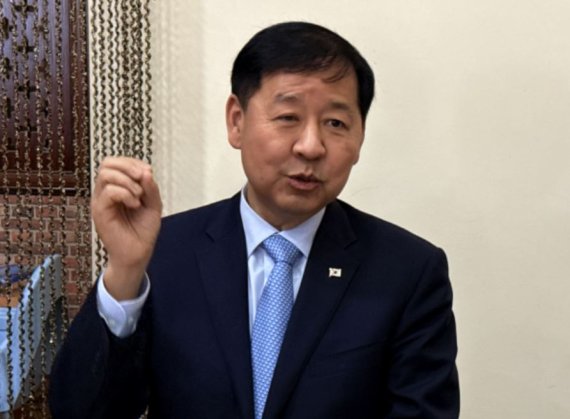
At a meeting with the ADB press corps in Samarkand, Uzbekistan, on the 5th local time, Koo said, "We had been looking at about three months as the benchmark for a prolonged Middle East crisis, and we are now almost there." He added, "We will closely watch and respond to rising diesel and gasoline prices, as well as the resulting secondary inflation."
Earlier, Ryoo Sangdai, the deputy governor of the Bank of Korea (BOK), also explained at a press briefing that "given the impact of the Middle East crisis, the boost from the semiconductor recovery means the hit to growth is not excessive, while there is greater room for inflation to be revised upward." Ryoo also suggested a possible shift in monetary policy direction, saying, "It is time to consider stopping base rate cuts and moving toward an interest rate hike cycle."
Koo expressed confidence on the growth front. He said, "How quickly the Middle East situation changes will determine growth and policy," but added, "I have already said that we will do whatever it takes to achieve the 2.0% economic growth target we promised for this year." Koo said the government would make a detailed announcement in the June economic growth strategy for the second half of the year. He also cited a booming stock market and higher-than-expected tax revenue as positive factors supporting growth.
The BOK is also forecasting 2.0% growth for this year. In line with that outlook, real gross domestic product (GDP) rose 1.7% in the first quarter from the previous quarter, the highest level in five years and six months, or 22 quarters, since the third quarter of 2020, when it grew 2.2%. On a year-on-year basis, growth was 3.6%. If growth reaches 2.4% in the first half, including the second quarter, and 1.6% in the second half, annual growth above 2.0% would be possible.
Global investment banks, including J.P. Morgan Chase (3.0%), BNP Paribas (2.7%), and Citigroup (2.9%), are expecting even stronger growth. Still, the BOK said the impact of the Middle East crisis began to be fully reflected from April and remains wary of downside risks.
As a result, there are concerns that the surprise first-quarter performance may be followed by disappointing results later in the year. Albert Park, chief economist of the Asian Development Bank (ADB), also told reporters the previous day that, under a scenario assuming average international oil prices of $96 per barrel this year, growth could be reduced by 0.9 percentage points.
In fact, the forecasts released so far have largely relied on the semiconductor boom, raising concerns that once the cycle ends, the main growth engine could fade. Against that backdrop, South Korea's potential growth rate, a measure of the economy's underlying strength over the long term, is not receiving high marks.
The Organisation for Economic Co-operation and Development (OECD) cut South Korea's potential growth rate from 1.92% last year to 1.71% this year, and lowered next year's estimate further to 1.57%. The Korea Development Institute (KDI) also projected 1.6% for this year. That is why there is growing talk about the need for a new growth driver after semiconductors.
On whether the government plans to pursue a second supplementary budget, Koo declined to elaborate, saying only, "We are focusing on executing the first supplementary budget."
[email protected] Kim Tae-il Reporter