Daycare centers closing down as parents struggle with waitlists of more than 100
- Input
- 2026-05-04 19:15:47
- Updated
- 2026-05-04 19:15:47
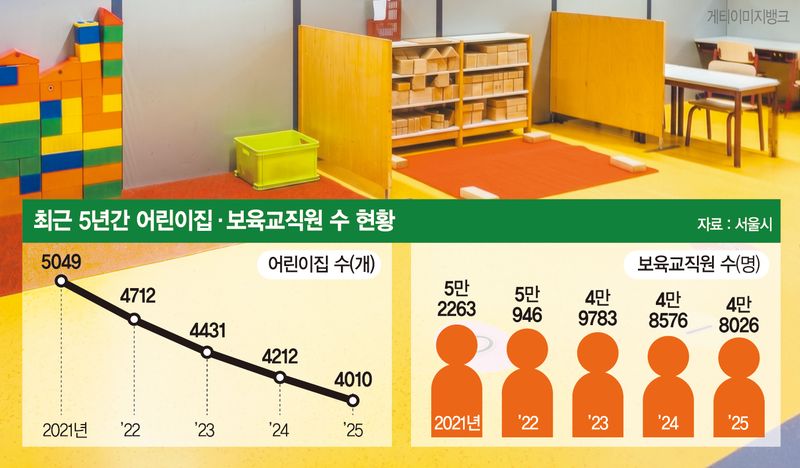
According to the Seoul Metropolitan Government on the 4th, the number of daycare centers in Seoul fell from 5,049 in 2021 to 4,712 in 2022, 4,431 in 2023, 4,212 in 2024, and 4,010 in 2025. Over the same period, the number of childcare staff also dropped from 52,263 to 48,026. Analysts say the decline reflects falling demand for childcare facilities as the low birth rate continues to weigh on the sector.
At childcare sites, more operators are voicing concerns about worsening finances. Park, 56, who has run a private daycare center for 10 years, said, "Our capacity is about 30 children, but for the past two to three years we have filled only about 80 percent of it, and this year it has fallen to around 60 percent." He added, "As revenue from childcare fees declines while teacher wages and rent remain fixed, the burden of running the center has no choice but to grow."
Because current childcare subsidies are paid in proportion to the number of children, even a drop of one or two children in enrollment can make it difficult to cover fixed costs such as teacher salaries. That structural limit leaves some centers with little choice but to close. Experts said the system should shift to infrastructure-based support that guarantees a minimum level of operation regardless of the number of children, if the childcare gap is to be prevented in practice.
The number of childcare staff is also falling every year, which is another problem. In the field, poor treatment such as low wages and long working hours is driving workers away. According to the ED's "2024 National Childcare Survey," the average monthly salary for childcare teachers was 2.873 million won, roughly at minimum-wage level. The average daily working time was 9 hours and 38 minutes, but actual hours, including overtime, are estimated to be much longer.
Moon, 25, who works at a private daycare center in Yeongdeungpo District, Seoul, said, "The working conditions are so poor that receiving overtime pay is unusual, and because the treatment and welfare benefits are low compared with the workload, it is hard to build expertise."
As a result, demand for childcare is concentrating at some daycare centers, and in some cases the waitlist problem is becoming more severe, creating a stark divide. Kim, 32, a working mother living in Seoul, applied for a place at a national and public daycare center when she gave birth last year, but her waitlist number exceeded 100. She said, "Since I have only one child and am just an ordinary dual-income parent, I do not get many extra points, so getting in feels like trying to pluck a star from the sky." She added, "I am looking into a home daycare center, but even there the competition is more than 10 to 1, so I have no hope."
Experts said the decline in daycare centers due to the low birth rate is inevitable, but emphasized that alternatives must be prepared to solve the childcare gap.
Jung Soondul, a professor in the Department of Social Welfare at Ewha Womans University, said, "Problems such as daycare centers not recruiting certain age groups or shutting down are appearing widely." She added, "It is necessary to build a system that allows stable care to be provided when there is sufficient demand for childcare."
[email protected] Seo Ji-yoon Reporter