Justice Served or the Destruction of Judicial Order? Controversy Over the 'Special Counsel Act on Fabricated Prosecution'
- Input
- 2026-05-04 18:42:41
- Updated
- 2026-05-04 18:42:41
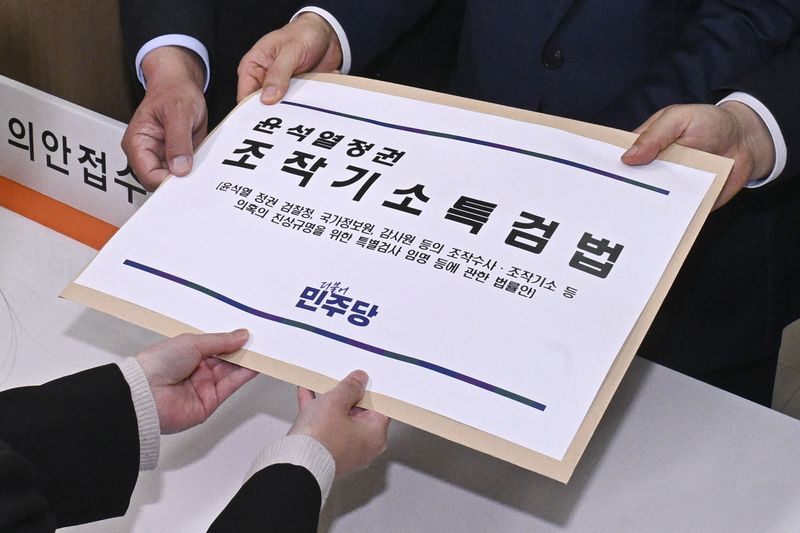
■ The judiciary would be shaken from its foundation
According to the legal community and others on the 4th, the 'Act on the Appointment of a Special Prosecutor to Investigate Allegations of Fabricated Investigations and Fabricated Prosecutions by the Yoon Suk Yeol administration's Supreme Prosecutors' Office of the Republic of Korea (SPO), National Intelligence Service (NIS), Board of Audit and Inspection (BAI), and others' is understood to grant the special prosecutor the authority to withdraw cases already prosecuted by the existing prosecution.
Article 8, Paragraph 7 of the bill states that "the Special Prosecutor shall carry out the work of maintaining the prosecution of transferred cases, including decisions on whether to maintain the prosecution." Although it does not explicitly mention 'withdrawal of prosecution,' many interpret the phrase 'decision on whether to maintain the prosecution' as effectively including the authority to withdraw it.
Opponents say the bill would shake the judicial order from the ground up. Under the Constitution, the power to prosecute belongs to the executive branch of the United States, while the power to adjudicate belongs to the Judiciary of South Korea. They argue that allowing a special prosecutor created by the legislature to withdraw indictments in cases already being heard by the courts would infringe on the judiciary's authority and violate the Constitution.
One law professor said, "The Democratic Party has argued for a separation of investigation and prosecution as part of its prosecution reform agenda, but using a special prosecutor who can do both is contradictory." He added, "When the court has not yet ruled on the fabricated prosecution allegations, having the special prosecutor reinvestigate the prosecutor's indictment is a political judgment that starts with a predetermined conclusion."
The Special Counsel Act on Fabricated Prosecution covers a total of 12 cases, eight of which involve President Lee Jae-myung, including the Daejang-dong development corruption scandal, the Baekhyeon-dong development corruption scandal, and violations of the Public Official Election Act.
Hanbyun issued a statement the previous day, saying, "This bill directly violates the most basic principle of the rule of law: no one can be the judge in their own case." Good Law Makers also described it as "a dangerous attempt to alter the state's judicial process itself in order to change the outcome of a specific person's trial."
Some also argue that while the National Assembly, as the legislature, is an elected body representing the people, not every action it takes is automatically legitimate. One legal source said, "The equation that a lawmaker's will is the same as the people's will is simply wrong." The source added that it is "an act that destroys substantive rule of law while invoking formal democracy."
■ Curbing the abuse of prosecutorial power is unavoidable
On the other hand, one legal source said, "There are concerns about granting the special prosecutor by law the authority to withdraw cases prosecuted by the prosecution," but added, "At the same time, given the need to correct the current abuse by prosecutors and the difficulty of expecting normalization from the current judiciary, this appears to be an unavoidable measure."
The idea is that you cannot entrust fish to a cat burdened with the label of 'fabricated prosecution,' and it is also difficult to hand the matter over to other investigative agencies such as the police. Even if investigations by existing agencies were possible, there is deep distrust that the current courts cannot be relied upon either.
In fact, during a recent National Assembly state investigation hearing, prosecutors were accused of forging evidence and coaching false testimony in connection with the Daejang-dong case, including allegations that the 'Jeong Young-hak transcript' was altered and that former Vice Governor Lee Hwa-young was induced through the so-called 'salmon drinking party' allegations. Earlier, the prosecution's 'Yoo Woo-sung espionage evidence fabrication and retaliatory prosecution case' was finalized by the Supreme Court of Korea in 2021 as Prosecutorial abuse of power. The case began with the prosecution indicting Yoo Woo-sung, a naturalized ethnic Chinese Korean, on charges of violating the National Security Act, followed by an acquittal at the Supreme Court of Korea and then additional retaliatory indictments by prosecutors. It is regarded as the first case in Korean judicial history to recognize abuse of prosecutorial authority.
hwlee@fnnews.com Reporter Lee Hwan-ju