Constitutional Revision Becomes a Political Attack Tool... "If You Oppose It, It's Yoon Again" vs. "Blocking Lee Jae-myung Prosecution Dismissal"
- Input
- 2026-05-04 15:55:48
- Updated
- 2026-05-04 15:55:48
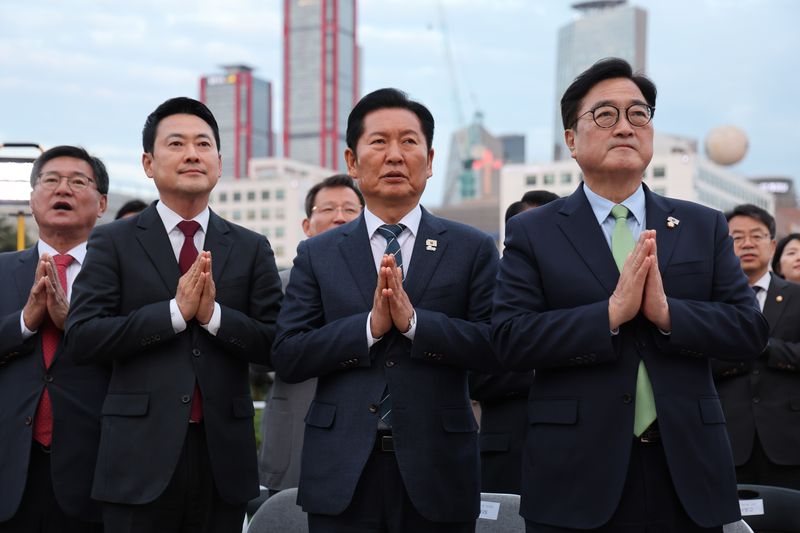
[The Financial News] The push to revise the Constitution for the first time in 39 years is being used as a political weapon ahead of the June local elections. The ruling bloc that led the revision effort pressured the People Power Party, saying opposition would make it part of the 'Yoon Again' camp, while the People Power Party pushed back by proposing that the Constitution include a clause to block the dismissal of President of South Korea Lee Jae-myung's prosecution.
According to political circles on the 4th, the constitutional amendment bill prepared by Woo Won-shik and parties other than the People Power Party is scheduled to be introduced at the plenary session of the National Assembly on the 7th. To hold a referendum alongside the June local elections, it must clear the National Assembly by the 10th, but passage is impossible without the People Power Party's cooperation. In response, the party is putting pressure on its rivals by pointing to the People Power Party's declaration of separation from Yoon Suk Yeol.
At a press conference on the 27th of last month, Woo urged the People Power Party to cooperate on the constitutional revision. He asked directly, "Some have wondered whether the force that hates constitutional revision the most is not 'Yoon Again.'" He added, "There are still claims that the People Power Party leadership is tied to 'Yoon Again.' Is that really the case, Jang Dong-hyuk?"
The amendment bill includes measures to strengthen the National Assembly's checks on a president's declaration of Martial Law. Critics say that if the People Power Party maintains its opposition stance, it would amount to indirect support for Yoon Suk Yeol's Martial Law crisis.
The People Power Party, however, said it has no objection to the content of the amendment bill, while maintaining that a National Assembly Special Committee on Constitutional Revision should be formed after the local elections to produce a bipartisan agreement. It says it cannot cooperate with putting a bill it did not take part in discussing to a referendum alongside the local elections.
The opposition has also linked the constitutional revision to the controversy over pressure to dismiss President of South Korea Lee Jae-myung's prosecution, which it has made a major issue for the local elections. The Democratic Party of Korea (DPK) is pushing hard for the dismissal through an Investigation of State Administration into allegations of fabricated indictments by prosecutors under the Yoon Suk Yeol administration, followed by a Special Prosecutor Act. The People Power Party and the Reform Party have decided to launch a resistance campaign to block it.
In response, People Power Party lawmaker Joo Jin-woo publicly proposed that the Constitution explicitly state, "Trials of a sitting president and his accomplices cannot be suspended or dismissed." Joo said, "Historically, authoritarian regimes have tried to push through unilateral constitutional revisions by the ruling party. That is exactly what is happening now." He argued that the proposed clause "fits perfectly with the provision that all citizens are equal before the law, makes it possible to check presidential abuse of power, and prevents a majority party from creating extraterritorial privilege through abuse of power."
As constitutional revision has become a tool for political attacks by both the ruling and opposition parties, the chances of it being passed have fallen. Even so, some defections from the People Power Party are still seen as possible. With the party likely to suffer a heavy defeat in the local elections and internal power dynamics expected to shift afterward, some lawmakers may cast conscience votes.
[email protected] Kim Yun-ho Reporter