'The ball' is in the National Assembly... Special Counsel Act on Fabricated Prosecution: 'Collapse of Judicial Order' vs. 'Inevitable Choice'
- Input
- 2026-05-04 16:12:02
- Updated
- 2026-05-04 16:12:02
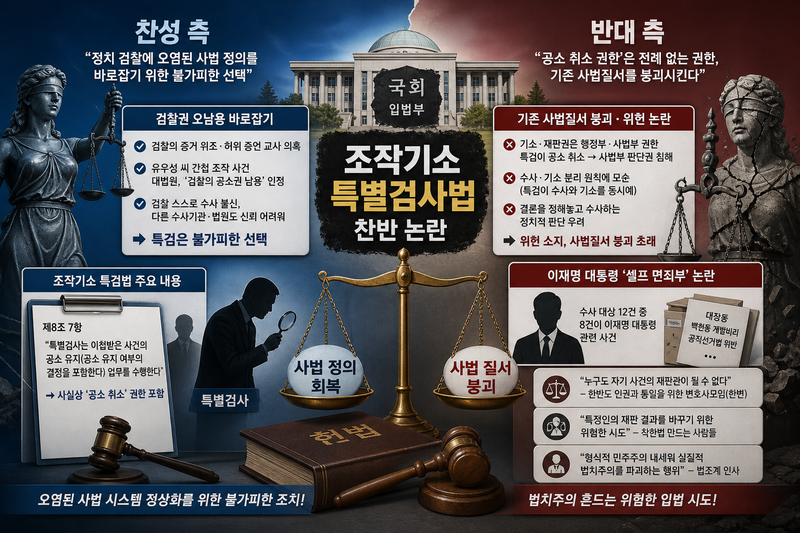
" ■ The Judiciary Will Be Shaked to Its Roots According to legal circles and others on the 4th, the "Act on the Appointment, etc. of a Special Prosecutor for the Investigation of Allegations of Manipulated Investigations and Indictments by the Prosecutor's Office, National Intelligence Service, and Board of Audit and Inspection under the Yoon Suk-yeol Administration" (Special Prosecutor Act on Manipulated Indictments), proposed by the Democratic Party of Korea, is known to grant the Special Prosecutor the authority to withdraw indictments filed by the existing prosecution.
Article 8, Paragraph 7 of the Special Prosecutor Act stipulates that "the Special Prosecutor shall perform the duties of maintaining the indictment of transferred cases (including the decision on whether to maintain the indictment). " Although "withdrawal of indictment" was not explicitly stated, many view the phrase "decision on whether to maintain the indictment" as effectively including the authority to cancel.
The main point of the opposing side is that this shakes the judicial order to its roots. The argument is that since the constitutional powers of indictment and trial belong to the executive and judicial branches, respectively, allowing a special prosecutor appointed by the legislature to withdraw an indictment on a case already under trial in court is unconstitutional as it infringes upon the judiciary's power of judgment.
A professor in the legal community criticized the move, stating, "The principle the Democratic Party put forward while advocating for prosecution reform is the separation of 'investigation and indictment,' yet utilizing a special prosecutor capable of both investigation and indictment is a contradiction. " He added, "Having a special prosecutor re-investigate a prosecutor's indictment before a court ruling on fabricated indictments has been issued is a political decision proceeding with a predetermined conclusion.
" The Special Prosecutor Act on Fabricated Indictments covers a total of 12 cases, eight of which are related to President Lee Jae-myung, including development corruption in Daejang-dong and Baekhyeon-dong and violations of the Public Official Election Act. The Lawyers for Human Rights and Unification of the Korean Peninsula (Hanbyeon) issued a statement the previous day criticizing the bill, stating, "The bill runs directly against the most fundamental principle of the rule of law that 'no one can be the judge of their own case.
'" The incorporated association 'People Who Make Good Laws' also characterized it as a "dangerous attempt to alter the state's judicial procedures themselves to change the trial outcome of a specific individual. " Arguments are also being raised that while the National Assembly (legislative branch) is indeed an elected power representing the people, not all of its actions are inherently legitimate.
One legal professional pointed out, "The equation that the will of a lawmaker is the will of the people is fundamentally wrong," criticizing it as "an act that destroys substantive rule of law while upholding formal democracy. " ■ Checks on Prosecutorial Abuse Inevitable On the other hand, a legal professional stated, "While there is room for controversy in legislating the authority for a special counsel to cancel cases indicted by the prosecution, it appears inevitable given the need to rectify the current abuses by the prosecution and the difficulty in expecting normalization of the current courts (judiciary).
" Since one cannot entrust a fish to a cat burdened with the stigma of "fabricated indictment," and it is also difficult to entrust the matter to other investigative agencies such as the police, a special counsel is seen as an inevitable choice.
This is the case.
Underlying this is a distrust that even if investigations by existing investigative agencies are possible, the current courts are also difficult to trust.
In fact, during recent parliamentary hearings on state affairs investigations, the prosecution faced allegations of fabricating evidence and instigating false testimony, including suspicions regarding the alteration of the "Jeong Young-hak transcript" related to the Daejang-dong case and the "salmon drinking party coercion" allegations against former Vice Governor Lee Hwa-young.
Prior to this, the prosecution's "case of fabricating evidence and retaliatory indictment regarding Yoo Woo-seong's espionage charges" was confirmed by the Supreme Court in 2021 as an abuse of prosecutorial power.
This case involved the prosecution indicting Yoo Woo-seong, a person of Chinese descent, on charges of violating the National Security Act, followed by a Supreme Court acquittal, and then subsequent retaliatory additional indictments by the prosecution.
It is cited as the first instance in South Korean judicial history where "abuse of prosecutorial power" by the prosecution was recognized.
[email protected] Lee Hwan-ju Reporter