The '10-Second Trial' Reignites as the First Constitutional Review Case
- Input
- 2026-05-04 15:16:02
- Updated
- 2026-05-04 15:16:02
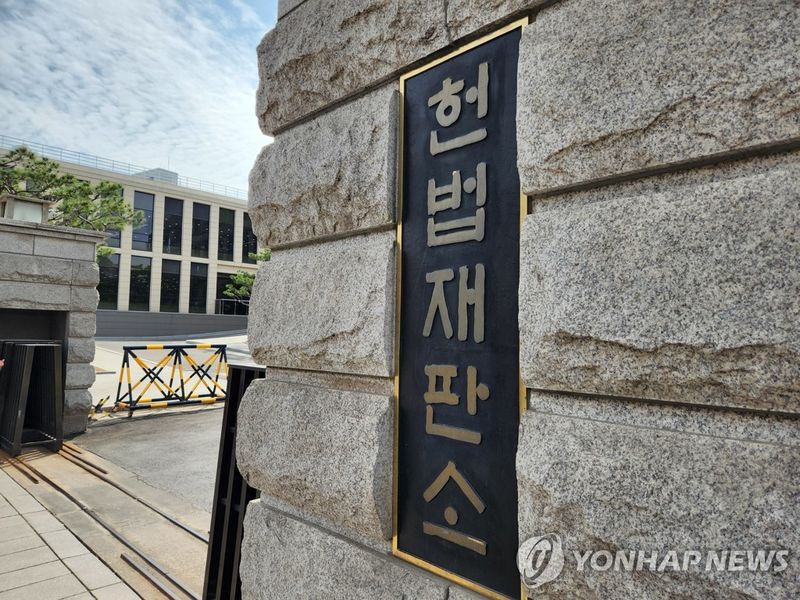
[The Financial News] As the Constitutional Court of Korea asked the Supreme Court of Korea to submit a written opinion on the first-ever constitutional review case over a court ruling, attention is now expanding to the necessity and limits of the long-debated 'summary dismissal' system in the legal community. The system allows the Supreme Court to dismiss an appeal without stating reasons when it determines that the grounds for appeal do not violate legal principles. It has the advantage of easing the court's workload, but critics have long argued that it infringes the constitutional right to a trial because the losing party is left without even knowing the reason for the ruling. It is often called a '10-second trial,' meaning a verdict that ends almost instantly.
According to the legal community on the 4th, the Constitutional Court of Korea on the 28th of last month referred the case filed by GC Biopharma against the Supreme Court of Korea to the full bench and notified the Supreme Court of the referral, requesting a response within 30 days. Related notices were also sent to the Ministry of Justice (MOJ) and the Korea Fair Trade Commission (KFTC). A written response from the Supreme Court is not mandatory.
The case began with an administrative lawsuit over collusion in a vaccine bidding process. GC Biopharma challenged sanctions imposed by the KFTC, but lost in both the appellate court and the Supreme Court. In particular, after the Supreme Court dismissed the appeal under the summary dismissal system, GC Biopharma filed a constitutional review petition, arguing that its right to seek a trial and its property rights had been violated. The company said the case did not meet the requirements for summary dismissal because there had already been an acquittal in the criminal case, yet a different conclusion was reached in the administrative case, and because there had been a misinterpretation of the law.
The summary dismissal system is designed to allow the Supreme Court to close civil, family, and administrative appeals without separate review when there is no serious violation of law, excluding criminal cases. However, summary dismissal is restricted when the lower court's ruling conflicts with Supreme Court precedent or when constitutional or other legal provisions were misapplied.
The Constitutional Court of Korea has already ruled this system constitutional. In a previous constitutional complaint case (2006Hun-Ma551 and others), the court found that the rule allowing judgments to be issued without stating reasons was consistent with the legislative purpose of ensuring the right to a trial through the prompt handling of cases. Still, some analysts say this case differs from earlier rulings because it examines whether summary dismissal was appropriate in a situation where conflicting judicial outcomes collided.
Observers say the outcome could affect not only the future operation of the constitutional review system, but also the Supreme Court's approach to handling appeals. A legal source said, "All courts will have to review the issue from the perspective of fundamental rights," adding, "The Supreme Court will also have no choice but to be more cautious in deciding summary dismissal."
The Supreme Court is responding through its internal task force on follow-up measures for constitutional review cases. A TF official said, "We plan to begin discussions this week," and added that whether to submit an opinion is also under review. Overseas examples are also expected to be considered. In Germany and other countries, the respondent in constitutional review cases is treated as a separate body rather than a court, so how to define the party to a lawsuit under Korea's legal system is also likely to be examined.
Some observers say the Supreme Court may either refrain from issuing a separate opinion or limit any submission to general principles. The reasoning is that it would not be appropriate for the highest court to explain the legitimacy of individual rulings in detail. Still, it may present a position emphasizing the necessity and function of the summary dismissal system from an institutional standpoint. A judge in the Seoul metropolitan area said, "It is not uncommon for administrative and criminal cases to reach different conclusions," adding, "At minimum, there could be an explanation of the purpose of the summary dismissal system, such as the efficient allocation of judicial burden."
A Constitutional Court of Korea official explained that this is not a case requiring oral argument, so the proceedings will center on written submissions rather than oral hearings.
[email protected] Choi Eun-sol Reporter