Donald Trump vs. Iran: 'Rescue Ships in the Strait of Hormuz' vs. 'Removing Them Would Violate the Ceasefire'
- Input
- 2026-05-04 15:22:11
- Updated
- 2026-05-04 15:22:11
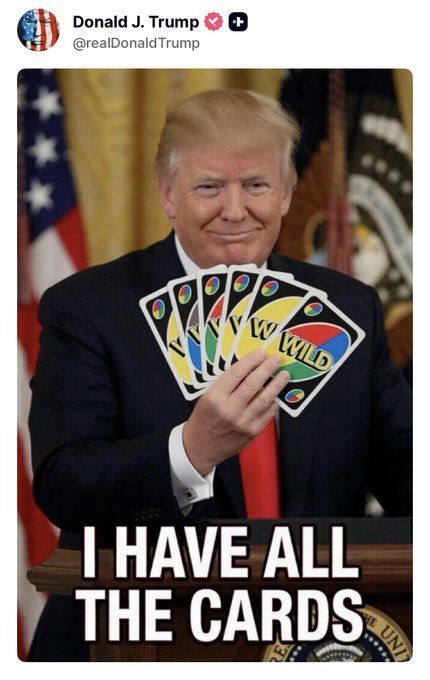
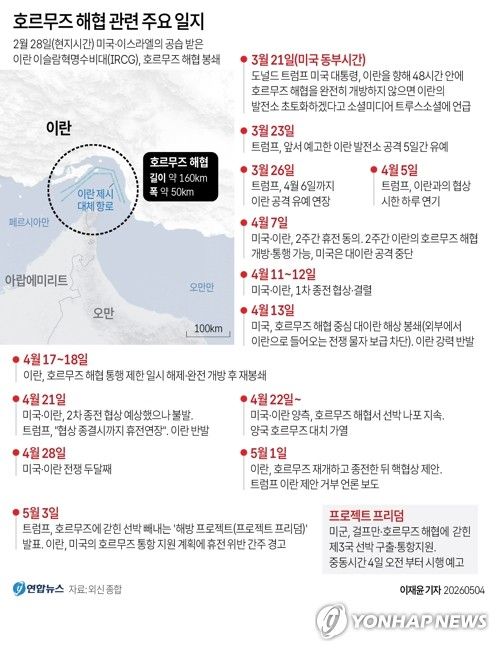
[The Financial News] U.S. President Donald Trump said he would launch 'Project Freedom' on the 4th (local time) to remove tankers stranded in the Strait of Hormuz. Iran warned of a strong response, calling the move a "ceasefire violation," raising concerns again about the possibility of a clash between the two countries.
"Ready for military conflict" vs. "Delusion"
According to AP and other outlets on the 3rd, Trump said on Truth Social the previous day that "neutral countries with nothing to do with the war are being harmed" and that he would "safely guide ships from those countries out of the restricted waters."
The measure targets hundreds of tankers and about 20,000 crew members stranded in the Strait of Hormuz. Trump described them as "victims of the situation" and called the move "a humanitarian step to help them return to work freely," while stressing that "if this process is obstructed, we will have no choice but to respond forcefully."
According to CENTCOM, the operation will involve guided-missile destroyers, more than 100 aircraft, and about 15,000 troops. However, the specific deployment method and scope of the operation were not disclosed.
Iran immediately pushed back. State-run IRNA criticized the plan as "delusion," and Ebrahim Azizi, head of the Iranian Parliament's National Security Commission, warned that "any intervention in the strait will be regarded as a clear violation of the ceasefire."
Observers say Iran's actual response will determine the course of the war. If Iran allows U.S. forces to escort ships and move vessels, its control over the strait, one of its strongest leverage points, could weaken. On the other hand, if it tries to block the move by force, it could lead to direct military clashes with U.S. forces and completely collapse the fragile ceasefire.
Earlier that day, a cargo ship near the Strait of Hormuz came under attack from small boats, and another vessel was struck by an unidentified projectile. Since the war began, at least 20 ship attacks have been recorded around the strait. It is currently estimated that between about 850 and as many as 2,000 ships are stranded in the strait and nearby waters.
Can counter-blockade measures work? Oil prices emerge as a key variable
Scott Bessent, U.S. Secretary of the Treasury, said in a Fox News interview that Iran's oil storage facilities are filling up quickly because of the U.S. counter-blockade, and that it may soon have to shut down oil wells. Bessent added that Iran is currently earning less than $1.3 million a day in transit fees, or about 1.9 billion won, and called it "pocket change" compared with its past oil revenue.
He predicted that the situation could actually push global oil prices lower. Citing the fact that futures markets are already pricing in lower oil prices three, six, and nine months out, he explained that "there are hundreds of tankers waiting to depart in the Gulf." His argument is that prices could stabilize if non-Iranian supply enters the market to replace Iranian crude.
The two sides are also pursuing ceasefire talks in parallel. The previous day, Iran proposed 14 revised points aimed at ending the war within 30 days, but Trump replied that they were "unacceptable." The U.S. position is that there will be no agreement unless Iran dismantles its nuclear program.
In addition, OFAC, under the Treasury Department, sent a notice to shipping companies on the 1st stating that any company that pays Iran or requests guarantees against attack for the purpose of safely passing through the Strait of Hormuz would be subject to sanctions without exception. The strategy is to suffocate the Iranian regime through financial pressure, asset freezes, and a maritime blockade.
Meanwhile, after the United Arab Emirates (UAE) abruptly announced that it would withdraw from OPEC and OPEC+, seven member countries — Saudi Arabia, Russia, Iraq, Kuwait, Kazakhstan, Algeria, and Oman — agreed to raise crude output by 188,000 barrels per day starting in June. OPEC, led by Saudi Arabia, has controlled oil production and managed prices by setting quotas for member states, but the move is seen as an effort to prevent further defections following the UAE's announcement.
[email protected] Kim Kyung-min Reporter