Nickel Prices Hit Highest Level in Over Two Years, Adding Pressure on K-Battery Makers as LFP Expands
- Input
- 2026-05-07 06:59:00
- Updated
- 2026-05-07 06:59:00
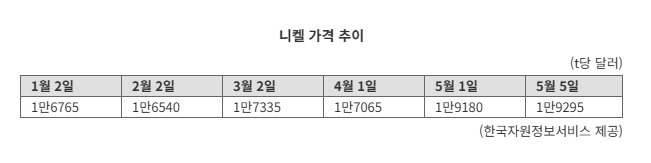
At the heart of this trend is a structural shift in Indonesia, the world's largest nickel producer. Indonesia has effectively led the supply of battery-grade nickel by promoting the high-pressure acid leaching (HPAL) process, which produces MHP from low-grade limonite ore.
Recently, however, that cost structure has been rapidly weakening. Sulfuric acid, a key input for the HPAL process, has come under upward price pressure as supplies of sulfur, its raw material, have fallen because of the war in the Middle East. Added to that, export restrictions from China, a major supplier, are further increasing the burden.
Indonesia also revised its nickel ore benchmark pricing system on the 15th of last month so that it is linked to international market prices, putting additional upward pressure on raw ore costs. As a result, the overall cost burden of the HPAL process is growing further. Analysts say the competitiveness of Indonesia's nickel value chain, once seen as a low-cost structure, is now being shaken.■ China's LFP push and the nickel factor add to K-battery concernsThe rising costs are expected to place direct pressure on South Korea's cathode material and battery industries as a whole.
That is because cathode material makers such as LG Chem Ltd., ECOPRO BM, POSCO Future M and L&F Corp., along with the three major battery makers LG Energy Solution, Samsung SDI Co., Ltd. and SK On, rely mainly on nickel-heavy lithium nickel cobalt manganese oxide (NCM) batteries.
Although some of the higher costs can be passed through under price-linked contracts, analysts say profitability will inevitably come under pressure because of the time lag and volatility. In addition to nickel, the rising prices of intermediates such as sulfuric acid and mixed hydroxide precipitate (MHP) are structurally increasing the cost burden for cathode materials.
This trend could also weaken the price competitiveness of premium electric vehicle batteries. Michael Insulan, vice president at Electra Battery Materials, told S&P Global that "higher raw material and sulfuric acid costs raise the production cost of nickel-based batteries and make LFP batteries more attractive."
The market is already shifting toward LFP. According to SNE Research, global electric vehicle cathode material shipments in January and February this year totaled 297,000 tons. NCM accounted for just 127,000 tons, up 2.2% from a year earlier, while LFP reached 170,000 tons, up 7.3%, widening the gap. LFP now holds about 57% of the market, more than half.
As the market continues to shift toward LFP, rising nickel prices are also increasing the likelihood that automakers will expand their adoption of Chinese-made LFP batteries. South Korea's battery industry is also seeking to enter the LFP segment and diversify its portfolio, but observers say the challenge is deepening because the industry has long relied on a high-nickel strategy.
[email protected] Gu Ja-yun Reporter