Who Will Be the Next Speaker of the National Assembly? Kim Tae-nyeon, Cho Jeong-sik and Park Ji-won in a Three-Way Race
- Input
- 2026-05-04 12:49:26
- Updated
- 2026-05-04 12:49:26
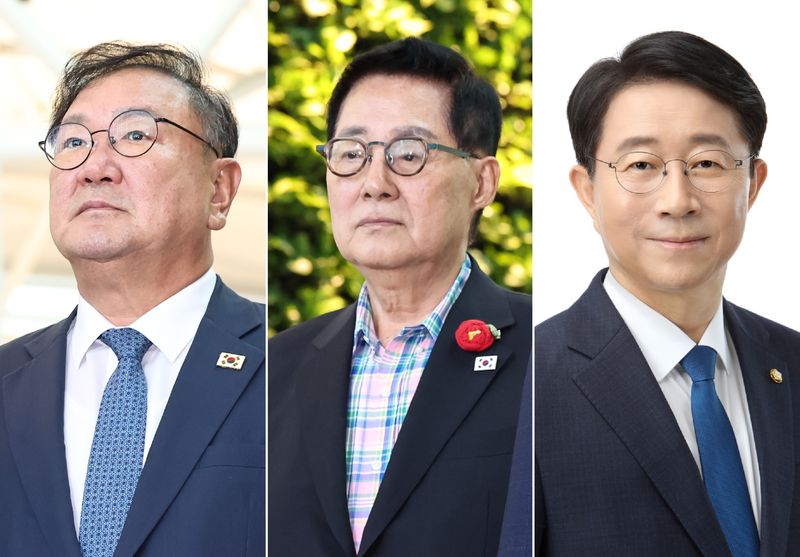
The three Democratic Party of Korea candidates seeking the post of Speaker of the National Assembly for the latter half of the 22nd National Assembly all registered their candidacies on the 4th.
Kim Tae-nyeon, the first to declare his bid for the speakership that day, said, "The Republic of Korea is now facing two major tasks. One is to institutionalize the era of popular sovereignty, and the other is to protect the country's future amid a wave of great transformation." He added, "To accomplish both tasks at once, we need a 'National Assembly that works well.' And at its center, there must be a 'Speaker who works well.'"
Kim said, "I am the right person for the job," and presented six key priorities. They include passing a 'law for a working National Assembly' to prevent intentional delays and disruptions in parliament, supporting legislation for the Lee Jae-myung administration's policy agenda, immediately pursuing a constitutional revision roadmap that includes restructuring the power system, creating a regular ruling-opposition-government meeting on livelihood and the economy, elevating parliamentary diplomacy to a national strategy, and launching social dialogue at the National Assembly level centered on the Speaker.
He described those tasks as "highly important matters that cannot be ranked against one another" and said, "I want to become a Speaker who does not focus on ceremony, but on getting things done, and doing them very well. That is why I want to create a truly new model of the Speaker."
On the same day, Cho Jeong-sik also formally announced his bid for the speakership, saying he would lead the National Assembly under the banners of a "people's livelihood-oriented National Assembly" and a "People's Sovereignty National Assembly."
Cho said he would first complete the formation of the second-half parliamentary leadership within June in order to build a people's livelihood-oriented National Assembly. His goal is to prevent delays in the reorganization of the Assembly caused by fierce confrontation between the ruling and opposition parties, and to avoid a situation in which parliament effectively shuts down. He also said, "I will hold plenary sessions every Thursday to improve the predictability of the National Assembly, and designate the last Thursday of every month as a 'livelihood legislation processing week' so that not a single bill related to people's livelihoods is left stalled in parliament."
His vision for a People's Sovereignty National Assembly includes establishing National Sovereignty Day to commemorate the blocking of the December 3 Martial Law, making legislative expos a permanent fixture, and regularizing social dialogue to broaden public participation in legislative activities. He also plans to create various advisory committees directly under the Speaker.
Cho also said he would push for a constitutional amendment on the power structure. The proposal would include a four-year renewable presidential term, transferring the BAI to the National Assembly, and granting parliament authority to control martial law. He added that he would work to strengthen the role and status of the National Assembly, as well as parliamentary diplomacy.
Park Ji-won, the oldest member of the National Assembly, entered the race for Speaker while emphasizing the various reform tasks being carried out by the Democratic Party of Korea, unlike the other candidates.
Park said, "One person changed, and the Republic of Korea is undergoing a dramatic transformation. Stock prices and the country's standing are rising sharply every day." He added, "But the forces behind the insurrection are still blocking the Lee administration's governance and the reforms needed to move toward a truly new Republic of Korea."
He said, "Our National Assembly must also become a first-class legislature that matches the country's standing and power," adding, "A mediocre National Assembly cannot lead the Republic of Korea, nor can it make the light revolution or the Lee Jae-myung administration succeed."
To that end, Park said he would support the Democratic Party's reform agenda by "proactively overhauling prosecution reform and judicial reform to complete the light revolution faster and more decisively."
He went on to say, "I will build a K National Assembly that works well." He added, "The best politics is cooperation. But I will not accommodate the 'Yoon Again' forces. For the people, I will firmly reform the Assembly into one that gives more support to lawmakers and standing committees that work more."
He also said he would strengthen parliamentary diplomacy and the National Assembly's special envoy function to support the government on foreign affairs and security issues. In addition, he said he would establish a tentative National Assembly Special Committee on Future Affairs to proactively prepare for social challenges facing South Korea, including artificial intelligence (AI), robots, population decline, regional depopulation, and low birth rates and aging.
[email protected] Kim Hyeong-gu Reporter