Successful Launch of Next-Generation Mid-sized Earth Observation Satellite No. 2... "Strengthening Competitiveness in the Satellite Industry"
- Input
- 2026-05-03 19:43:28
- Updated
- 2026-05-03 19:43:28
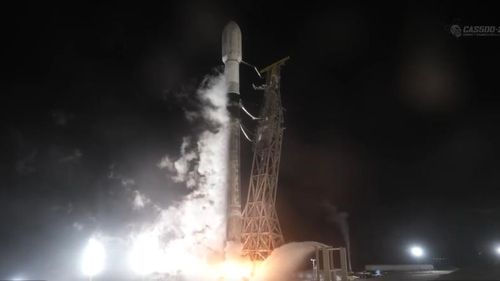
[Financial News] Next-Generation Mid-sized Earth Observation Satellite No. 2, which will carry out precise Earth observation missions for land and disaster management, successfully entered orbit on the 3rd. The launch of a satellite whose core body and payload components were developed with domestic technology is being seen as a leap forward in the technological competitiveness of South Korea's satellite industry.
According to the Korea AeroSpace Administration (KASA), Next-Generation Mid-sized Earth Observation Satellite No. 2 was launched at 4 p.m. Korea time aboard SpaceX's Falcon 9 rocket from Vandenberg Space Force Base in the State of California, United States. About 60 minutes after launch, the satellite separated normally from the rocket. It then made its first contact with Svalbard Satellite Station (SvalSat) in Norway about 15 minutes later. The satellite's main systems are currently operating normally.
The satellite will orbit at an altitude of about 498 kilometers in a sun-synchronous orbit and carry out precise ground observation missions. After about four months of initial operations, it is scheduled to begin full-scale missions in the second half of this year together with the existing National Land Satellite 1.
The Next-Generation Medium-Sized Satellite Development Project is a ground observation satellite development program aimed at securing a standard 500-kilogram-class platform and transferring technology to the private sector. The project was led by Korea Aerospace Industries, Ltd. (KAI). Weighing 534 kilograms, the satellite is equipped with a high-performance optical camera capable of precise observation, with 0.5-meter-class resolution in black and white and 2-meter-class resolution in color.
This satellite is especially significant because its main body and key payload were developed using independent technology. KAI participated jointly with the Korea Aerospace Research Institute (KARI) in the development of the first satellite in 2015 and received technology transfer. Since 2018, it has completed the development of the second satellite as the lead organization.
The second satellite had originally been scheduled for launch on a Russian rocket in 2022, but the timetable was delayed due to the Russia-Ukraine war. The launch was finally completed about four years later.
KASA said the launch strengthened the foundation for self-reliance in core satellite technologies and marked an important turning point in building a private-sector-led space industry ecosystem. The Ministry of Land, Infrastructure and Transport also emphasized that "with the simultaneous operation system for National Land Satellite 1 and 2 now in place, it has become possible to provide faster and more diverse satellite image services."
Oh Tae-seok, Administrator of the Korea AeroSpace Administration, said, "The launch of the second satellite is an important milestone in opening the era of New Space centered on the private sector." He added, "By securing ultra-precise satellite imagery on our own, we will greatly strengthen not only our capabilities in land and disaster management but also the competitiveness of South Korea's space industry."
[email protected] Hong Ye-ji Reporter