Major Blue-Chip Unions Push Back on Performance Bonuses, Even Demand a Role in Management [Labor Disputes Threatening Business Circles (1)]
- Input
- 2026-05-03 18:54:27
- Updated
- 2026-05-03 18:54:27

At the meeting, Ahn held close consultations with the companies, listened to the difficulties facing the petrochemical industry, and discussed possible government support measures.
Minister Ahn Duk-geun of the Ministry of Trade, Industry and Energy speaks with chief executives of petrochemical companies.
LG Chem and Lotte Chemical were among the companies that attended. LG Chem also introduced its COMPOSTFUL plastic in Busan.
The year 2026 is expected to become a turning point in labor-management relations. Amid the semiconductor boom, debate is intensifying over how profits should be shared and how responsibility should be assigned. With the Yellow Envelope Law set to take effect, labor-related legislation such as retirement-age extensions, a basic workplace law, and a worker presumption system is also likely to move forward quickly after the local elections. These bills are also seen as requiring a new paradigm in labor-management relations. As that shift unfolds, concerns are growing over increasingly unstable relations between labor and management. Severe conflict can bring enormous social costs. That is why the government and Cheong Wa Dae are closely watching labor talks and negotiation trends. The Financial News will examine key issues through a series of feature stories on labor disputes and strike risks.
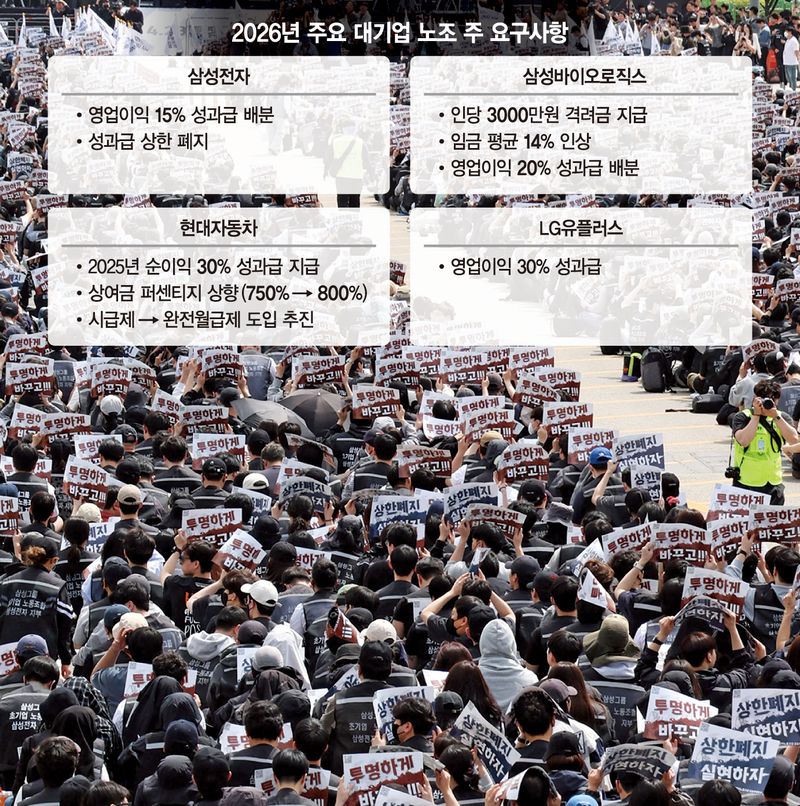
As tariff pressure from the United States and geopolitical risks from the Middle East converge, concerns over summer labor offensives are spreading across industry. Performance bonus demands, triggered by the semiconductor boom, have emerged as a central point of conflict in labor disputes at major conglomerates. At the same time, unions at parent companies are launching preemptive action by demanding both higher bonuses and a role in management, adding to corporate burdens.
Analysts say management is already facing multiple labor risks even before subcontractor negotiations begin in earnest under the Yellow Envelope Law. In particular, clashes over how corporate profits should be distributed are raising concerns that investment, hiring, and the securing of future growth engines could all be affected.
■ Spread of performance bonus disputes
According to industry sources on the 3rd, labor offensives are already underway before summer has fully begun. Unions at Samsung Biologics, Samsung Electronics Co., Ltd., Hyundai Motor Company, and LG Uplus Corp. are either on strike or have issued warnings.
A defining feature of this year’s labor offensives is that Samsung Group affiliates are leading the way. Samsung Biologics has already been on a full strike since the 1st, while the Samsung Electronics union has formally said it may launch a general strike if wage and bonus negotiations break down. This is the first time Samsung Biologics has actually gone on strike, and the first time the Samsung Electronics union has warned of a general strike.
The biggest issue this year is the criteria for distributing performance bonuses and how they are linked to company results. As demands grow for a portion of operating profit and net profit to be reflected in bonuses, comparisons of bonus levels between companies are becoming a direct catalyst for labor disputes. The negotiation structure is shifting away from wage increases alone and toward arguments over how performance should be shared.
The strong semiconductor market is further intensifying the conflict. SK Hynix abolished the cap on profit-sharing bonuses and decided to allocate 10% of operating profit to its bonus pool, creating a high-paying benchmark that is now raising expectations among unions at other companies.
Those outside comparisons are spilling over into internal conflict. The larger the performance gap between business divisions, the more severe the dispute becomes. At Samsung Electronics, the gap between the Device Solutions Division and other businesses such as home appliances and mobile devices is fueling tensions among workers. As performance becomes concentrated in certain divisions, concerns over fairness inside the company are coming to the fore and turning into organizational conflict.
There are also moves to expand the scope of bargaining beyond wages and bonuses to include management decisions. Samsung Biologics is a prime example. The union is reportedly seeking to include clauses in its collective bargaining proposal that would require prior consent on key management matters such as new hiring, personnel evaluations, and mergers and acquisitions (M&A).
■ Fears of weakened future competitiveness
From the companies’ perspective, there are growing concerns that these demands could gradually weaken their ability to invest. The semiconductor industry, which has recently been in the spotlight, is a capital-intensive sector that requires preemptive investments worth tens of trillions of won. Rising labor costs could quickly translate into pressure to cut investment.
A business circles official said, "If demands for higher bonuses become entrenched, they could lead to higher costs in the short term and reduced investment in the medium to long term." As the situation worsens, the government is also keeping a close watch. In response to the recent spread of labor disputes, President of the United States Lee Jae-myung said at a senior aides meeting on the 30th of last month, "If some organized workers make excessive or unfair demands just to save themselves and are then criticized by the public, that will harm not only the union in question but also other workers." Although he did not name any specific company, some interpret the remark as a clear reference to the growing criticism surrounding the Samsung Electronics union strike. For now, however, the government believes the current disputes are not directly tied to the Yellow Envelope Law. The bonus and management-participation demands are issues centered on existing regular employee unions. Still, if subcontractor negotiations begin in earnest, the scope and intensity of labor disputes are likely to expand further. There are concerns that if conflict spreads from parent companies to partner firms, it could affect the industry’s overall cost structure and supply chain stability. An official at the Ministry of Employment and Labor (MOEL) said, "The recent strikes at Samsung Electronics and other major companies are separate from the Yellow Envelope Law." There is also a view that Samsung Biologics’ demand for prior management consent should be seen as a separate issue from the Yellow Envelope Law. The revised law added business management decisions that affect working conditions to the scope of labor disputes. According to the guidelines, this means that if an employer’s decision affects working conditions, it can be included in a labor dispute. However, it does not mean that workers must launch a dispute or seek prior consent before a company exercises a specific management right.
jhyuk@fnnews.com Kim Jun-hyuk, Jung Sang-hee, Kim Dong-chan Reporter