Trump starts retaliation for non-participation in war, raising tariffs and pulling troops [U.S.-Iran War]
- Input
- 2026-05-03 18:54:12
- Updated
- 2026-05-03 18:54:12
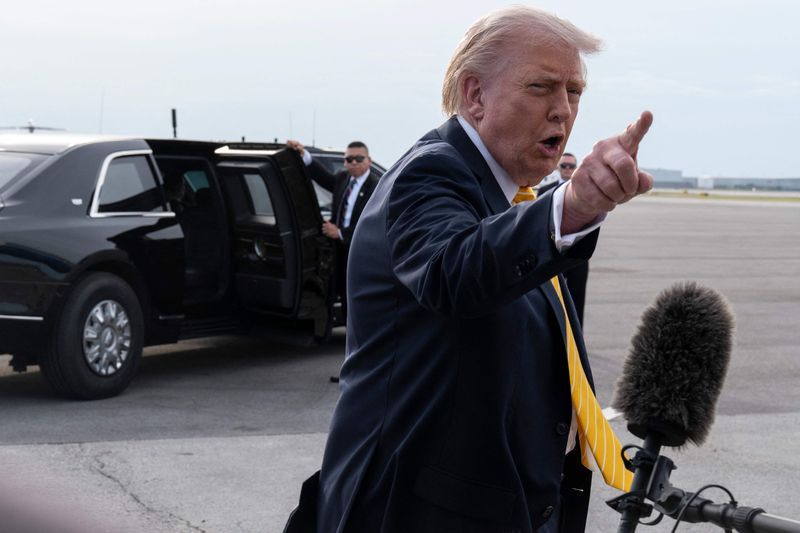
Trump announced the move on Truth Social on the 1st (local time), saying that the EU was not fully complying with the trade agreement. At the same time, he offered an exemption for goods made in the U.S.A. He added, "There will be no tariff if European companies produce cars and trucks at factories in the U.S.A.," signaling an effort to expand local production. The strategy is to use tariffs as leverage to draw manufacturing investment and jobs. It also appears to signal a broader reshaping of the transatlantic trade order, beyond a simple tariff hike.
The abrupt tariff hike was driven first and foremost by what Trump described as noncompliance with the trade agreement. He has repeatedly raised the tariff card, arguing that the EU has been slow to carry out its promised investments in the U.S.A. in exchange for lower tariffs. At the White House on the same day, he told reporters that the tariff increase on EU cars and trucks was tied to the issue of noncompliance. "Car factories worth more than $100 million are being built in the U.S.A. right now," he said. "Countries such as Japan, the ROK, Canada, and Mexico are all building factories in the U.S.A., but the EU is not honoring the agreement."
Earlier, on July 27 last year, Trump and Ursula von der Leyen, President of the European Commission, met in Scotland, UK, and reached a trade deal that lowered tariffs. Under the agreement, the EU would purchase $750 billion worth of U.S. energy and military equipment and improve access to its agricultural market. In return, it would invest an additional $600 billion in the U.S.A., while the U.S.A. would lower reciprocal tariffs on the EU to 15% and cut sector-specific tariffs on automobiles and other goods to 15% across the board.
The background to the sudden tariff hike is also closely linked to Trump's frustration over the lack of cooperation from key European allies during the war with Iran. Tensions have been high over the refusal by major NATO members in Western Europe to send warships to the Strait of Hormuz and their decision to bar U.S. and Israeli aircraft from using some military bases in Europe. Trump has said he would "remember" their actions, signaling his intent to retaliate.
On the 29th of last month, Trump said he was considering reducing U.S. troops stationed in Germany. The U.S. Department of Defense then confirmed on the 1st that about 5,000 troops are expected to be withdrawn within the next six to 12 months.
With Trump's announcement, the EU will for now be at a disadvantage in competition with Japanese and ROK automakers, who are still subject to a 15% tariff in the U.S. auto market. However, Japan and the ROK have also not responded actively to Trump's requests for help, so it is too early for them to feel safe from his indirect retaliation through tariffs.
Meanwhile, the EU warned on the 1st (local time) that it could retaliate against Trump's tariff pressure. The European Commission said the EU is complying with the trade agreement and warned that it could respond if the U.S. raises tariffs. A Commission spokesperson said, "If the U.S. takes measures that run counter to the joint statement on the trade agreement, we will keep options open to protect the EU's interests." The spokesperson also stressed that the EU is carrying out its commitments under the joint statement in line with standard legislative procedures.
Bernd Lange, chairperson of the European Parliament's trade committee, pushed back in a post on X, saying, "Trump's tariff increase on cars is unacceptable." He argued that the European Parliament is respecting the trade agreement with the U.S. and is also completing its legislative work, adding that it is the U.S. that is breaking its promises.
[email protected] Reporter