Internet Banks Targeted by Criminals for Easy Account Opening... Fraudulent Accounts Up 11-Fold in 6 Years [Rising Phishing Scams]
- Input
- 2026-05-03 18:54:01
- Updated
- 2026-05-03 18:54:01
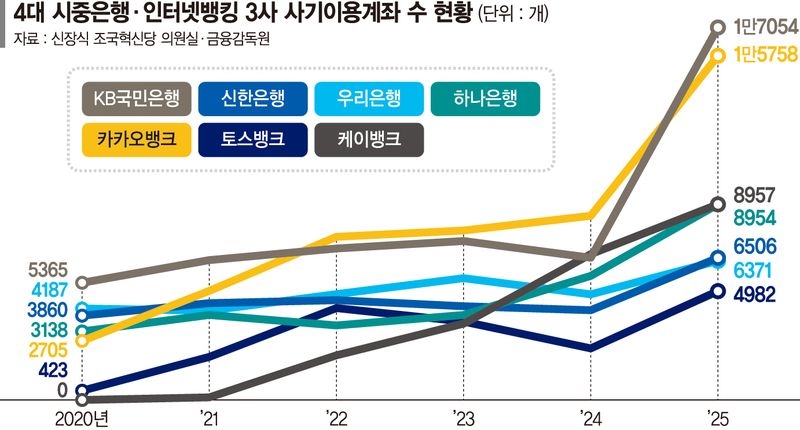
According to data submitted by Shin Jang-sik of the Rebuilding Korea Party to the National Policy Committee on the 3rd, the number of fraudulent-use accounts at the four major commercial banks (KB Kookmin Bank, Shinhan Bank, Woori Bank and Hana Bank) and the three internet banks (KakaoBank Corp, K Bank and Toss Bank) totaled 68,582 last year. That was about 250% higher than in 2020, when the figure stood at 19,678.
A fraudulent-use account refers to an account into which a victim's funds were transferred or from which funds were moved. Under the Special Act on the Prevention of Loss Caused by Telecommunications-Based Financial Fraud and Refund of Damages, financial institutions must suspend an account and notify the FSS if there are signs that it may be being used for fraud.
As of last year, KB Kookmin Bank had the most fraudulent-use accounts at 17,054, followed by KakaoBank Corp with 15,758, K Bank with 8,957, Hana Bank with 8,954, Shinhan Bank with 6,506, Woori Bank with 6,371 and Toss Bank with 4,982.
The three internet banks saw the sharpest growth. While commercial banks increased by 1.5 to 3 times over six years, KakaoBank Corp rose from 2,705 to 15,758, a 5.8-fold increase, and Toss Bank jumped from 423 to 4,982, more than 11 times higher. K Bank, which began compiling fraudulent-use account data in 2021, surged from 119 to 8,957 last year.
A KakaoBank Corp official explained, "Because our monthly active users are the highest in the domestic banking sector, we inevitably have a relatively large number of suspended accounts due to the high volume of account openings and transactions. We have more than doubled the number of staff handling financial fraud monitoring and victim relief compared with last year, so we can detect suspicious transactions earlier and strengthen our response to account suspensions."
Industry observers say the image of internet banks as offering "easy finance" has made them targets for criminal groups. An industry source noted, "The banking sector as a whole is providing convenient mobile app-based financial services through Digital Transformation, but internet banks have had a strong image of being easy and fast since their launch. That perception may also have increased their exposure to criminal targeting and financial fraud."
The growing sophistication of phishing tactics is also weighing on the banking sector. As crimes such as impersonating institutions or family members become more varied, cases in which stolen funds move through multiple accounts in a short time are increasing.
Banks are responding by upgrading their Fraud Detection System (FDS), strengthening monitoring of new accounts and managing long-unused accounts, but analysts say these measures have limits when it comes to fundamentally blocking exposure to financial fraud. In particular, because all account openings at internet banks are handled non-face-to-face, pre-screening and post-transaction monitoring systems for fraud prevention are even more important.
Shin said, "As convenience and innovation expand, internet banks also need to strengthen their management systems for user protection, including non-face-to-face account opening procedures and FDS, to match that growth."
[email protected] Lee Hyun-jung Reporter