ASEAN Is Aging Faster Than South Korea and Japan... A 'Rapidly Aging' Region Creates Opportunities for Korea
- Input
- 2026-05-03 18:46:52
- Updated
- 2026-05-03 18:46:52
At the first nationwide policy meeting on the silver economy, held in March and chaired by the prime minister, former Vietnamese Prime Minister Pham Minh Chinh stressed the importance of the silver economy industry. He redefined older adults not as people who need support, but as "actors in economic activity and a resource." Chinh also called for building an industrial ecosystem that spans "healthcare, long-term care, pensions and age-friendly tourism."
ASEAN, which has grown on the back of a demographic dividend driven by a large labor force, is now entering an aging phase faster than expected. As a result, countries in the region are revising their response strategies. Policy priorities are shifting away from boosting birth rates and toward fostering a silver economy built on the assumption of aging. A demographic dividend refers to a period in which the working-age population (ages 15 to 64) exceeds the youth population (ages 0 to 14), increasing labor supply and consumption and lifting economic growth.
Companies operating in the region are also being urged to rethink investment strategies in ASEAN that have assumed a young workforce.
■ Vietnam is aging faster than South Korea and Japan... Thailand sees more working seniors
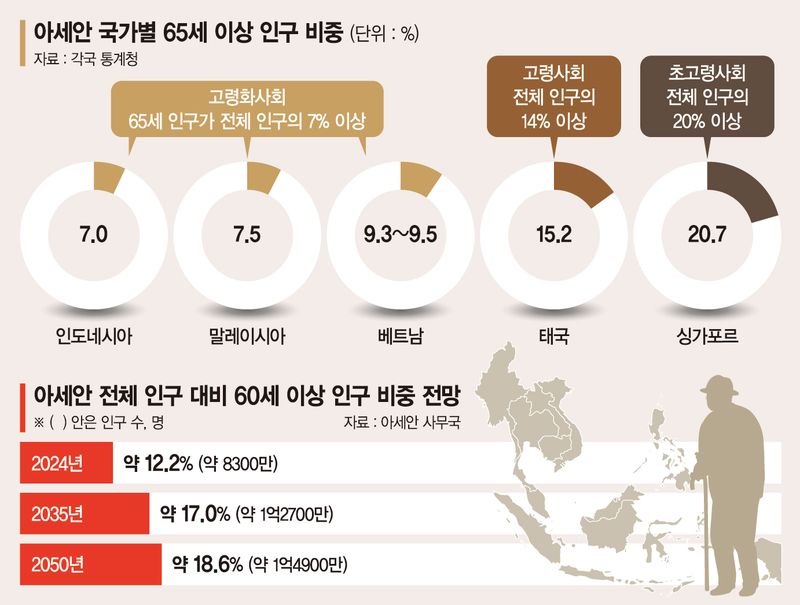
According to various statistics released on the 3rd, Vietnam is aging faster than other ASEAN countries. The population aged 60 and older has already exceeded 16 million, and the country is expected to enter an aged society around 2038 to 2040, roughly 10 years from now. If that happens as projected, the transition from an aging society to an aged society will take only 17 to 20 years. That is far faster than South Korea's 26 years and Japan's 36 years.
Vietnam's labor supply growth has recently slowed as the birth rate falls, while the burden of social security, including pensions and healthcare, is rising quickly.
In an interview with local media, Bui Quang Binh, a professor at Da Nang University of Economics, said, "Vietnam is moving from a demographic dividend to an aged society in a short period of time." He added that "the labor-driven growth model has reached its limits, and a shift toward a silver, digital and green economy is needed."
The Vietnamese government plans to use the meeting as a springboard to develop the silver economy into a new growth engine.
Thailand was the first country in Southeast Asia to feel the shock of aging. Its population in 2025 is estimated at about 65.8 million, down by more than 140,000 from a year earlier. People aged 60 and older number 15 million, accounting for more than 20% of the total, and 37% of them are still working. Many continue laboring simply to make ends meet in low-income conditions. The Thai government is expanding retraining and job-matching programs, while also promoting a 'retiree industry' that combines healthcare, long-term care and tourism.
Singapore and Malaysia are also aging rapidly. Singapore has already entered a super-aged society, with people aged 65 and older making up more than 20% of the population. It is expanding investment in 'age tech,' including longer working lives and digital healthcare. Malaysia is also expected to enter an aged society around 2040 and is working to improve its pension and healthcare systems.
■ Aging is happening twice as fast as in the OECD... "Institutions are lagging behind"
Aging in ASEAN has a strong 'growing old before getting rich' character. In other words, the region is aging before it has accumulated enough income, causing growth to slow and fiscal burdens to rise at the same time.
The Organisation for Economic Co-operation and Development (OECD) and the Economic Research Institute for ASEAN and East Asia (ERIA) have consistently projected that ASEAN countries will age at roughly twice the pace of the OECD. Another risk is that two-thirds of workers are employed in the informal sector, leaving them outside social security systems such as pensions and health insurance.
Public spending stands at about 20% of GDP, only half the OECD average. Meanwhile, pension, healthcare and long-term care costs are rising quickly, making a larger fiscal burden unavoidable, analysts say.
■ "The silver economy is both an opportunity and a risk"
Countries are trying to turn aging into an industrial opportunity. The silver economy is emerging as a new market spanning all industries, including healthcare, finance, tourism and housing. In particular, Singapore's silver economy, as it moves toward a super-aged society, was estimated to have reached $72 billion last year. Singapore is focusing its investment on telemedicine, age-friendly housing and policies that encourage older adults to keep working and learning.
Kyung Young Ko, a professor of digital trade at Yonsei University Graduate School of International Studies, said, "Aging in ASEAN can create market opportunities in the silver economy, but because of family-centered care and weak safety nets, it also has a high chance of becoming a social burden depending on income and regional disparities." She added, "Because the pace of aging and the capacity to respond differ by country, expanding healthcare and care infrastructure and introducing digital healthcare will be key tasks."
Meanwhile, aging has also become a variable for Korean companies operating in the region. A company official active in ASEAN said, "The pace of demographic change is faster than expected, so we are constantly revising our strategy." The official added, "It is now difficult to approach the market on the assumption that it is simply a young market."
[email protected] Kim Jun-seok Reporter