Korean Big Three battery makers see rebound in the second half on ESS and high oil prices
- Input
- 2026-05-03 18:39:19
- Updated
- 2026-05-03 18:39:19
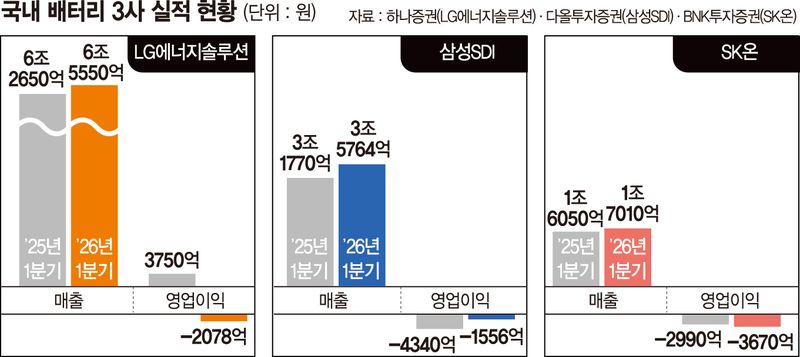
According to the battery industry on the 3rd, the three companies' combined operating loss in the first quarter is estimated at about 700 billion won. That is roughly 150 billion won smaller than the previous quarter.
LG Energy Solution posted sales of 6.555 trillion won and an operating loss of 207.8 billion won, extending its losses for a second straight quarter. Sales in its mid- to large-sized automotive battery segment slipped slightly from the previous quarter after a General Motors (GM) joint venture halted operations. Losses were also larger than expected because expansion of its ESS pack plant could not keep pace with cell production.
Samsung SDI recorded sales of 3.5764 trillion won and an operating loss of 155.6 billion won, marking its sixth consecutive quarter in the red. Its battery division alone suffered a loss of 177 billion won as utilization at its Hungary plant, its European base, remained low. SK On has not yet released earnings, but securities firms expect an operating loss of more than 300 billion won.
Still, the three battery makers are expected to begin turning profitable in earnest from the second quarter. The key driver of the rebound is ESS.
LG Energy Solution plans to complete the conversion of its five production sites in North America to ESS lines in stages and build up more than 50GWh of ESS production capacity locally. It also aims to raise ESS sales to the mid-30% range or higher by the end of the year, from the current mid-20% range.
Samsung SDI plans to begin mass production of LFP-based ESS batteries in the second half of this year at StarPlus Energy LLC's plant in Indiana, while also supplying contracts worth a combined 2 trillion won signed last year through 2029. SK On will also complete the conversion of its ESS line at its State of Georgia plant in the second half and begin full-scale shipments. It is currently negotiating supply deals worth about 1 trillion won with multiple customers in North America.
The EV market is also recovering at a faster pace. After Renault, LG Energy Solution added Mercedes-Benz as an LFP customer, broadening its EV battery portfolio from mid- and low-priced models to premium vehicles.
Samsung SDI also strengthened its order pipeline by signing a multi-year supply deal with Mercedes-Benz for prismatic EV batteries worth up to 10 trillion won.
The European Union (EU)'s push to reduce dependence on China is also creating a favorable environment for Korean battery makers. Lee Yong-wook, a researcher at Hanwha Investment & Securities Co., Ltd., explained, "Korea is included in the EU's local production requirements in Europe, while China is excluded, so domestic battery makers are expected to benefit."
[email protected] Kim Dong-chan Reporter