MZ Gangsters Who No Longer Use Their Fists Make a Fortune Through Online Crime
- Input
- 2026-05-03 18:23:53
- Updated
- 2026-05-03 18:23:53
According to data on gang members by age over the past five years, which this paper obtained from the Korean National Police Agency on the 3rd, the number of teenage gang members rose from just two in 2021 to 57 last year, an increase of about 29 times in four years. Over the same period, the number of gang members in their 20s also climbed from 599 to 720, up more than 20 percent. Even so, the overall size of organized crime groups has shown only modest growth and appears to have entered a period of stagnation.
Looking at the Korean National Police Agency's tally of gang management personnel, the total number of groups increased by only three, from 206 in 2021 to 209 in 2025. Membership also remained in the 5,000 range for five straight years. New recruits peaked at 583 in 2022 before falling to 205 last year. During the same period, the number of disbanded members also hovered around 200, meaning inflows and outflows have effectively converged at similar levels.
One reason for this stagnation in group size is the influx of many MZ-generation members in their teens and 20s, who are familiar with sophisticated, organized white-collar crimes such as fraud. In the past, local revenue models such as running entertainment venues or collecting protection money were central. Now, however, groups are making high profits through crimes including used-car sales fraud, insurance fraud, voice phishing and speculative gambling, allowing them to earn money without expanding their organizations.
Yeom Gun-woong, a professor in the Department of Police and Fire Administration at Yuwon University, said, "If they build a large organization that becomes visible to the police, they could end up facing crackdowns or punishment. So they keep the group as small as possible, maintaining only the minimum structure needed to threaten others or show force, while maximizing profits."
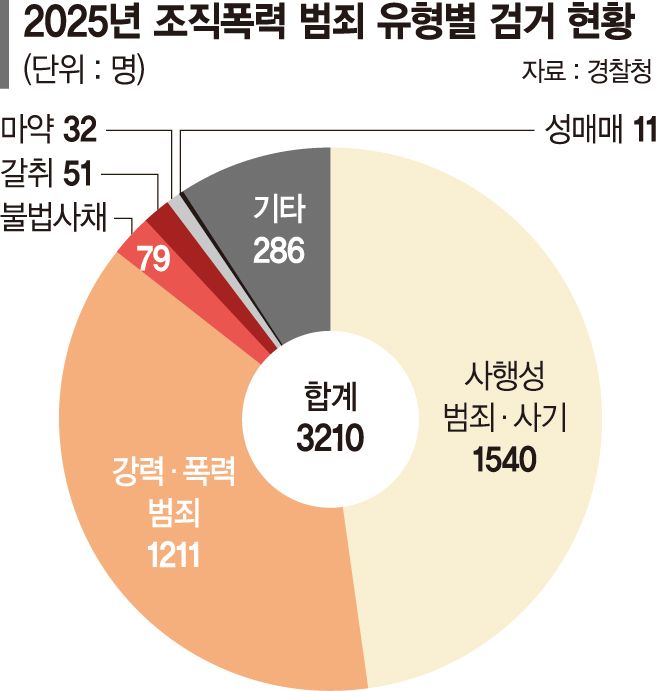
In fact, the number of people arrested for speculative crimes jumped from 516 in 2021 to 751 in 2022 and remained high at 737 last year. Fraud crimes, including voice phishing, were separately tallied for the first time in 2024, when 774 arrests were recorded, and the figure rose again to 803 last year, establishing them as a major crime category. Last year, arrests for speculative crimes and fraud totaled 1,540, accounting for about 48 percent of all arrests, or 3,210. That surpassed the share of arrests for robbery and violent crimes, which stood at about 38 percent. Arrests for extortion, prostitution and drug crimes last year were 51, 11 and 32, respectively, all in the double digits.
Experts say these changes are making organized crime even more dangerous. In the past, damage was concentrated in specific neighborhoods or industries. Now, however, the harm can spread across the entire population. Some groups are also becoming more international, carrying out crimes in coordination with online scam rings based overseas. The police are also changing their response. A police official said, "To respond to scam crimes, we have formed an integrated task force and expanded investigative manpower. We are also strengthening international cooperation to deal with crimes based overseas." The official added, "Starting this year, we have expanded our management system to include not only traditional violent groups but also organizations that commit economic crimes such as fraud and gambling."
Experts stress that enforcement alone is not enough and that prevention must also be part of the response, including blocking the entry of younger recruits. They say authorities should work with the Korea Communications Standards Commission (KCSC) and other relevant agencies to block social media posts related to gang recruitment and strengthen preventive education for teenagers, in order to stop group expansion through new recruits before it starts. They also point out that because the core of organized crime lies in financial flows, authorities need to move quickly to cut off criminal proceeds.
Professor Shin I-cheol of Wonkwang Digital University said, "Through revisions to the Act on Regulation and Punishment of Criminal Proceeds Concealment and improvements to the independent forfeiture system, criminal proceeds should be frozen and confiscated even before suspects are arrested or tried. The sentencing standards for forming a criminal organization should also be strengthened so that punishment is stricter than in ordinary criminal cases."
[email protected] Kim Ye-ji Reporter