A Middle East naphtha shock sends a warning signal: Is the push to go plastic-free a crisis or an opportunity? [Lee You-beom’s Eco & Energy column]
- Input
- 2026-05-02 06:00:00
- Updated
- 2026-05-02 06:00:00
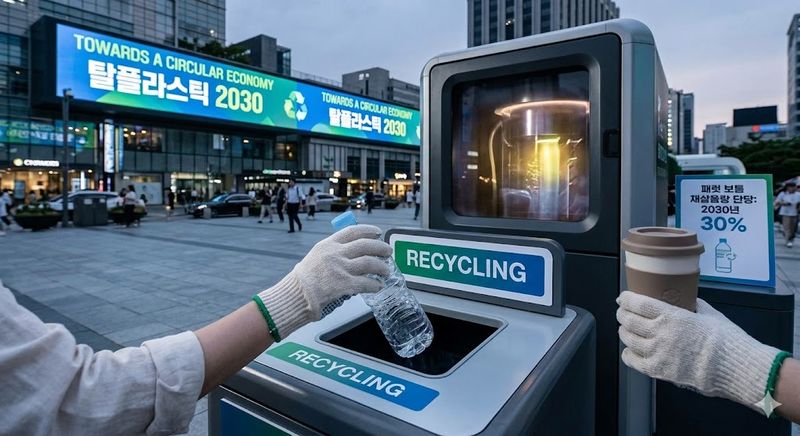
[Financial News] As a naphtha supply crunch triggered by the Middle East war exposed the vulnerability of an economy dependent on plastics, the Ministry of Climate, Energy and Environment reported its "plan to promote a transition to a plastic-free circular economy" to the State Council of South Korea on April 28. The core of the plan is to cut the use of virgin plastic by more than 30% from current levels by 2030. Industry and environmental groups remain sharply divided, with some calling it an appropriate transition to reshape the economic structure and others dismissing it as a hollow, face-saving measure.
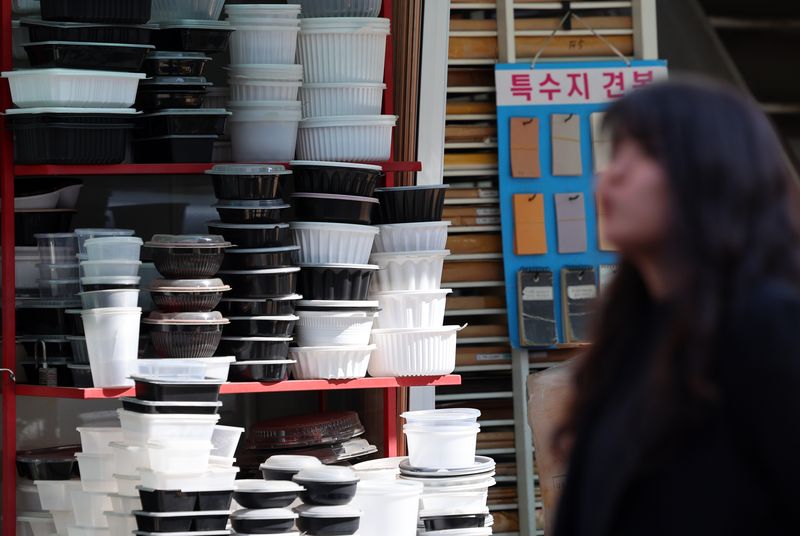
Cutting 3 million tons by 2030... The key is mandatory use of recycled materials
The centerpiece of the plan announced by the Ministry of Climate, Energy and Environment is a full paradigm shift from a "take-make-dispose" linear economy to a "make-use-return" circular economy. The government has set a concrete target of reducing 3 million tons, or about 30%, of the 10 million tons of waste plastic expected to be generated in 2030. It aims to manage the entire life cycle, from product design to recycling after disposal.
The top priority is "source reduction," or preventing waste from being created in the first place. The government plans to expand rules against excessive packaging across the food and distribution sectors. In particular, it will work with delivery platforms to spread "Zero Waste Zones," where reusable containers are mandatory, to major urban centers and university districts nationwide by 2027. It will also support wider distribution of "Eco Box" packaging that does not require cushioning materials or tape, while greatly expanding eligibility for the Carbon Neutral Point System, which rewards consumers for reducing single-use items, to encourage voluntary participation.
The plan's strongest enforcement tool is the legalization of mandatory recycled-content ratios. The share of recycled materials blended into PET bottles, currently around 10%, will be raised to 30% by 2030. This is not a mere recommendation but a legal obligation, and noncompliance will result in sharply higher Recycling Dues.
Of particular note is the plan to significantly expand facilities that produce plastic waste pyrolysis oil, a form of chemical recycling that heats waste plastic to high temperatures and turns it back into liquid oil. To support this, the government will simplify permitting procedures for waste treatment facilities and recognize raw materials produced through chemical recycling as equivalent to virgin materials in terms of carbon reduction, encouraging corporate investment in the technology. The scope will also expand beyond PET to include polyethylene (PE) and polypropylene (PP), which are used in home appliances and automotive interior materials, with the goal of completing a resource-circulation system across the industrial sector.
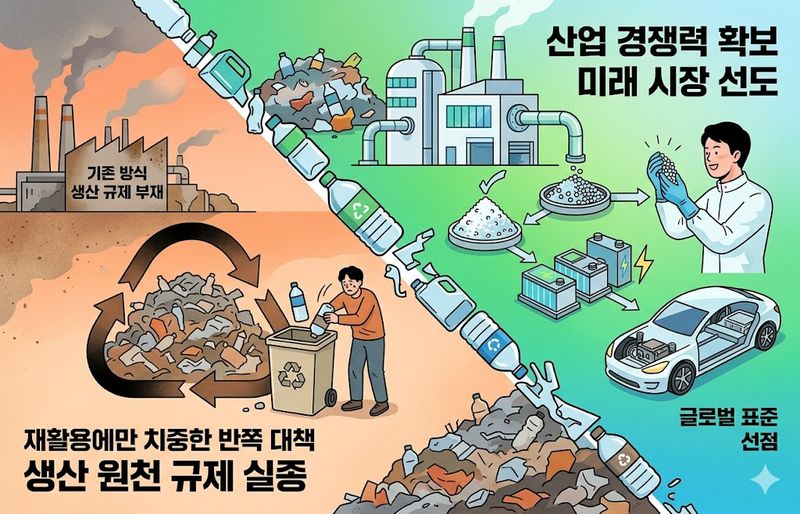
An opportunity to strengthen industrial competitiveness vs. a half-baked plan focused only on recycling
Industry and economic experts are welcoming the plan, saying it could serve as a catalyst for a "structural overhaul" of South Korea's petrochemical industry.
The European Union (EU) is already moving to restrict imports of products whose use of recycled materials cannot be verified through the Ecodesign for Sustainable Products Regulation (ESPR). The United States is also tightening plastic regulations at the state level. In this context, the government's decision to set clear domestic standards is significant because it gives exporters a "predictable business environment."
Conventional mechanical recycling has suffered from quality degradation, but chemical recycling, which breaks plastic down at the molecular level and returns it to an oil state, can be repeated indefinitely. If government support is added to the multitrillion-won investments already being made by major domestic companies such as SK Geo Centric and LG Chem Ltd. in this field, South Korea could become a "hub" for the global urban mining business for waste plastics. However, some environmental groups and experts argue that the plan ignores the root causes of plastic pollution.
International environmental organizations such as Greenpeace say in unison that "recycling is only a last resort, not the answer." They point out that the plan lacks strong measures to curb production at the source, such as quotas on virgin plastic produced by petrochemical companies or major cuts in tax incentives. That is why critics say it is like "leaving the faucet open while only wiping up the water on the floor."
In the past, policies such as the Disposable Cup Deposit System and a ban on straws were pushed forward but later left to local governments or postponed, citing burdens on small business owners. Environmental groups say that without strong regulation, it is impossible to drive changes in public behavior. They also accuse the government of dulling its own policy edge under pressure from industry lobbying and short-term economic indicators.
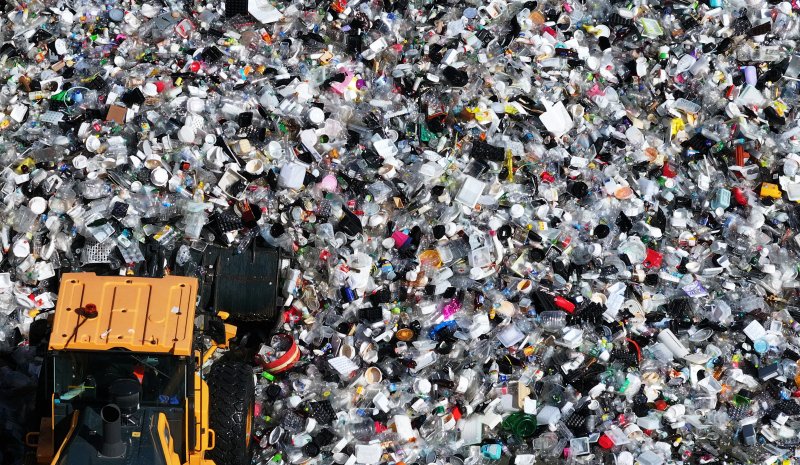
Circular economy: a matter of survival that must overcome technical limits
The road to a plastic-free future still has huge obstacles. Studies are increasingly showing that recycling processes themselves generate large amounts of microplastics. If the government focuses only on raising recycled-content ratios, it could even worsen the concentration of microplastics in wastewater discharged from factories. The introduction of sophisticated filtration technology and clear standards in this area is still in its infancy.
Recycled materials are more expensive to produce than virgin feedstock. That could ultimately be passed on to consumers through higher final product prices. Large companies with ample capital may be able to adapt, but small and mid-sized firms that rely on plastic containers could face an existential crisis. Critics say the plan needs stronger support measures for a "just transition" for these businesses.
The Ministry of Climate, Energy and Environment's plan is not perfect, but it is being praised for drawing South Korea's first serious blueprint for escaping its "plastic addiction." Still, success depends on three things working together: consistent government enforcement, corporate technological innovation, and public willingness to accept inconvenience. Experts say companies that use recycled plastic should receive bold carbon credit incentives, while education and institutions that change the culture of treating single-use items as normal must move forward in parallel.
A ministry official said, "This plan is not a fixed ending but an evolving process," adding, "We will accept criticism from civil society and quickly improve the roadmap for reducing microplastics and support measures for small and mid-sized companies."
Climate, environment, and energy are like two sides of the same coin. Depending on how energy is produced, it can accelerate global warming. Conversely, changes in climate and the environment affect energy demand and supply.[Lee You-beom’s Eco & Energy column]meets readers every Saturday with issues in climate, environment, and energy that are inseparably linked. If you subscribe to the reporter page, you can receive it more conveniently.
[email protected] Lee You-beom Reporter