U.S. Seeks Additional Tariffs, Excludes South Korea from Intellectual Property Watch List
- Input
- 2026-05-01 10:39:36
- Updated
- 2026-05-01 10:39:36

[The Financial News] The United States, which has been monitoring trading partners in order to impose tariffs, excluded South Korea from its watch list for the 18th straight year in its annual intellectual property trade report. However, it increased references to South Korea in relation to pharmaceutical and medical device trade.
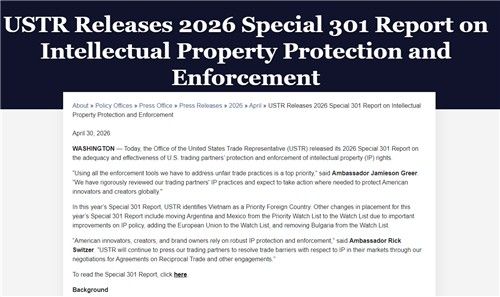
On April 30 local time, the Office of the United States Trade Representative (USTR) released the "2026 Special 301 Report" and designated Vietnam as a priority foreign country that could face trade retaliation under Section 301 of the Trade Act of 1974.
The next tier, the priority watch list, included six countries, among them China, Russia and India. The watch list totaled 19 countries after the European Union (EU) was added.
South Korea was not included. Since the report was first issued in 1989, South Korea had appeared every year on either the priority watch list or the watch list until it was removed starting with the 2009 report.
Last year, the U.S. collected reciprocal tariffs on South Korea and other countries under the International Emergency Economic Powers Act (IEEPA). After the U.S. Supreme Court ruled in February that the measure was illegal, Washington quickly began looking for another legal basis. On March 11, USTR said it would launch an investigation into unfair practices under Section 301 of the Trade Act of 1974 targeting 15 countries and the EU, citing electronics and automobiles.
In a press release on the report, U.S. Trade Representative Jamieson Greer stressed that "using every tool at our disposal to respond to unfair trade practices is our top priority." He added, "We have thoroughly reviewed our trading partners' intellectual property practices and will take the necessary steps to protect American innovators and creators around the world."
Although USTR did not place South Korea on the watch list in this report, it raised several issues related to the country. Along with China, Japan, Canada and Russia, USTR mentioned South Korea and expressed concern over policies tied to pharmaceutical innovation and market access.
In last year's report, USTR said stakeholders continued to raise concerns about a lack of transparency in South Korea's drug and medical device pricing. This year, it added more detail about conditions in South Korea. USTR said drug prices in South Korea are lowered throughout the product life cycle through systems such as actual transaction price cuts (ATP) and price-volume agreements (PVA). At the same time, it added that U.S. industry continues to raise concerns about the lack of transparency in certification standards for innovative pharmaceutical companies in South Korea.
USTR also pointed out that counterfeit goods across a wide range of sectors, from semiconductors to shoes, are being distributed in India, South Korea and Türkiye. The report also said that South Korea passed an amendment to its copyright law earlier this year that clarifies that intentionally posting links to copyrighted infringing content for commercial purposes constitutes copyright infringement.
[email protected] Park Jong-won Reporter