Samsung Flies on One Wing as Friction Between Semiconductors and Finished Goods Deepens [Strike Risks Loom Over Companies]
- Input
- 2026-04-30 18:34:59
- Updated
- 2026-04-30 18:34:59
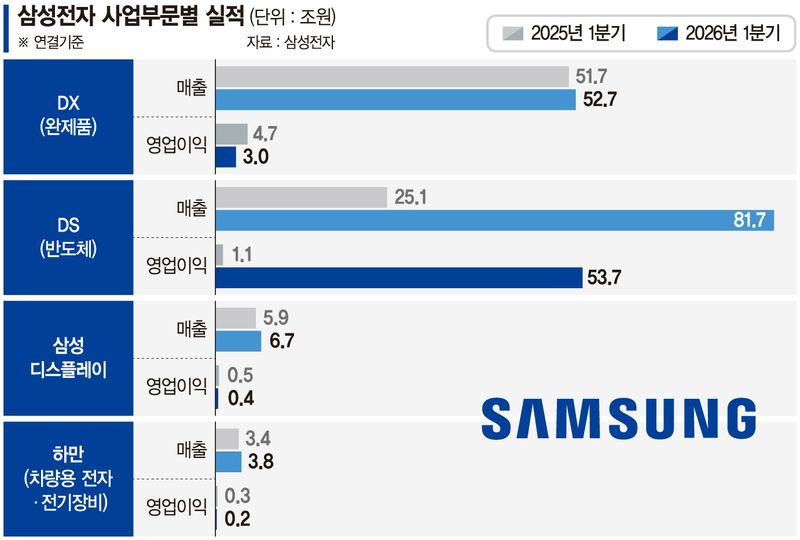
Samsung Electronics Co., Ltd.'s Device eXperience (DX) Division, which makes home appliances, TVs and smartphones, is effectively in a phase of business restructuring. While the semiconductor business posted the highest quarterly results in company history, driven by an overwhelming 94% contribution, the other half of Samsung Electronics Co., Ltd.'s business, including home appliances and other finished goods, only barely managed to stay in the black.
Tensions are also rising internally as one of Samsung Electronics Co., Ltd.'s two wings appears to be faltering. Analysts say that if the company accepts the semiconductor workforce's demand for a performance bonus system based on operating profit, friction and dissatisfaction between the semiconductor and non-semiconductor units will inevitably intensify.
■ The widening gap between Samsung's two wings
According to Samsung Electronics Co., Ltd.'s finalized first-quarter results released on the 30th, the DX Division posted sales of 52.7 trillion won and operating profit of 3 trillion won. Sales rose 2% from a year earlier, but operating profit plunged 36.1%. By contrast, the Device Solutions Division recorded sales of 81.7 trillion won and operating profit of 53.7 trillion won, up 225% and 4,727.2%, respectively, over the same period, showing that the gap between the two divisions has widened sharply. Just a year ago, the situation was the opposite. In the first quarter of last year, the DX Division posted operating profit of 4.7 trillion won, more than four times the Device Solutions Division's 1.1 trillion won. But with the industry rapidly reorganizing around artificial intelligence (AI) over the past year, the picture has completely reversed. In addition to weaker demand, higher raw material costs, including memory chips used in finished products, also hurt DX Division profitability.
The gap between the two divisions is expected to widen further for now. Kim Jae-jun, vice president of Samsung Electronics Co., Ltd.'s memory business, expressed confidence, saying that customers worried about supply shortages are already placing orders for next year's demand in advance. However, Kim Won-woo, an executive at the Visual Display Business Division (VD), said, "With raw material prices rising this year and the external business environment remaining uncertain, it is not easy to secure results and profitability."
Organizational changes aimed at improving the DX Division's fundamentals are also gaining pace. Following cuts to its Japan operations, Samsung Electronics Co., Ltd. has effectively halted sales of home appliances and TVs in China, further strengthening its strategy of "selection and concentration." It is also slimming down its organization by reassigning some VD Division staff to subsidiaries. There are also calls for new businesses, including humanoid robots, to deliver tangible results.
■ Labor tensions deepen amid a memory boom
The strong memory market is expected to continue for some time. In particular, as the AI market shifts from "training" to "inference," demand for general-purpose memory such as server DRAM is rising rapidly.
Samsung Electronics Co., Ltd. is also accelerating its monetization strategy for next-generation memory, including HBM. All of the HBM4 chips it shipped for the first time in the world in February were sold, and the company plans to significantly expand supply in the second half of the year. Vice President Kim said, "HBM4's differentiated performance has drawn concentrated customer demand, so all of the production volume we prepared has been sold," adding, "More than half of total HBM sales will come from HBM4 starting in the third quarter." Samsung Electronics Co., Ltd. is also speeding up preparations for related businesses by shipping samples of HBM4E, the next-generation product, in the second quarter.
The non-memory semiconductor segment, often described as Samsung Electronics Co., Ltd.'s weak spot, is also expected to have narrowed its losses. It posted an operating loss of more than 200 billion won in the first quarter of last year, but this year's deficit is projected to have shrunk to around 100 billion won. Kang Suk-chae, vice president in charge of Samsung Electronics Co., Ltd.'s foundry business, said, "Utilization at our advanced process lines has now reached the maximum level," and added, "We are in discussions with major clients on 2-nanometer cooperation, and we will secure concrete results in the near future."
As the gap between business divisions widens, conflict over the performance-based compensation system is also intensifying. The labor union is demanding that 15% of annual operating profit be distributed with weights applied by division and business unit. With the operating profit gap between the DS and DX divisions widening, there are concerns that if this demand is accepted, the difference in bonus payouts by division could become astronomical.
[email protected] Jung Won-il, Im Su-bin Reporter