Regular workers earn 1 million won while non-regular workers earn 650,000 won: wage gap returns to 10-year high
- Input
- 2026-04-30 18:34:03
- Updated
- 2026-04-30 18:34:03
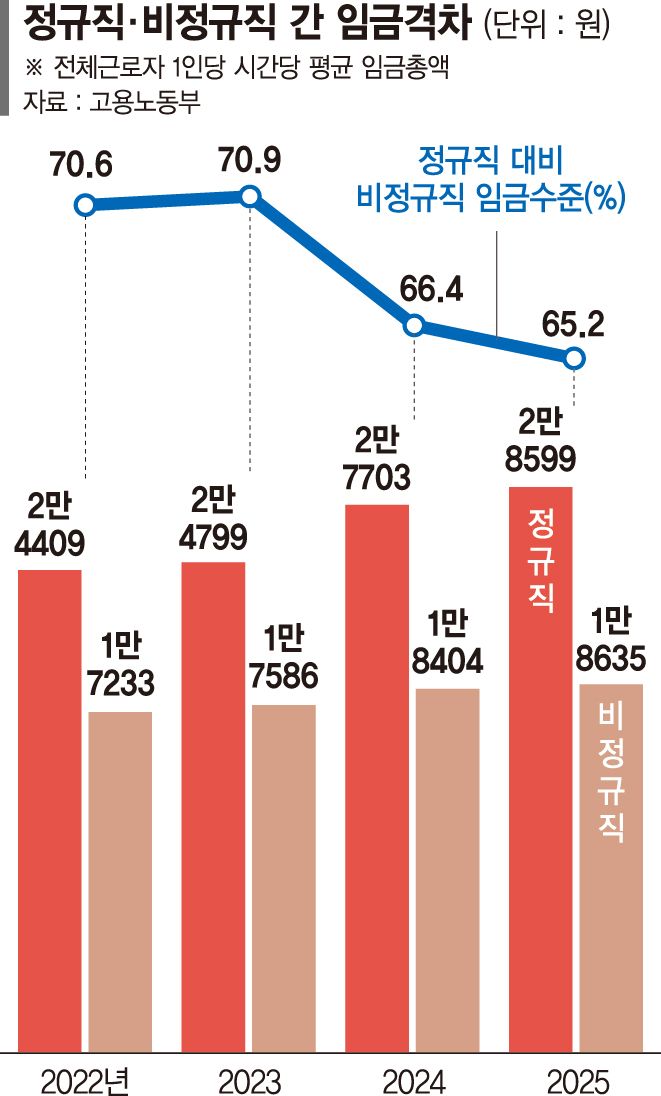
According to the results of the Survey on Labor Conditions by Employment Type, excluding special-type workers, released by MOEL on the 30th, the average hourly wage for all workers stood at 25,839 won in June last year, up 2.7% from a year earlier. The increase, however, was much stronger for regular workers than for non-regular workers. Hourly wages for regular workers rose 3.2% to 28,599 won. By contrast, non-regular workers earned 18,635 won per hour, up only 1.3%. That was below the 2.2% inflation rate over the same period. Over the past three years, hourly wages for regular workers have risen by nearly 4,000 won, while those for non-regular workers have increased by about 1,000 won, widening the gap from around 7,000 won to nearly 10,000 won.
Jeong Hyang-suk, director of the Labor Market Research Division at MOEL, explained, "The increase centered on part-time workers, women, people aged 60 and older, and health and social welfare jobs, driven by aging, tends to pull down wages for non-regular workers." She added, "The picture looks very different depending on employment type."
The hourly wage level of all non-regular workers compared with all regular workers fell to 65.2%, returning to the level seen 10 years ago. In other words, when a regular worker earns 1 million won, a non-regular worker earns only 652,000 won. The previous peak gap was recorded in 2015, when the ratio stood at 65.5%. It then remained in the mid-to-high 60% range before peaking at 72.4% in 2020. The ratio stayed in the 70% range through 2023, but fell to 66.4% in 2024, and the decline continued last year.
Jeong added, "If the government’s proposed fair allowance is paid, wages for non-regular workers are expected to improve."
The wage gap also widened by company size. Using the wage level of regular workers at companies with 300 or more employees as 100%, non-regular workers at those companies earned only 61.1% of that amount, down 1.3 percentage points from a year earlier. Regular workers at companies with fewer than 300 employees stood at 58.9%, up 1.2 percentage points, while non-regular workers at smaller firms remained at 41.5%.
Meanwhile, the share of low-wage workers, defined as those earning less than two-thirds of the median wage, improved slightly to 15.8%, down about 0.3 percentage points.
Other indicators, including working hours, union membership rates, retirement pension enrollment rates, and bonus payment rates, all improved.
Average monthly working hours were 162.1 hours for regular workers and 104.8 hours for non-regular workers. Regular workers saw a decline of six minutes, while non-regular workers worked one hour less. The overall union membership rate rose 0.5 percentage points to 10.2%. By employment type, the rate was 13.7% for regular workers and 1.2% for non-regular workers.
The retirement pension enrollment rate and the bonus payment rate, or expected payment rate, stood at 52.8% and 53.7%, respectively, with both regular and non-regular workers posting slight improvements.
[email protected] Kim Jun-hyeok Reporter