[Tech Odyssey by Kim Do-yeol] The First Dream of Artificial Intelligence and Its Fall
- Input
- 2026-05-02 07:00:00
- Updated
- 2026-05-02 07:00:00
Rosenblatt declared with confidence, "This machine will soon walk on its own, speak, read, and even recognize its own existence." The New York Times (NYT) ran a bold headline, saying the Navy had unveiled the embryo of a self-thinking machine. People dreamed of the day when robots that think exactly like humans would take over their living rooms.
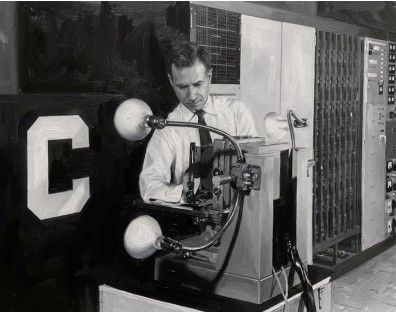
The Perceptron was special because of its structure. At the time, most computers followed rules entered by humans one by one. The Perceptron was different. Like human neurons exchanging electrical signals and learning from them, it searched for the correct answer within its own internal network. Even when it made mistakes at first, it gradually adjusted the strength of its circuit connections with each error until it could finally recognize a square. Rosenblatt believed this simple principle could be expanded without limit.
But that brilliant optimism collapsed in an unexpected place. Marvin Minsky, another genius in the field of AI and Rosenblatt's high school classmate, stepped in to halt it. In 1969, Minsky and a colleague published a book that proved the mathematical limits of the Perceptron. The problem they posed was simple: the exclusive OR (XOR) problem. The Perceptron could not solve this logical structure, which even a child could understand. Minsky delivered a blunt verdict: "Research on neural networks has reached a dead end and is no longer worth pursuing."
That was effectively a death sentence for the Perceptron. Governments and companies that had funded the research all pulled back at once, and AI research labs shut their doors. Even using the word "neural network" in a paper became taboo. The first generation of AI researchers were suddenly branded as people studying fake science. This period is known as the AI winter. Rosenblatt, the father of the Perceptron, watched his dream collapse and died in a tragic accident in 1971.
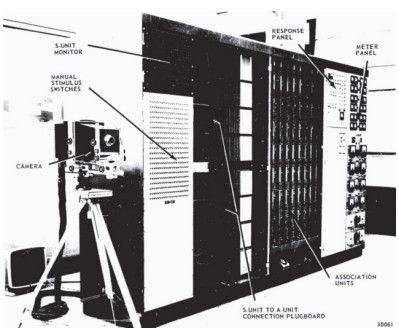
But even in a harsh winter, trees do not give up on spring. Even on barren ground where public attention and state support had vanished, some scientists quietly kept hold of their thoughts in lonely laboratories. That blind yet noble belief later became the invisible force behind the great revival known as Deep learning.
The Perceptron was not a failure. It simply appeared too early and carried too much expectation. Inside the AI technologies we use every day today are the very ideas that were once discarded more than 60 years ago. The technology did not disappear; it was simply waiting until the world was ready.
The Perceptron was not a failure. It simply appeared too early and carried too much expectation. Rosenblatt never lived to see his dream vindicated. Yet at the heart of the AI technologies we use every day, the very ideas he designed overnight in a cold laboratory are still alive. The technology did not disappear. It was only waiting quietly until it was ready. And at last, we are now entering that spring.
Kim Do-yeol, Director of Media Strategy, Webcash Group