[Editorial] Bonus Pay Disputes Spread, President Lee Criticizes “Excessive Demands”
- Input
- 2026-04-30 18:07:35
- Updated
- 2026-04-30 18:07:35
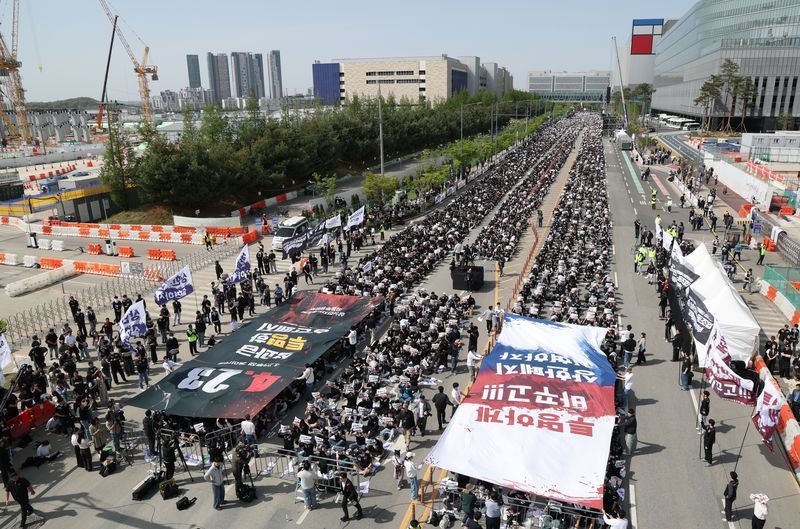
The bonus pay dispute that began at SK Hynix, Samsung Electronics, and Hyundai Motor Company is now surfacing at other firms as well. Hanwha Aerospace Co., Ltd. and LG Uplus Corp. have also asked management to increase bonuses. The LG Uplus union is demanding 30% of operating profit, while Hanwha Aerospace is calling for the abolition of the bonus cap.
What started as a bonus issue at a few highly profitable large companies is not ending there. It is spreading across society and deepening labor-management conflict. In particular, with the Yellow Envelope Law now in force, subcontractor unions have gained a channel to demand negotiations from prime contractors, and they too appear to be joining the push for bonus pay.
Workers at a partner company at the SK hynix Cheongju Plant said on the day that they would seek direct talks with the prime contractor, demanding an end to discriminatory bonus payments for subcontracted workers. The bonus issue is not only fueling labor-management conflict; it is also stoking conflict between workers. It is unlikely that a prime contractor union would welcome such demands from a subcontractor union.
At a senior aides meeting that day, President Lee said, "It is not about only saving myself. We need a sense of responsibility and solidarity to build a society where all workers and all citizens can live together." He added, "I hope everyone will think of the fact that within every family, some are workers and some are employers, and that in a broader sense, we are all members of the same Republic of Korea (ROK), and try to see things from one another's perspective."
It would be fortunate if the bonus issue ended with a few semiconductor companies enjoying strong business conditions. But reality is different. Many companies set bonus caps, as Samsung Electronics does, limiting them to within half of annual salary. That makes it likely that unions at many firms will push to abolish those caps. If subcontractor unions also demand their share, prime contractors will face uncontrollable confusion and damage.
For companies, there would be little reason to strive for higher profits. Even if they earn more, the money would not necessarily go toward future investment; it would simply flow out in bonus payments. Faced with union power backed by the threat of strikes, companies and owners have few effective ways to respond. They cannot simply shut down operations, yet they also cannot stand by while a strike threatens massive losses. It is a deadlock.
There is nothing wrong with President Lee's point. He was highlighting the fact that members of so-called "elite unions," who already receive annual salaries in the hundreds of millions of won, can create a sense of unfairness and cause harm not only to other workers but to the public as a whole by making unreasonable demands that go beyond common sense.
May 1 is International Workers' Day. It is a commemorative day established to promote workers' rights and welfare. Workers are not only the members of unions at a handful of top-tier companies. They should ask themselves whether they are even slightly considering coexistence and fairness with other workers. They must abandon the selfish idea that only their own prosperity matters. If companies survive, unions survive too. Before that, they should think about the national economy and the country's future development.