For the Class of 2028, SNU cuts regular-admission share to 15.6% and Yonsei to 19.6% ... "Managing school grades will be key"
- Input
- 2026-04-30 12:59:21
- Updated
- 2026-04-30 12:59:21
\r\n[Financial News] In the 2028 college admissions cycle, which current high school sophomores will take, the share of early admissions has climbed above 80%, reaching an all-time high. As SNU has said it will also increase the weight of school grades in regular admissions starting in 2028, choosing the right high school and managing grades are expected to become even more important.
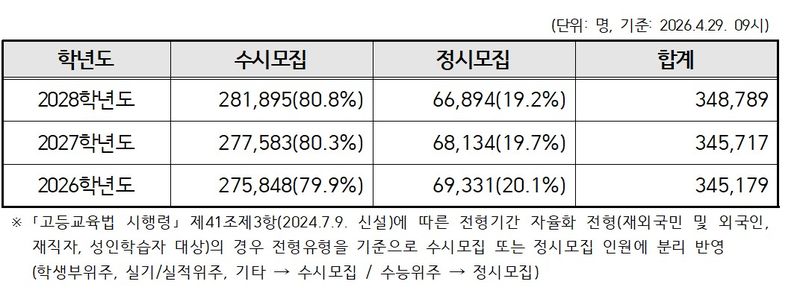
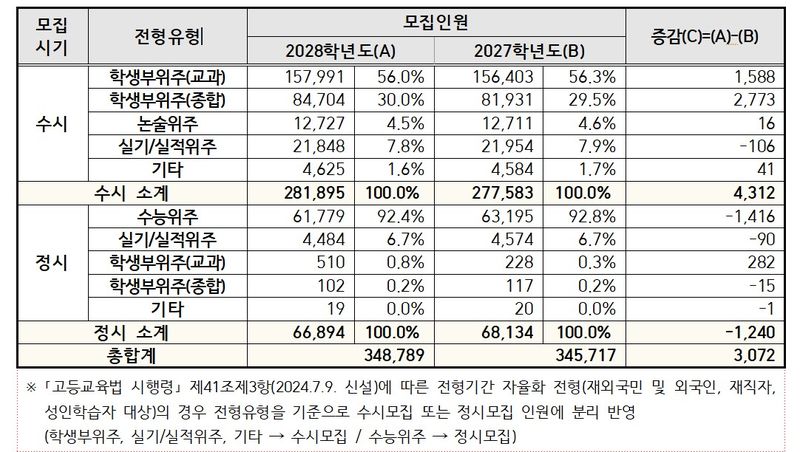
On the 30th, KCUE said it had compiled the 2028 admissions plans of 194 universities nationwide. Total enrollment stands at 348,789, up 3,072 from the previous year. Of that, early admissions account for 281,895 students, or 80.8%, up 4,312 students, or 0.5 percentage point, from a year earlier. Regular admissions total 66,894 students, or 19.2%, down 1,240 students, or 0.5 percentage point.
The share of early admissions has risen steadily from 75.7% in the 2022 admissions cycle to 78.0% in 2023, 79.0% in 2024, 79.6% in 2025, and 79.9% in 2026. In 2028, it will exceed 80% for the first time.
The shift is even more pronounced at top universities. SNU's regular-admission quota for 2028 is 1,307 students, down 242, or 15.6%, from the previous year, lowering its share to 34.3%. Yonsei University will admit 1,355 students through regular admissions, down 331, or 19.6%, bringing its share to 33.8%. Korea University, by contrast, cut its quota by just 3 students, or 0.2%, to 1,867, keeping its share at around 40.0%.
As a result, the regular-admission quota at the three universities combined will fall by 576 students, or 11.3%, from 5,105 to 4,529.
Changes are also visible within early admissions. Among early-admission slots, student-record-based screening accounts for 86.0%, up 4,628 students from a year earlier. The share of school-record screening has fallen from 16.0% to 15.6%, while comprehensive screening has expanded from 69.2% to 71.7%. In other words, the system is placing greater weight not only on grades but also on extracurricular activities and document reviews.
In regular admissions, CSAT-based screening accounts for 92.4%.
The admissions cycle will also introduce major system changes. Starting in 2028, the integrated CSAT without subject choices will be implemented for the first time, and school grades will be converted from the current nine-tier system to a five-tier system. The high school credit system will also be fully applied.
The admissions industry sees the changes as a shift toward a school-grade-centered structure. With SNU expanding the role of grades even in regular admissions, analysts say the importance of grade management has increased regardless of whether students apply through early or regular admissions. If some universities keep a minimum CSAT requirement, a structure may emerge in which students must meet standards in grades, documents, and the CSAT all at once.
Jongro Academy said, "In the 2028 college admissions cycle, the five-tier grade system, CSAT reform, and full implementation of the high school credit system will sharply increase the weight of school grades," adding, "For top universities in particular, the importance of document screening has also risen alongside school grades." It continued, "Applicants should first and foremost manage their school grades thoroughly," and "They must recognize that opportunities for regular admissions through the CSAT have narrowed at top universities."
\r\nIn medical school admissions, the quota for the regional talent special track fell by 103 from a year earlier to 1,147, while the regional physician selection track rose by 122 to 610. Combined, the two tracks increased by 504 students year on year.
Within social-integration admissions, the quota for opportunity-balanced admissions rose by 428 from a year earlier to 37,752, while the regional-balanced quota at universities in the Seoul metropolitan area increased by 724 to 15,263.
Lim Seong Ho, head of Jongro Academy, said, "As top students who receive multiple offers in early admissions move on to other schools, there is a growing chance that regional universities will fail to fill their early-admission quotas." He added, "Some universities may end up shifting a significant number of students into regular admissions, regardless of their early-admission share." He also said, "Students who are strong in both grades and the CSAT may have an advantage," and "If a minimum CSAT requirement is imposed, they may need to satisfy grades, documents, and the CSAT all at once."
\r\n
spring@fnnews.com Lee Bo-mi Reporter