Hanwha Engine Takes Aim at 300 Billion Won in Sales by Entering U.S. Data Center Power Business: Korea Investment & Securities
- Input
- 2026-05-01 05:59:00
- Updated
- 2026-05-01 05:59:00
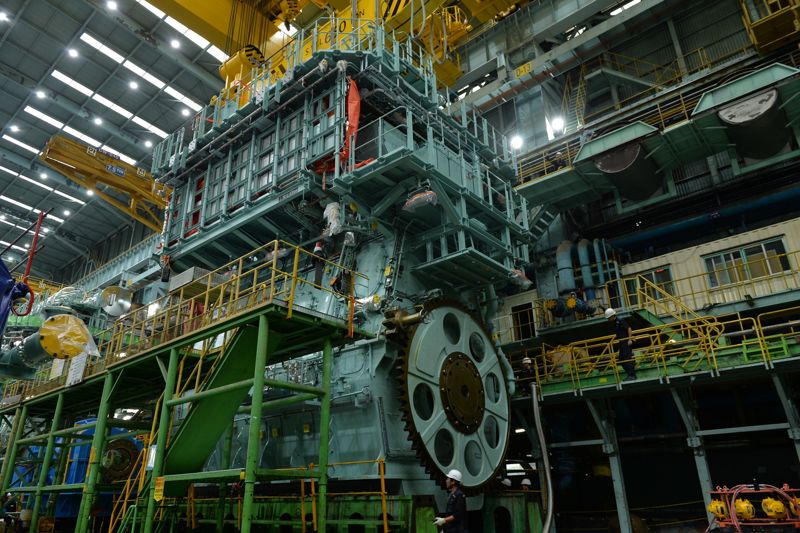

[Financial News] Hanwha Engine is moving beyond its core ship engine business and stepping up its entry into the U.S. data center power generation market, aiming to surpass 3 trillion won in annual sales by 2027. The shift is becoming more concrete as Hanwha Energy, a group affiliate, signs long-term power purchase agreements (PPAs) with U.S. hyperscalers, while Hanwha Engine supplies subsidiary engines for behind-the-meter (BTM) power plants.
Hanwha Energy signs long-term PPA with hyperscalers... a 'game changer'
According to Korea Investment & Securities on the 1st, the key to Hanwha Engine's entry into the U.S. data center power business is the role of Hanwha Energy. Hanwha Energy is signing long-term PPAs with hyperscalers such as Microsoft Corporation, Meta Platforms, and Google. It is also pursuing a strategy to build its own BTM power plants near data center sites.
The BTM model installs power-generation facilities directly inside or near the data center site, rather than routing electricity through the utility grid. As power demand from AI data centers in the United States surges and existing transmission and distribution capacity reaches saturation, hyperscalers are increasingly adopting BTM as an alternative way to secure electricity. U.S. data center power demand is projected to rise about 197% from 2025 to 2030, reaching a record 95 GW. In this structure, Hanwha Energy handles power sales as the PPA counterparty, while Hanwha Engine supplies four-stroke medium-speed subsidiary engines to the plants, creating an in-group value chain.
Hanwha Engine will resume production of four-stroke medium-speed engines, which it halted in 2016 due to deteriorating profitability, after about 10 years. The company is investing with the goal of starting production facilities in 2027. Its four-stroke medium-speed engines will be produced through OEM manufacturing based on a license from Everllence (formerly MAN Energy Solutions), a global engine licensing company.
Kang Kyung-tae, a researcher at Korea Investment & Securities, said, "Hanwha Engine's strength is that it can more easily build a market entry track record by linking with the power businesses of group affiliates such as Hanwha Energy." He added, "The company can provide a total solution that goes beyond simple engine manufacturing to include power plant EPC and operations."
Sales of four-stroke medium-speed engines for data centers are set to accelerate
Korea Investment & Securities estimated Hanwha Engine's annual sales at 1.683 trillion won in 2026, 2.831 trillion won in 2027, and 2.983 trillion won in 2028. Operating profit is projected at 248 billion won in 2026, 454 billion won in 2027, and 498 billion won in 2028. The 68% year-on-year jump in sales in 2027 reflects not only the continued pricing effect of existing two-stroke low-speed ship engines, but also the full-scale contribution from data center-related four-stroke medium-speed engine sales.
The improvement in operating margin from 14.7% in 2026 to 16.7% in 2028 is attributed to a larger share of high-value-added engines and the strong profitability of the data center power business.
The market for engines used in U.S. data center power generation is already seeing full-scale global competition. Finland's Wärtsilä signed a contract this year to supply 40 gas engines with a combined capacity of 412 MW to a hyperscale data center in Ohio. HD Hyundai Heavy Industries (HHI) also recently entered the U.S. data center market for the first time, winning a 627.1 billion won contract to supply power-generation equipment. HHI will provide its large medium-speed engine, HiMSEN, as part of the data center power infrastructure.
Hanwha Engine's core ship engine business is also maintaining steady growth. The company plans to deliver 120 two-stroke low-speed engines in 2026, and the average price of engines delivered in the first quarter rose sharply year on year to 9.1 billion won per unit. Kang Kyung-tae said, "The upward trend in ship engine prices will continue through 2028," adding that "the Shipbuilding Supercycle and rising demand for eco-friendly dual-fuel engines are structural factors behind the price increase."
As capital expenditures expand by about 25% in both 2024 and 2025, production capacity is also steadily increasing. Analysts say this has laid the foundation for stable execution of the order backlog and further sales growth.
[email protected] Kang Gu-gwi Reporter