"Why not? The landlord is offering it at half the market price" [Jip Nawara Ttukttak!]
- Input
- 2026-05-01 06:00:00
- Updated
- 2026-05-01 06:00:00

[The Financial News] Purchased rental housing, in which the public buys existing homes in prime urban locations and rents them out below market rates, is drawing strong interest from young people and newlyweds. The main appeal is that public institutions such as Korea Land and Housing Corporation (LH) and Seoul Housing & Urban Development Corporation (SH Corporation) become the landlords, eliminating concerns over jeonse fraud and significantly easing the burden of deposits and rent.
According to the industry on the 30th, this year's nationwide supply of purchased rental housing will total about 26,000 households, up 1,000 from a year earlier. More than half of that, or 14,000 households, will be concentrated in the Seoul metropolitan area, including Seoul, and 12,000 households are scheduled to be supplied in the first half alone.
Looking at the three categories — young people, newlywed and newborn Type I, and newlywed and newborn Type II — young people’s purchased rental housing is available for up to 10 years at 40% to 50% of market rent. It is open to unmarried, asset-free people aged 19 to 39, including college students and job seekers. Applicants qualify as long as they themselves do not own a home, regardless of whether their parents do. They are divided into first, second and third priority groups based on income and asset standards.
An analysis of subscription results in Seoul last year showed fierce competition for homes with two-room layouts or strong infrastructure, such as properties near subway stations, where more than 50 first-priority applicants crowded in. By contrast, homes far from business districts or with smaller floor areas had only one first-priority applicant. If your top goal is simply to win, targeting less popular homes with weaker transit access or smaller sizes can improve your odds.
Newlywed and newborn purchased rental housing is designed for newlywed couples and households with newborns who do not own a home. It is divided into Type I and Type II depending on income standards and housing type. In both categories, households with newborns born within the past two years are given first priority, making the program favorable for families expecting a child or raising an infant.
Newlywed and Newborn Type I is supplied at 30% to 40% of market rent and is mostly offered in multi-family or small multi-household homes, such as villas. The income requirement is no more than 70% of the average monthly income per urban worker household, or 90% for dual-income couples. Asset limits are 345 million won, and vehicle value must be 45.42 million won or less, although the standards are relaxed depending on the number of children.
In Seoul, Newlywed and Newborn Type II, supplied through SH's Mirinae House public housing program, is priced at 70% to 80% of market rent. The deposit burden is somewhat higher, but the program stands out because it includes newly built apartments and high-end officetels. The income cap is 130% of the average monthly income per urban worker household, or 200% for dual-income couples, while the asset limit is 362 million won. There is no limit on vehicle value, but it should be noted that the value of a car is included in total assets.
Looking at last year's recruitment results for the newlywed and newborn categories, supply volume appears to be a key factor. Complexes that offered just one unit saw competition surge to as high as 103-to-1, while a complex that supplied 209 units recorded a much lower 4.8-to-1 ratio. Applying to larger developments can be a way to avoid competition and raise the chance of winning.
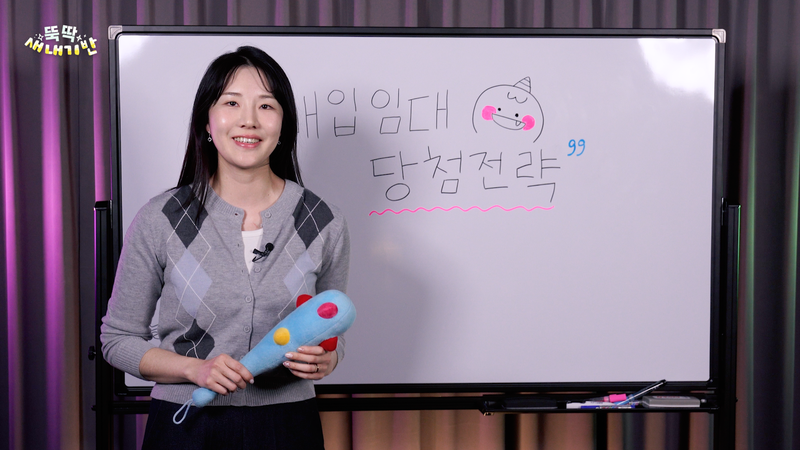
More details can be found on the YouTube channel Jip Nawara Ttukttak!
[email protected] Jeon Min-kyung Reporter