Coupang Faces Expanded Disclosure Duties and Self-Dealing Rules, Raising Concerns Over Diplomatic Tensions With the U.S. [Bom Kim Designated as Coupang’s Controlling Shareholder]
- Input
- 2026-04-29 18:32:36
- Updated
- 2026-04-29 18:32:36
Concerns are also growing that the latest change could fuel diplomatic friction between South Korea and the United States, especially after members of the U.S. House of Representatives recently formally demanded that authorities "stop attacking U.S. companies like Coupang."
■ From corporation to controlling shareholder: regulations take effect
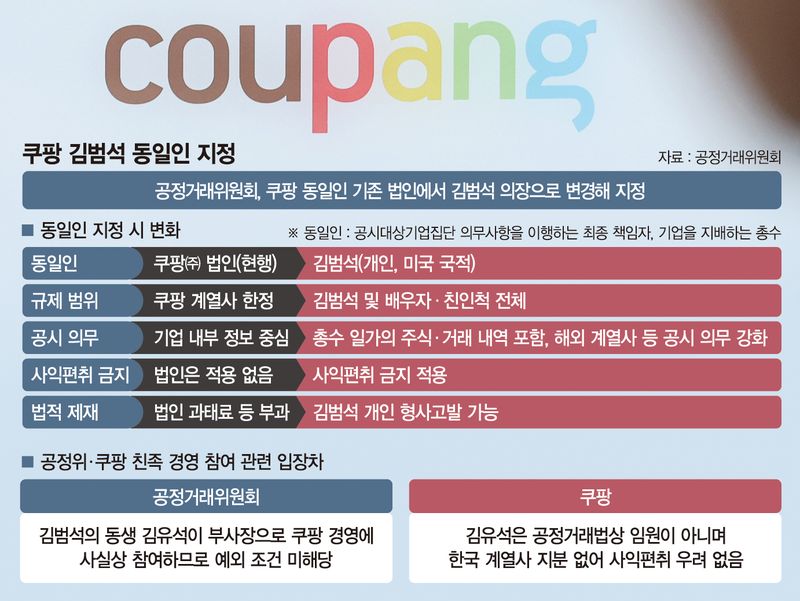
According to industry sources on the 29th, Coupang had previously been recognized as having a corporate entity as its controlling shareholder, allowing it to avoid regulations tied to controlling-shareholder designation. With this change, however, it has been converted into a "group with a controlling shareholder," and Kim will now bear direct responsibility for submitting designation materials and disclosure documents related to the corporate group. Transactions with special related parties will also fall under self-dealing regulations.
The key point is that the disclosure standard has shifted from a "corporation" to an individual controlling shareholder. As the corporate group is redefined around Kim himself and his relatives, the scope of disclosure will expand. As a result, Coupang will now have to disclose once a year the general status and shareholder structure of overseas affiliates in which Kim and his relatives together hold a certain level of ownership.
Self-dealing rules will also apply. These rules restrict controlling families from using affiliates to provide business opportunities or financial support to related companies on favorable terms. With Kim now designated as the controlling shareholder, Coupang said related transactions will also be subject to regulation and review by the KFTC.
By changing the controlling-shareholder designation, Coupang now faces a broader regulatory scope that includes not only expanded disclosure obligations but also the controlling shareholder’s family members.
Back Kwang-hyun, an attorney at Barun Law LLC specializing in fair trade, said, "As transactions with companies involving relatives are now included in the disclosure requirements, demands for transparency in internal transactions will become much stronger." He added, "Transactions with companies owned by the controlling family will be directly subject to self-dealing rules, so they are more likely to be deemed illegal than ordinary internal transactions." He explained, "Although this may appear to be only an expansion of disclosure obligations, in reality it brings the entire controlling family into the regulatory scope." He continued, "Because transactions with family-related companies that were not previously disclosed may now have to be reported, the burden of disclosure management will inevitably grow, and violations of disclosure duties could lead to sanctions."
■ Coupang calls it "double regulation" and signals administrative litigation
Coupang immediately pushed back against the KFTC’s decision, arguing that the agency had forced through the controlling-shareholder change despite the company’s transparent governance structure.
Coupang said, "Coupang, Inc., our U.S. parent company, owns 100% of the Korean Coupang entity, and Korean Coupang also owns 100% of its subsidiaries and sub-subsidiaries, so there is no risk of self-dealing at all." It added, "Bom Kim and his relatives do not hold any shares in Korean affiliates."
The company also argued that the designation amounts to "double regulation," saying, "As a U.S.-listed company, we already comply with the SEC’s disclosure requirements for related parties." It said the controlling-shareholder system was designed to prevent self-dealing by conglomerates and is not suitable for a multinational company with a 100% ownership structure.
Coupang is also concerned that its global governance structure could cause the regulatory scope to expand excessively. If other CEOs serving on the board of the U.S. headquarters are also classified as related persons to the controlling shareholder, companies they are involved with could also become subject to disclosure requirements.
In addition, the move came shortly after 54 members of the U.S. House of Representatives sent a public letter to Kang Kyung-wha, Ambassador of South Korea to the United States, urging the South Korean government to stop its "Coupang crackdown," raising the possibility that the issue could escalate into a diplomatic dispute.
clean@fnnews.com Lee Jeong-hwa Reporter