Oil Alliance in Turmoil... "Oil Prices Face Short-Term Gains, Medium- to Long-Term Downward Pressure" [Major Shift in the Global Oil Market]
- Input
- 2026-04-29 18:31:46
- Updated
- 2026-04-29 18:31:46
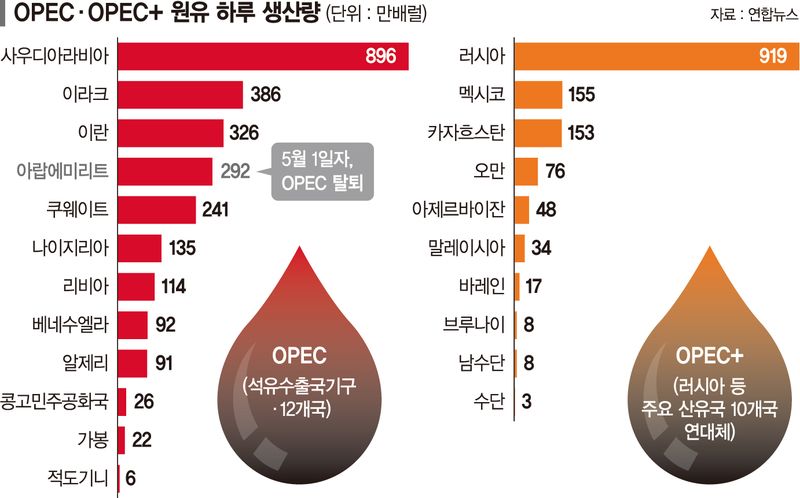
Because U.S. President Donald Trump has repeatedly criticized OPEC's price-setting structure, which relies heavily on production cuts, analysts say the UAE's announcement could accelerate structural changes in the global crude market. International oil prices are likely to face only limited short-term effects, but over the medium to long term, downward pressure may grow as supply competition intensifies.
■ Short-term high oil prices, long-term downward pressure
On the 28th local time, the UAE announced its withdrawal from OPEC at a meeting in Jeddah, Saudi Arabia, where Gulf Cooperation Council (GCC) countries had gathered to discuss responses to the Iran War. OPEC is an organization created by oil-producing countries to manage international oil prices by adjusting output, and it currently has 12 member states. The UAE is the third-largest producer within OPEC, after the Kingdom of Saudi Arabia and Iraq. Saudi Arabia produces 9 million to 10 million barrels per day, Iraq 4 million to 4.5 million barrels, and the UAE 3 million to 3.5 million barrels. The UAE accounts for about 12% of OPEC's total production.
In the short term, the impact of the Strait of Hormuz blockade is likely to limit any supply increase, keeping international oil prices firm. Gulf crude exports are being constrained by disruptions to shipping through the strait, so even if the UAE raises output, there are limits to how much exports can actually expand. In the medium to long term, however, downward pressure on oil prices could increase. Once traffic through the Strait of Hormuz returns to normal, the UAE would have room to boost production to more than 4.5 million barrels per day, beyond its current quota.
The bigger variable is the weakening cohesion within OPEC. The UAE's departure, as a key oil producer, raises the chance that other members may also leave and could undermine compliance with production-cut agreements. Market watchers say Brent Crude Oil will likely remain above $100 per barrel in the short term, but after the war ends and normal traffic resumes through Hormuz, prices may gradually turn lower as expectations for higher supply build.
■ The rift widened by the Iran War
For years, the UAE has steadily challenged Saudi Arabia's leadership in the Middle East in terms of economic and energy influence. In particular, it has focused on diversifying its economy by accelerating the development of Finance, Tourism, Logistics, and Artificial Intelligence (AI) industries to reduce its dependence on oil. As a result, it is seen as having built an economic structure that can withstand low oil prices, unlike Saudi Arabia's high-price-dependent model. Saudi Arabia, meanwhile, is pushing industrial diversification under Saudi Vision 2030, but its state finances and growth remain heavily dependent on oil prices.
That difference has also shaped the two countries' oil policies. "Saudi Arabia aims to preserve its dominance in the oil market for the next 100 years, but the UAE feels far less urgency," one observer noted. The war between the United States and Iran has widened the gap between the UAE and Saudi Arabia even further. Since the outbreak of the war, the UAE is considered the country that has suffered the most direct attacks from Iran. Over the month from the 28th of last month to the 28th of this month, 2,256 drones and 563 missiles fell on the UAE, putting it on the front line of the conflict.
Through this experience, the UAE has come to see the limits of a regional collective security system. According to The Wall Street Journal (WSJ), UAE government officials have openly expressed frustration with multilateral responses in the region. The implication is that they had expected a tougher and more consistent joint response to Iran, but reality fell short.
In the end, analysts say the UAE has come to believe that cooperation with a real security provider matters more than traditional Arab solidarity. The Kingdom of Saudi Arabia is expanding ties with China and Russia to reduce dependence on the United States, while the UAE is strengthening technological and military cooperation by normalizing relations with Israel through the Abraham Accords.
[email protected] Reporter