Refiners say UAE output increase could expand crude supply and diversify supply chains
- Input
- 2026-04-29 18:31:44
- Updated
- 2026-04-29 18:31:44
Refiners expect global crude supply to rise if the UAE moves beyond production limits and increases output. However, tensions around the Strait of Hormuz remain high, so any short-term improvement in supply is likely to be limited. Some also warn that the weakening of the OPEC framework could increase market uncertainty over the medium to long term.
According to industry sources on the 29th, the UAE's minister of energy and infrastructure said with the withdrawal decision that the country had secured flexibility by escaping the production obligations of OPEC and OPEC+ and expressed its intention to boost oil output.
That has led to expectations in South Korea that the move could translate into actual production growth and a larger supply. Analysts say that if the UAE raises output, other oil-producing countries may also step up production in response, putting downward pressure on international oil prices.
Kim Tae-hwan, head of the Oil Policy Research Office at the Korea Energy Economics Institute, said, "The UAE has long wanted to leave OPEC because it has the largest spare production capacity among OPEC members, and the Iran war appears to have been the catalyst." He added, "For now, the war is still ongoing, so it is not easy to expand supply in the short term. But if Saudi Arabia and the UAE enter a competitive relationship over the medium to long term, that would be favorable for us."
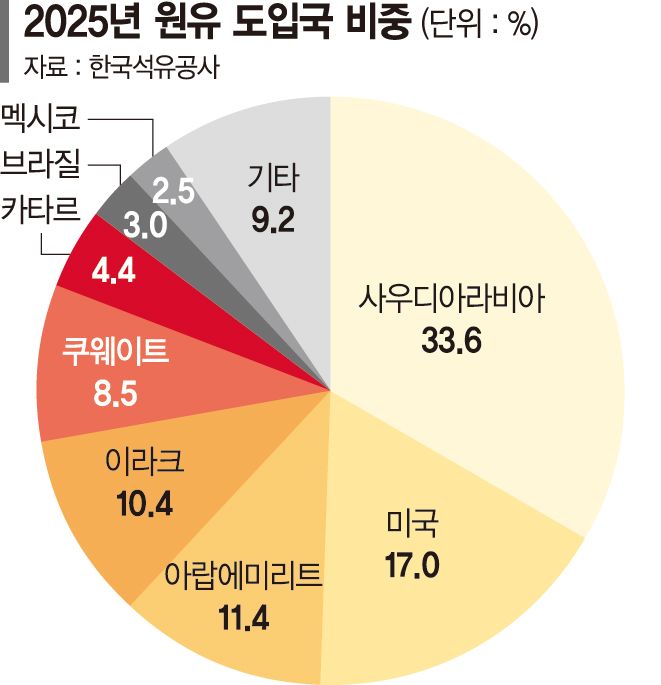
Based on last year's crude oil import shares, the Kingdom of Saudi Arabia ranked first at 33.6 percent, followed by the United States at 17.0 percent and the United Arab Emirates at 11.4 percent.
An industry official said, "As the UAE's decision raises the likelihood of increased production, it is positive from the perspective of crude oil consumers." The official added, "In particular, South Korea maintains close ties with the UAE, so import volumes could rise further." Following the outbreak of the Iran war early last month, the UAE promised to supply South Korea with 24 million barrels of crude oil.
The fact that the UAE can export crude oil through a pipeline connected to the Port of Fujairah without passing through the Strait of Hormuz is also seen as a competitive advantage. A Korea Petroleum Association official said, "As the Iran war has heightened risks in the Strait of Hormuz, non-Hormuz countries that can export oil without using the strait will want to take advantage of that."
However, as tensions in the Middle East drag on, the possibility remains that unexpected developments could disrupt production increases or transportation. Limits in pipeline capacity, port infrastructure and vessel availability also make it difficult to sharply raise export volumes in the short term. The structural changes brought by the UAE's withdrawal are another burden. If leadership competition intensifies between Saudi Arabia and the UAE, both key pillars of OPEC, the already unstable Middle East situation could worsen further. There are also concerns that unpredictable variables in the process could deliver additional shocks to the market.
Overall, the UAE's exit from OPEC is seen as a factor that could push oil prices down by encouraging higher production, but a breakdown in the output-cut agreement could also fuel market anxiety and trigger a short-term price spike.
An industry official said, "Unless the Middle East situation is fully resolved, it will not be easy to ease supply concerns in the short term." The official added, "The UAE would also need to expand facilities to increase crude supply through the Port of Fujairah, so it will take time before this leads to a meaningful increase in actual crude supply."
[email protected] Park Shin-young Reporter