14 by-elections confirmed as Democratic Party races to nominate candidates, while People Power Party faces a hiring crunch
- Input
- 2026-04-29 18:28:46
- Updated
- 2026-04-29 18:28:46
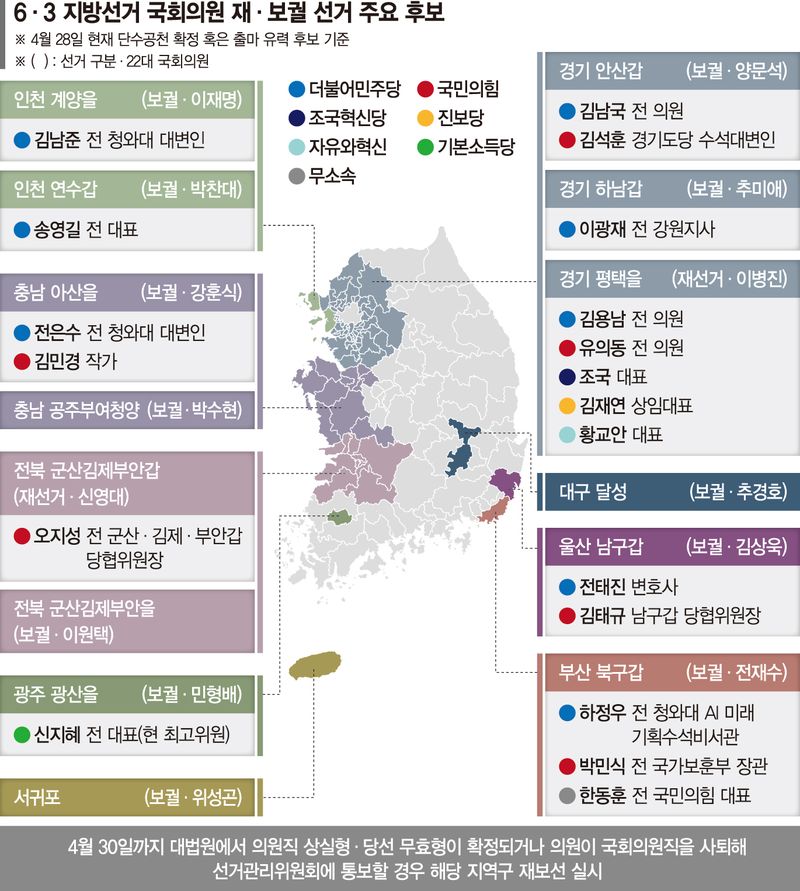
The nine lawmakers who gave up their seats to run in the local elections that day were Choo Mi-ae, Park Chan-dae, Jeon Jae-soo, Kim Sang-wook, Park Soo-hyun, Min Hyung-bae, Lee Won-taek, and Wi Seong-gon of the Democratic Party of Korea, along with Choo Kyung-ho of the People Power Party. Including existing vacancies in Ansan Gap, Pyeongtaek-eul, Incheon Gyeyang-eul constituency, Asan Eul, and Jeonbuk Gunsan-Gimje-Buan A, by-elections for lawmakers will be held in a total of 14 districts.
■ A deep talent pool for the Democratic Party
Of the 14 districts, all except Dalseong County, Daegu, were constituencies previously held by the Democratic Party of Korea. That is why the party was able to sort out candidate placement early and speed up its nomination process. It has already completed strategic nominations in the Seoul metropolitan area, where swing voters make up a large share of the electorate. It has put forward figures with presidential-level recognition and strong name value, including former Gangwon State Governor Lee Kwang-jae in Hanam-gap, Gyeonggi Province, former lawmaker Kim Yong-nam in Pyeongtaek-eul, Gyeonggi constituency, former lawmaker Kim Nam-kuk in Ansan-gap constituency, former Presidential Spokesperson Kim Nam-jun in Incheon Gyeyang-eul constituency, and former party leader Song Young-gil in Incheon Yeonsu A.
In Busan Buk-gu-gap constituency and Asan Eul, which are also expected to be as fiercely contested as the capital region, the party is moving through nomination procedures after deciding on former Senior Presidential Secretary for AI Future Planning Ha Jung-woo and former Presidential Spokesperson Jeon Eun-soo as its candidates.
The Democratic Party says that even in districts where candidates have not yet taken shape, decisions will be made once internal coordination is complete. It plans to finish all nominations in early next month and then enter the full-scale campaign. With room to spare in its talent pool, the party has also begun investing in what it calls the creation of a 'big-name first-term lawmaker.' The goal is to help Ha, the former senior secretary, defeat former People Power Party leader Han Dong-hoon, who is running as an independent in Busan Buk-gu-gap constituency, and enter the National Assembly of the Republic of Korea.
The effort to promote Ha began around the end of last year and the start of this year, when rumors first surfaced that he might run. As the election drew closer, Democratic Party leader Jung Cheong-rae publicly said he was personally persuading Ha to run, adding fuel to the speculation. The spotlight intensified after President Lee Jae Myung appeared to discourage Ha from running in a public setting. The impression is strong that the government and the ruling party are deliberately backing him. Inside the party, some have even joked that 'the local elections are completely covered by Ha Jung-woo.'
At a talent recruitment ceremony held at the National Assembly of the Republic of Korea that day, Jung praised Ha, saying he had led Naver's AI research and development and helped design the Lee Jae Myung administration's policy for building a top-three AI nation. "If he has played the role of architect for a top-three AI nation, we expect him to now complete that work through legislation in the National Assembly," Jung said. "What Busan needs is strategic thinking that can read the future and the ability to turn innovation into reality. Ha is the best person to drive Busan's renewed leap forward."
■ The People Power Party has only four confirmed nominations
By contrast, the People Power Party has confirmed candidates in only four of the 14 by-election districts. They are former lawmaker Yu Eui-dong in Pyeongtaek-eul, Gyeonggi constituency, former Ansan City Council chairperson Kim Seok-hoon in Ansan-gap constituency, Farm-Friendly Special Committee secretary Kim Min-kyung in Asan Eul, and former district committee chairperson Oh Ji-seong in Jeonbuk Gunsan-Gimje-Buan A. The party says it will finalize all candidates by the 5th of next month, but with President Lee Jae Myung's approval ratings surging and the political tide tilting in his favor, it is proving difficult to find people willing to run. Even Incheon Gyeyang-eul constituency, President Lee's former district when he was a lawmaker, has had to reopen applications because no one applied.
The broader shortage of candidates is one problem, but the bigger concern inside the party is the lack of heavyweight figures it can put forward as marquee candidates. The leadership is trying to persuade former Emergency Measures Committee Chairman Hwang Woo-yea to run in Incheon Yeonsu A, former lawmaker Yoo Seong-min in Hanam-gap, Gyeonggi Province, former Jeju Governor Won Hee-ryong in Seogwipo constituency, and former presidential chief of staff Chung Jin-suk in Gongju-Buyeo-Cheongyang constituency. Most of them, however, are said to have declined.
The districts where candidates have taken shape are concentrated in the Yeongnam region, where conservative support is strong. Former Korea Communications Commission Chairperson Lee Jin-sook is seen as a likely candidate in Dalseong County, Daegu, former Vice Chairperson of the Korea Communications Commission Kim Tae-gyu in Ulsan Nam-gu Gap constituency, and former Minister of Patriots and Veterans Affairs Park Min-shik in Busan Buk-gu-gap constituency. Even so, there is growing pessimism that victory can be guaranteed anywhere except Dalseong County, Daegu. In particular, Busan Buk-gu-gap constituency is facing the risk of a split conservative vote because former party leader Han Dong-hoon is running as an independent.
[email protected] Kim Yun-ho, Lee Hae-ram Reporter