KOSPI Races Toward 7,000, While KOSDAQ Moves at a Slower Pace Amid Weakness in Leading Stocks
- Input
- 2026-04-29 18:17:28
- Updated
- 2026-04-29 18:17:28
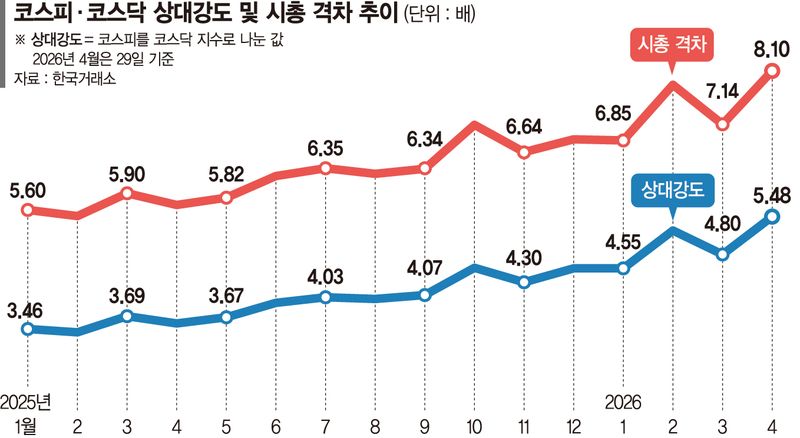
According to the Korea Exchange (KRX) on the 29th, the KOSPI Composite Index closed at 6,690.90, while the KOSDAQ finished at 1,220.26. So far this year, the KOSPI has climbed 58.77%, compared with a 31.83% gain for the KOSDAQ.
Compared with the KOSPI, the KOSDAQ has continued to rise at a slower pace. Last year, the KOSPI surged 75.63%, while the KOSDAQ rose only 36.46%.
As a result, the gap between the two indices has continued to widen. The relative strength ratio, calculated by dividing the KOSPI by the KOSDAQ, stood at 5.48 times and has remained at a high level after hitting an all-time high of 5.51 times on the 23rd. The ratio was 3.49 times at the beginning of last year and 4.56 times at the start of this year.
The market-cap gap has also widened in line with the indices. The KOSPI's total market capitalization is now 8.10 times that of the KOSDAQ, up sharply from 5.70 times at the beginning of last year and 6.90 times at the start of this year. A gap of more than eight times has not been seen since January 2015, or in more than 11 years.
The rally is being interpreted as the result of the KOSPI's rapid gains, led by Samsung Electronics Co., Ltd. and SK Hynix, as the AI-driven semiconductor boom continues, while investor sentiment toward biotech stocks, which lead the KOSDAQ, has not improved.
Brokerages expect the KOSPI's total operating profit this year to reach the 700 trillion won to 800 trillion won range, roughly two to three times higher than a year earlier. The KOSDAQ's operating profit is projected at around 18 trillion won, with growth of more than 50% from last year.
Cho Chang-min, an analyst at Hyundai Motor Securities Co., Ltd., said, "A key feature of this KOSPI recovery phase is that stock prices are rising while the price-earnings ratio (PER) is falling at the same time. That means earnings forecasts are improving faster than prices are recovering." He added, "As long as earnings continue to drive prices, there is still room for further upside."
Some also expect the semiconductor-led rally to slow and for rotation into other sectors to begin in earnest. Lee Kyung-soo, an analyst at Hana Securities Co., Ltd., said, "The KRX Semiconductor Index tends to underperform the market in February, May, August and November, when earnings consensus enters a lull." He added, "Over the next month, another alpha theme is likely to lead the market rather than semiconductors."
For the KOSDAQ, the index is likely to be shaped by the performance of biotech stocks. Jeong Hee-chan, an analyst at Samsung Futures, said, "This month, the KOSDAQ continued to underperform the KOSPI." He explained, "Semiconductor materials, parts and equipment stocks, which account for a large share of the KOSDAQ, and secondary battery stocks, which have benefited from the AI boom and hopes for an energy transition amid the war, posted gains. But the main reason was deteriorating investor sentiment toward biotech, which has the largest market-cap weighting." He added, "Individual stock events such as poor disclosure and disappointing clinical results have weighed on sentiment across the sector. However, major global medical conferences are scheduled one after another from late next month to early June, so it will be worth watching whether sentiment in the biotech sector can recover."
[email protected] Seo Min-ji Reporter