[Exclusive] 0% tariff quota to be applied to 12,000 tons of imported pork starting next month
- Input
- 2026-04-28 18:41:01
- Updated
- 2026-04-28 18:41:01
According to the processed food industry, the Ministry of Economy and Finance (MOEF), and the Ministry of Agriculture, Food and Rural Affairs (MAFRA) on the 28th, consultations are under way to apply a 0% tariff quota to imported pork from May through December this year. The cuts subject to the measure are pork shoulder and hind leg, which are classified under the HS code as 'frozen other.' Discussions are currently focused on a volume of 12,000 tons.
The government cited rising prices for pork hind leg as the basis for the tariff quota. The relatively cheaper hind leg is mainly used as raw material for processed meats such as ham and sausages, or for institutional meals and dishes such as stir-fried pork. As imported pork prices have surged due to the stronger won and other factors, the industry has increased demand for domestic pork hind leg as a substitute, worsening supply concerns. In addition, culling caused by African swine fever (ASF) and upward pressure on production costs stemming from the Arab–Israeli War have prompted the government to take preemptive action.
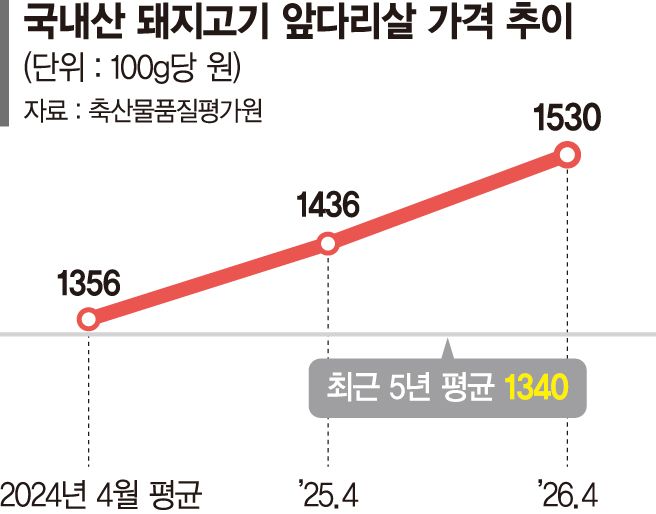
Pork prices are indeed on the rise. The consumer price index for pork has increased year on year for 21 consecutive months, from July 2024 through March this year. According to the Korea Institute for Animal Products Quality Evaluation (KAPE), the consumer price of domestic pork shoulder stood at 1,530 won per 100 grams in April, up 6.5% from 1,436 won a year earlier and 14.2% above the five-year average of 1,340 won.
Supply, meanwhile, is shrinking. The number of breeding sows in the country, a key indicator for price forecasts, came to 872,000 in the first quarter of this year, down 2.1% from a year earlier and 4.3% from the same period in a normal year.
The government said the tariff quota would have little impact on domestic pork farms. It argued that imported shoulder and hind leg cuts are mainly used for processing, making them separate from domestic pork used for grilling.
Lee Gi-hong, head of the Korea Pork Producers Association, argued that "tariff quotas are a waste of taxpayers' money. A fundamental solution is needed." He added, "More than 130,000 head of livestock died in last year's heat wave. The government needs to invest in measures to prevent heat damage, including installing cooling and heating water systems, supplying air conditioners, and reducing electricity bills." He also said, "To strengthen the international competitiveness of livestock farms, budget support for smart farms and modernization projects is important."
[email protected] Choi Yong-jun Reporter