‘A Home in Seoul, Work in the Provinces’ Samsung Electronics and SK Hynix Employees Also Caught in Long-Term Holding Deduction Debate
- Input
- 2026-04-28 18:25:53
- Updated
- 2026-04-28 18:25:53
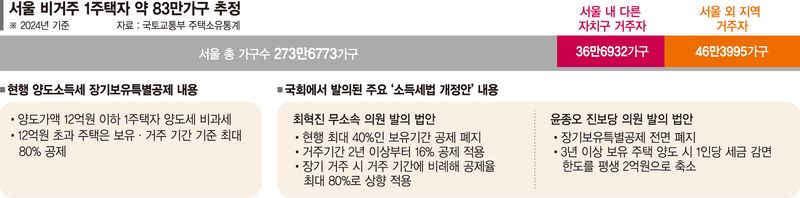
As the long-term holding special deduction for capital gains tax is expected to be reworked to focus on residence rather than ownership, anxiety is growing among executives and employees at major companies who live in the provinces. Many have bought apartments in Seoul while renting near their company sites, making them nonresident single-home owners. They were once envied for making a smart investment, but now they are being pushed into the category of speculators.
According to industry estimates on the 28th, as many as 830,000 households own homes in Seoul but do not actually live there. Ministry of Land, Infrastructure and Transport housing ownership statistics show that, as of 2024, of Seoul's total 2,736,773 households, 366,932 live in another district within Seoul, while 366,932 live outside the capital region.
As the upcoming tax reform plan to be announced in July is expected to include a measure linking long-term holding deduction benefits to the length of residence, complaints are already surfacing among employees at major Korean companies. For many, it is common to buy a home in Seoul or the metropolitan area while renting monthly or on a deposit basis near provincial workplaces. Samsung Electronics Co., Ltd. in Pyeongtaek, Gumi, and Gwangju, SK hynix in Cheongju, and Hyundai Motor Company in Ulsan are representative examples. One real estate expert said, "The higher the bonuses in an industry, the stronger the tendency to buy homes in the capital region," adding that "rising rent and deposit prices in provincial cities with major company sites are also a result of the same background."
Employees at financial and public institutions, which are being considered for public-sector consolidation and a second round of regional relocation, are facing similar concerns. One public institution worker who owns a home in Seoul said, "Most of us are dual-income couples, and if we want to keep living in the house, we may have to become weekend couples," adding, "We would become involuntary nonresidents, and now we also have to worry about taxes. It is a double blow."
The government says it will recognize exceptions for cases involving work or education and other "unavoidable reasons," but if the criteria remain unclear, disputes are likely to be frequent. In particular, some public institution employees are worried that government policy could force them to sell their existing homes.
Critics are also saying the tax reform push amounts to an infringement on property rights. One expert said, "Holding a solid asset in a good location is a legitimate exercise of an individual's property rights," and added that "the special circumstances of workers in the provinces, for whom actual residence is structurally impossible, need to be reflected in greater detail."
Meanwhile, the National Assembly introduced a revision to the Income Tax Act the previous day that would abolish deductions based on holding period and instead apply different deduction rates according to actual residence period. Another bill has also been proposed that would eliminate the long-term holding special deduction entirely and cut the lifetime tax reduction limit per person to 200 million won for the sale of homes held for at least three years.
[email protected] Jeon Min-kyung Reporter