Foreign and luxury spending expands as the three major department stores all post strong first-quarter results
- Input
- 2026-04-28 18:25:51
- Updated
- 2026-04-28 18:25:51
■ Foreign and luxury spending drive rapid growth
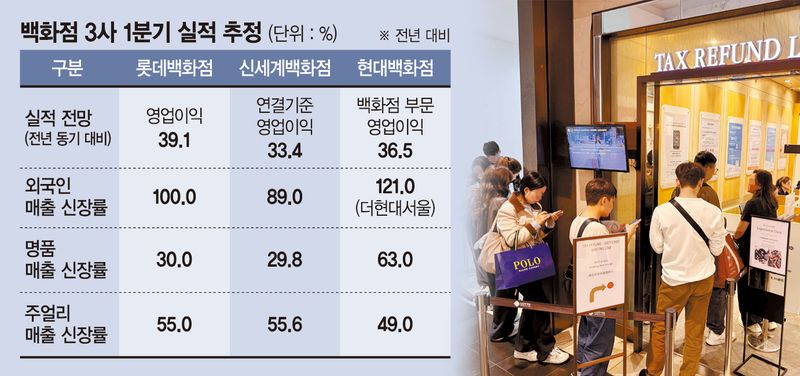
According to the securities industry on the 28th, first-quarter results in South Korea's department store sector showed solid growth. Jeong-hye Hong, an analyst at Shinyoung Securities, forecast that Lotte Department Store's first-quarter gross sales and operating profit would reach 2.2838 trillion won and 177.9 billion won, respectively, up 10.4% and 39.1% from a year earlier. She said the recovery in foreign demand and the expansion of luxury sales were the main drivers of the improved performance.
Hyundai Department Store is expected to post somewhat weak results on a consolidated basis, but its department store division appears to have maintained growth. Hong projected that Hyundai Department Store Group's consolidated first-quarter gross sales and operating profit would fall 2.5% and 8.0% year on year, respectively. By contrast, gross sales and operating profit at the department store division are estimated to have risen about 9% and 36.5%, respectively.
The improved results are seen as the outcome of stronger foreign demand combined with rising luxury consumption. Lotte Department Store said foreign sales in the first quarter nearly doubled from a year earlier. Over the same period, luxury sales rose 30%, while luxury jewelry sales increased 55%. Shinsegae Department Store also reported an 89% increase in foreign sales during the same period. By store, the main branch in Myeong-dong, Seoul, posted the largest gain at 140%, followed by 98% at the Centum City branch and 54% at the Gangnam branch. Overall luxury sales at Shinsegae Department Store rose 29.8%, while luxury jewelry sales climbed 55.6%. Hyundai Department Store is also seeing a clear trend of stronger foreign spending. Foreign sales at The Hyundai Seoul, the store most frequently visited by foreign customers, jumped 121%. On a companywide basis, fashion sales rose 131%, luxury sales 63%, and watch and jewelry sales 49%.
Industry officials say foreign and luxury spending have expanded at the same time, creating a strong synergy. One industry source said, "Luxury goods and foreign demand were the biggest factors behind the earnings improvement." The source added, "As other categories such as fashion and food also grew, overall sales increased as well."
Some analysts also say changes in the asset market environment have affected department store spending. One industry source said, "With cash flow constrained by real estate regulations and other factors, consumer spending power appears to have shifted toward luxury goods and similar categories."
■ Structural shift toward foreign visitors
Overall, the department store industry is rapidly shifting away from a domestic-demand-centered model and toward one driven by foreign visitors. As tourism grows and luxury consumption rises alongside it, the structure of sales is also changing more quickly.
Industry observers see this shift as a typical structural transition similar to what has already happened at major department stores in Japan and France. Examples include Isetan Shinjuku and Takashimaya in Tokyo's Ginza district, as well as Galeries Lafayette in Paris, where foreign sales account for a significant share of total revenue. In South Korea, foreign sales at Shinsegae Department Store Main Branch have expanded to around 30% of the total, putting it on the path to becoming a global department store. Analysts attribute this to a combination of rising inbound tourism, growing preference for K-beauty and K-fashion, and the reshaping of key commercial districts such as Myeong-dong and Gangnam District.
clean@fnnews.com Lee Jeong-hwa Reporter