Samsung Electro-Mechanics Nears Entry Into Top 10 by Market Cap, Backed by Jang Deok-hyun's Bold Leadership
- Input
- 2026-04-28 18:20:42
- Updated
- 2026-04-28 18:20:42
■ Jang Deok-hyun: "Let's become a top-tier component maker"
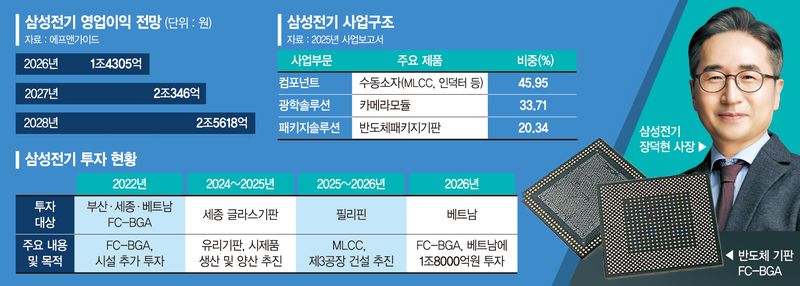
According to the components and securities industries on the 28th, Samsung Electro-Mechanics is widely expected to post operating profit in the mid-1 trillion won range this year, driven by multilayer ceramic capacitors (MLCCs), often called the "rice of the electronics industry," and flip-chip ball grid array (FC-BGA) semiconductor package substrates. Next year, it is expected to move into the 2 trillion won range, and by 2028, forecasts suggest operating profit could reach the mid-2 trillion won range or even 3 trillion won. According to the company's annual report, its major global customers include Google, Tesla, Inc., TSMC, Xiaomi Corporation, Intel Corporation and Sony. Demand is so strong that customers are reportedly asking to discuss supply volumes for 2029 to 2030, three years ahead. The company is increasingly being praised for successfully transforming itself from Samsung Electronics Co., Ltd.'s back-end parts base into a world-class component maker.
The gap with Japanese rival Murata Manufacturing Co., Ltd., which it has long been chasing, is also narrowing quickly. In the field of FC-BGA for AI applications in particular, the two companies are effectively neck and neck. Samsung Electro-Mechanics' recent announcement that it will expand its FC-BGA plant in Vietnam with an investment of 180 billion won is seen as a bold move to gain the upper hand. An industry source said, "Once the investment in the Vietnam plant is completed, the company could leap to No. 1 in the global AI semiconductor substrate market."
These results are the outcome of a five-year effort to fundamentally reshape the company. Since 2021, in line with the Lee Jae-yong era and the "New Samsung" vision, Samsung Electro-Mechanics has been working to break away from its role as Samsung Electronics Co., Ltd.'s back-end parts base.
President Jang Deok-hyun, who played a key role in the "Samsung semiconductor miracle," was brought in to lead this period of sweeping change. He judged that the company had limits as a maker of mobile components and pushed aggressively into higher-end markets such as automotive electronics and AI server components, which are said to be three to ten times more expensive. Under the goal of becoming the No. 1 tech company, trillion-won-scale investments were made every year at home and abroad. The industry points to Jang's "timing strategy." The view is that reading technology trends and proactively improving the company's fundamentals led to maximum earnings growth.
■ From a "timing" strategy to an "expansion" strategy
Demand for the company's flagship products, MLCCs and FC-BGAs, is understood to exceed production capacity by more than 30% and 50%, respectively. MLCC production is currently running at full capacity, while FC-BGA utilization is expected to reach 100% as early as the third or fourth quarter of this year. Lee Min-hee, a researcher at BNK Securities, said, "Samsung Electro-Mechanics is virtually unrivaled in Korea when it comes to high-end server substrates," adding that "its accumulated technological strength is now beginning to bear fruit in earnest."
Samsung Electro-Mechanics has begun laying the groundwork for the next five years based on its scalability as Samsung's electronics and electrical components maker. The company is moving into glass substrates, robots and even space-related businesses. Jang's vision is that "all of Samsung Electro-Mechanics' product lines, including MLCCs, power inductors and semiconductor substrates, are connected to humanoids," and that the company must accelerate its pace in line with the humanoid market, which is opening faster than expected.
Starting in the second half of this year, Samsung Electro-Mechanics plans to expand into the robot joint, or actuator, segment, a core area for robots, after beginning mass production of eyes for humanoid robots.
[email protected] Jo Eun-hyo Reporter