The number of ETFs in the "trillion-won club" rises 40% this year, but concentration in major asset managers is a burden
- Input
- 2026-04-28 18:19:32
- Updated
- 2026-04-28 18:19:32
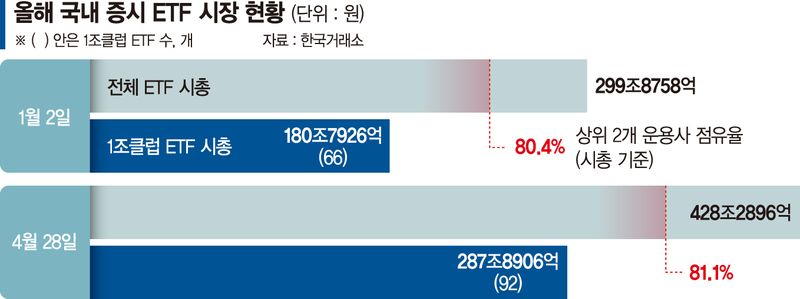
According to the Korea Exchange (KRX) on the 28th, the number of ETFs that surpassed 1 trillion won in market capitalization increased by 26 this year, from 66 on Jan. 2 to 92 as of the day. That represents a gain of 39.4%. Over the same period, the combined market capitalization of those ETFs rose 59.2% from 180.7926 trillion won to 287.8906 trillion won.
Market watchers say the growth of large ETFs reflects their shift from a simple supplementary product to a core tool for stock investing. They offer diversification, easier trading than individual stocks, and greater usefulness in tax-advantaged accounts such as pension accounts and individual savings accounts (ISAs), which has kept money flowing in steadily. The total market capitalization of all domestic ETFs also climbed about 42.8% this year, from 299.8758 trillion won at the start of the year to 428.2896 trillion won as of the 28th.
Recently, products investing in specific industries or themes such as semiconductors, artificial intelligence (AI), nuclear power, and major U.S. index funds have grown rapidly, leading to more new entries into the trillion-won club. Analysts say demand has expanded not only for major domestic index ETFs but also for products tied to the U.S. stock market and sector themes.
Oh Gwang-young, a researcher at Shinyoung Securities Co., Ltd., said, "The ETF market is expected to further solidify its position as a basic investment tool for domestic investors." He added, "We expect new types of ETFs and government support, including regulatory improvements, to better meet investor needs."
Still, the gains from market growth are concentrated in a small number of asset management companies. By manager, Samsung Asset Management increased its number of trillion-won-club ETFs from 24 at the start of the year to 34, the largest share. Mirae Asset Global Investments Co., Ltd. followed, with its count rising from 21 to 30 over the same period. Together, the two firms now hold 64 ETFs worth more than 1 trillion won, accounting for about 70% of the total, slightly above the 68.2% share at the start of the year.
Measured by fund size, the concentration was even higher. Samsung Asset Management's share of the market capitalization of ETFs worth more than 1 trillion won rose from 44.6% at the start of the year to 46.8%. Combined with Mirae Asset Global Investments Co., Ltd., the top two firms' share expanded from 80.4% to 81.1%.
Analysts say the growing tilt toward large firms stems from the ETF market structure, where scale leads to additional inflows. The larger the trading volume and net assets, the smaller the price gap and the easier the trading, which tends to draw investor money into bigger products. Industry officials also say that this kind of concentration, driven by brand recognition and liquidity advantages, is to some extent a natural part of the ETF market's growth.
However, there are concerns that if concentration deepens further because of aggressive marketing and fee-cutting competition among large managers, the market's competitive structure could weaken.
One asset management company official said, "Competition in advertising and sales channels backed by greater capital strength could widen the gap further, and if ultra-low-fee competition continues, smaller managers with weaker profit bases may face greater pressure to sustain their businesses." The official added, "In the long term, this trend could also reduce ETF product diversity and limit investor choice."
[email protected] Bae Han-geul Reporter