Bo-geum-jari Loan Rate Hiked Four Times This Year, Overtaking Commercial Bank Mortgage Rates
- Input
- 2026-04-28 15:38:20
- Updated
- 2026-04-28 15:38:20
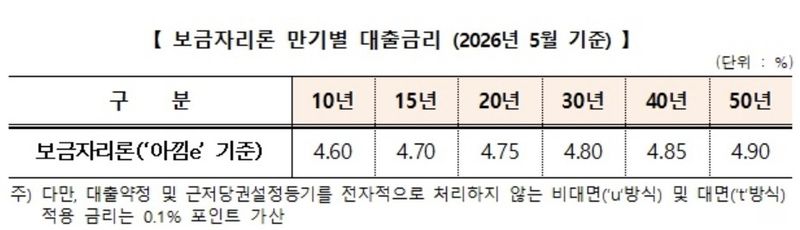
[The Financial News] The policy-backed Bo-geum-jari Loan has been found to have surpassed mortgage rates offered by commercial banks. The rate was raised four times this year to curb demand after outstanding balances surged sharply. As the financial authorities reduce the share of policy loans, the Bo-geum-jari Loan rate is expected to remain elevated for the time being.
According to the financial sector on the 28th, Korea Housing Finance Corporation (HF) will apply a 0.25 percentage point increase to the Bo-geum-jari Loan, a long-term, fixed-rate, installment-repayment mortgage product, from May 1, setting rates at 4.60% for 10-year loans and 4.90% for 50-year loans.
For new applications submitted from May 11, an additional 0.1 percentage point will be applied if the mortgaged home is located in a regulated area. That means the maximum rate could reach 5.0%. The top rate for the Bo-geum-jari Loan exceeding 5.0% is the first since December 2022, when it stood at 4.75% to 5.05%.
In December last year, Bo-geum-jari Loan rates were in the 3.65% to 3.95% range, but after four rate hikes this year, they will rise to 4.6% to 4.9% from May. As of the 28th, the lowest fixed-rate mortgage rates for five-year terms at the Five Major Commercial Banks — KB Kookmin Bank, Shinhan Financial Group, Hana Bank, Woori Bank and NH NongHyup — are in the 4.25% to 4.74% range. It is unusual for the Bo-geum-jari Loan rate to be higher than fixed mortgage rates at commercial banks.
The increase is attributed to a surge in Bo-geum-jari Loan sales as borrowers shifted to the product after the financial authorities effectively restrained mortgage lending at commercial banks this year. In fact, Bo-geum-jari Loan sales from January to February this year totaled 4.9822 trillion won, nearly double the 2.5359 trillion won recorded in the same period last year. HF's annual target for Bo-geum-jari Loan sales is 20 trillion won, meaning about 25% of the target was used up in just two months.
As sales expanded sharply, HF had little choice but to raise rates to manage demand. The Bo-geum-jari Loan rate is linked to funding costs such as the issuance rate of Mortgage-Backed Securities (MBS), while also taking into account the broader role of policy financial institutions.
The financial authorities are expected to tighten Bo-geum-jari Loan rules further, raising the possibility of additional rate increases. Last month, they announced this year's household debt management plan and decided to cut the share of policy loans from 30% to 20%.
A reduction in the policy-loan share could also lead to lower Bo-geum-jari Loan limits. Under the June 27 loan regulations last year, limits for policy loans such as the Didimdol Loan and Buteumok Jeonse Loan were reduced, while Bo-geum-jari Loan was excluded from the measures.
[email protected] Park So-hyun Reporter