Mortgage Loan Rates Rise for 6 Straight Months, Hitting Highest Level in 28 Months
- Input
- 2026-04-28 12:00:00
- Updated
- 2026-04-28 12:00:00

According to the Bank of Korea (BOK)'s "Weighted Average Interest Rates of Financial Institutions for March 2026," the interest rate on new household mortgage loans at deposit banks stood at 4.34% in March. That was up 0.02 percentage points from the previous month’s 4.32%.
It was the highest level since November 2023, when it reached 4.48%. It also marked a six-month streak of increases since October last year, when the rate stood at 3.98%.
The rise is attributed to a 0.17 percentage point increase in the five-year bank bond yield, which serves as the benchmark rate, during March. The five-year yield has been on an upward trend, rising from 3.58% in January to 3.73% in February and 3.90% in March.
Fixed rates rose 0.02 percentage points from 4.30% to 4.32%, while variable rates increased 0.01 percentage points from 4.38% to 4.39%.
Lee Hye-young, head of the Financial Statistics Team at the Economic Statistics Department 1 of the BOK, explained, "Mortgage rates rose as longer-term rates increased, reflecting the impact of higher Treasury bond yields along with the five-year bank bond yield." She added, "In April, bank bond yields are moving downward, while variable rates and COFIX are on an upward trend, so the gap between the two is expected to narrow."
Jeonse loan rates rose 0.01 percentage points from the previous month to 4.07%. That is the highest level in 13 months, since February last year, when the rate stood at 4.09%. The rate for guaranteed loans, a broader category that includes jeonse loans, fell 0.01 percentage points. The decline was driven by an increase in lower-rate guaranteed group loans.
The rate on general credit loans rose 0.04 percentage points to 5.57%. Although it had fallen the previous month, it turned upward again after one month, partly due to a higher share of loans to mid- and low-credit borrowers at some banks.
As a result, the overall household loan rate, including mortgage loans, jeonse loans and credit loans, rose 0.06 percentage points to 4.51%. That is the highest level since March last year, when it also stood at 4.51%.
Among household loans measured by new lending, the share of fixed-rate loans was revised down 7.6 percentage points from the previous month to 35.5%. It has fallen for eight straight months since reaching 62.2% in August last year, and is the lowest since September 2022, when it stood at 33.6%. The share of fixed-rate mortgage loans also dropped 10.3 percentage points to 60.8%, extending its decline for a fifth consecutive month since November last year, when it reached 90.2%.
Lee said, "As the share of fixed-rate loans, which carry relatively higher rates, has declined, the pace of increase in mortgage and jeonse loan rates has been limited." She added, "Excluding policy loans such as Bogeumjari loans, fixed rates are higher, so preference for variable-rate products has increased further."
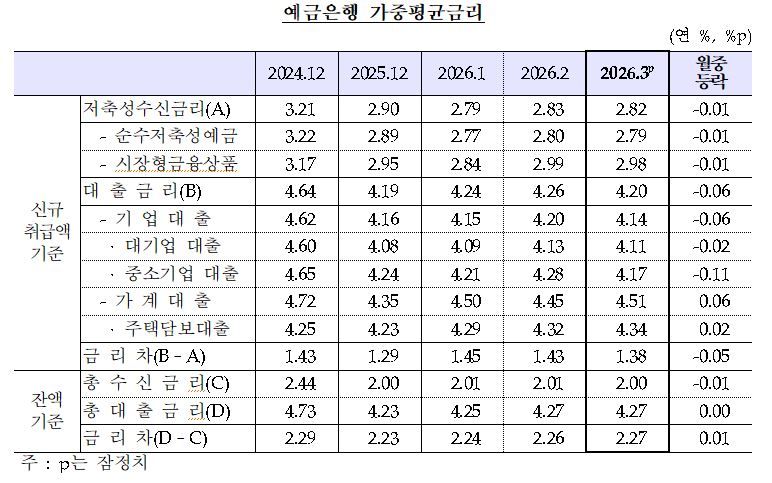
The spread between lending and deposit rates for new loans narrowed by 0.05 percentage points from 1.43 percentage points to 1.38 percentage points.
In March, the interest rate on savings deposits fell 0.01 percentage points from the previous month to 2.82%. Rates on pure savings deposits such as time deposits, as well as market-based financial products such as financial bonds and certificates of deposit (CDs), also each declined by 0.01 percentage points.
At the end of March, the total deposit rate based on outstanding balances fell 0.01 percentage points from the previous month to 2.00%. The total lending rate was unchanged from the previous month-end at 4.27%. The spread between the two widened by 0.01 percentage points from the previous month-end to 2.27 percentage points.
Among nonbank financial institutions, deposit rates for one-year time deposits and savings deposits rose 0.17 percentage points at mutual savings banks, 0.14 percentage points at credit unions, 0.09 percentage points at mutual finance cooperatives, and 0.16 percentage points at the Korean Federation of Community Credit Cooperatives. On the lending side, rates fell 0.53 percentage points at mutual savings banks and 0.01 percentage points at the Korean Federation of Community Credit Cooperatives, while they rose 0.12 percentage points at credit unions and 0.04 percentage points at mutual finance cooperatives.
[email protected] Kim Tae-il Reporter