[Editorial] Partnering with Google DeepMind to Make a Leap Forward as an AI Powerhouse
- Input
- 2026-04-27 18:40:27
- Updated
- 2026-04-27 18:40:27
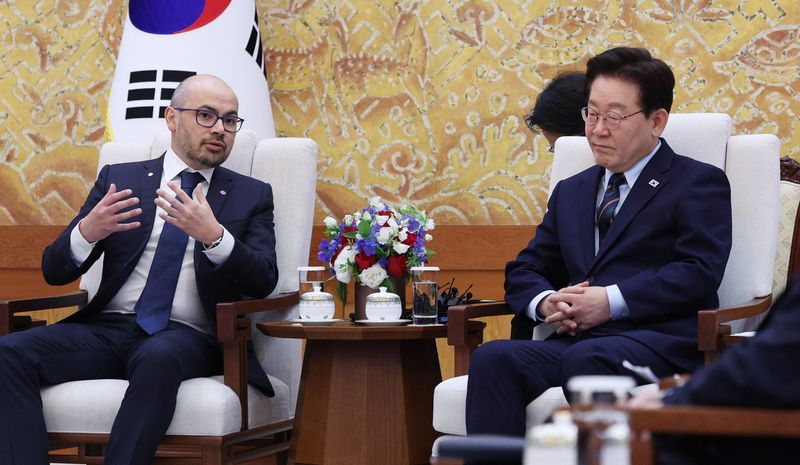
President Lee Jae-myung met with Hassabis on the 27th. At the meeting, the South Korean government and Google reportedly discussed AI-driven scientific and technological innovation, as well as the responsible use of AI. They also agreed to actively build a partnership aimed at helping South Korea become one of the world’s top three AI powers.
The meeting with Hassabis can be seen in the broader context of a series of visits to South Korea by leaders of global big tech firms. South Korea is home to the world’s strongest memory chip makers, giving it a crucial position in AI. It also has a solid manufacturing data base, which is essential for AI and humanoid development. Excluding China, few countries can match Korea in this regard. That is why the heads of OpenAI, Nvidia Corporation, and AMD have all recently visited the country. For overseas tech giants, visits to South Korea are also important for their own development and business strategies.
It is also worth noting that the nature of cooperation between big tech and AI is changing. In the past, cooperation mainly centered on attracting data centers and securing semiconductor supply. Now it is expanding into foundation models, AI for science, talent exchange, and standards for responsible AI. The government is making the acquisition of a world-class independent AI model one of its key policy goals. It is hoped that Hassabis, who oversaw the development of AlphaGo and Google Gemini, can lend his support. The government should actively seek ways to create synergy while safeguarding technological sovereignty.
Ten years have passed since the AlphaGo shock. In that time, the global industrial paradigm has changed fundamentally. U.S. companies that entered AI development early now hold the strongest position. Google LLC, Microsoft Corporation, Nvidia Corporation, and OpenAI sit at the top of the food chain. China, though later than the United States, has also built a solid position by nurturing science and engineering talent at the national level and has nearly caught up with the U.S. According to the AI Index 2026 Report recently released by the Stanford Institute for Human-Centered Artificial Intelligence (HAI), U.S. institutions produced 40 major AI models, while China produced 15. The U.S. still dominates in model count, but the performance gap has narrowed rapidly. The difference in performance between the two countries’ top AI models is reportedly within just 3%.
South Korea’s standing in AI leaves much to be desired. The epicenter of the AlphaGo shock was none other than Korea itself, and although the country had an excellent information technology foundation, its response was slow. There are signs of improvement in the metrics thanks to various efforts, including the push for an independent AI model, but compared with the two leading powers, the U.S. and China, Korea still remains a latecomer with a significant gap to close.
National support and attention, the scale of private investment, and the capabilities of technical talent will likely determine who leads the global AI race. Even now, South Korea must pursue the two front-runners with relentless momentum. The government is pushing large-scale support measures under its vision of becoming one of the world’s top three AI powers. This year, it will allocate three times more budget than last year for building national AI infrastructure and purchasing graphics processing units (GPUs). The semiconductor boom is also fueling a surge of interest in semiconductor engineering departments. What is needed now is bold, government-led compensation and treatment for science and engineering talent, along with decisive action to open the floodgates for private AI investment. This is the last golden window of opportunity.