"We wanted to keep our home in Seoul while moving to the provinces..." Retirees face growing concerns [Controversy Over Long-Term Holding Special Deduction Revision]
- Input
- 2026-04-27 18:29:07
- Updated
- 2026-04-27 18:29:07
According to the real estate industry on the 27th, President Lee Jae-myung's message about abolishing the long-term holding special deduction is affecting moves to the provinces. Under the current system, when a one-household, one-home owner sells a home, the Capital Gains Tax on the sale profit is reduced by up to 40% if the property has been held for more than 10 years. If the owner has also lived there for 10 years, the deduction can be cut by another 40%. That means the tax burden can be reduced by as much as 80%. But President Lee pointed to the benefit tied to the holding period among the two criteria of ownership and actual residence. In other words, the deduction that one-home owners received simply for holding a property could disappear.
The issue is especially relevant for people who lived in Seoul and planned to move to the provinces to secure retirement cash flow and return to their hometowns. The average apartment price in Seoul is about 1.5 billion won, which exceeds the 1.2 billion won threshold for Capital Gains Tax exemption for one-household, one-home owners. Some had planned to rent out their Seoul home and move to a cheaper area in the provinces to earn rental income, but now they fear they may have to pay more tax when they sell.
Critics also say there is a disconnect between the government's policy of preserving one-household, one-home tax benefits even when people buy an additional home in the provinces for balanced regional development, and the proposed abolition of the long-term holding special deduction. The threshold for becoming a two-home owner, such as Acquisition Tax and the Comprehensive Real Estate Holding Tax, has been eased. But if the deduction on a core asset like an apartment in Seoul is undermined, it could discourage people returning to farming or rural life from establishing a base in the provinces.
There are currently special tax provisions for those who acquire a rural house. If a household owns one rural house outside the Seoul metropolitan area and one ordinary home, the rural house is treated as if it does not exist when the ordinary home is sold, allowing the one-household, one-home tax exemption to apply.
There is also a special rule to encourage second homes in Population-Declining Areas. If an existing one-home owner acquires an additional home in such an area with an officially assessed value of 900 million won or less, the same one-home owner tax benefits are applied when calculating Capital Gains Tax and the Comprehensive Real Estate Holding Tax.
Kim Shin-eon, an adjunct professor at Dongguk University and a tax accountant, said, "Ultimately, abolishing the long-term holding special deduction could become a concern for apartment owners in Seoul who do not live there and want to buy a lower-priced home in the provinces and move their residence." He added, "Many people keep their Seoul home, live in the provinces, and use their jeonse deposit to invest in stocks or create retirement income."
Lee Jeom-ok, deputy head of Shinhan Premier Pathfinder and a tax accountant, said, "If people view homes in the Seoul metropolitan area as assets rather than places to live, and believe the tax-saving effect on capital gains will shrink when they sell later, that will affect their decision to move to the provinces."
It could also influence the decisions of people hoping to return to farming or rural life and choose their place of residence more flexibly.
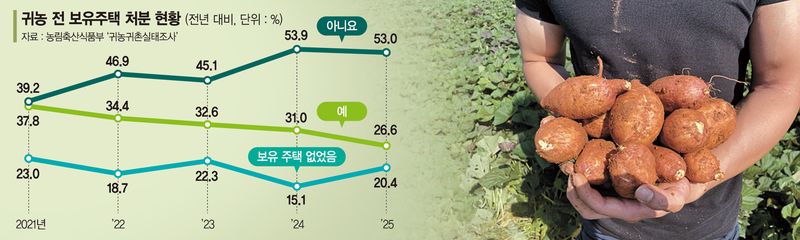
According to the Survey on the Current Status of Returning to Farming and Rural Life, only 26.4% of respondents said they sold their home before moving to the countryside last year. Among those who returned to farming, the figure was 26.6%. That is down 11.2 percentage points from 37.8% in 2021.
The number of people selling their city homes is steadily declining. Because returning to farming itself carries risks, many people try it while keeping a safe asset. Agricultural experts say that if the tax burden on homes in Seoul rises further, returning to farming will become even more difficult. In fact, 42.2% of people who returned to farming in 2024 moved from the Seoul metropolitan area.
The tax authorities, MOEF, gave a cautious response, saying the abolition of the deduction for actual residents is still "under discussion." The ministry is preparing a Tax Revision Bill scheduled for release in July, taking into account the president's message.
A MOEF official said, "Even if a one-household, one-home owner holds a farming house or similar property, the basic rule is that Capital Gains Tax is imposed if the existing home exceeds 1.2 billion won."
Woo Byung-tak, a senior researcher at Shinhan Premier Pathfinder, said, "If the long-term holding special deduction is abolished, it may be worth considering additional tax benefits, such as lower Acquisition Tax, for purchasing homes in the provinces."
Choi Yong-jun, Kim Chan-mi, [email protected]