China's industrial profits jumped 15.8% last month, with clear divergence across sectors
- Input
- 2026-04-27 18:23:12
- Updated
- 2026-04-27 18:23:12
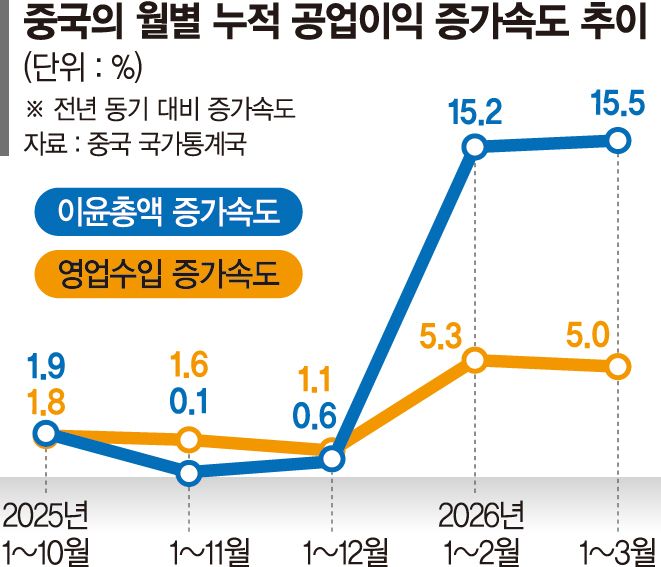
On the 27th, the National Bureau of Statistics of China (NBS) said that profits at industrial firms above the designated size, defined as companies with annual revenue of at least 20 million yuan, rose 15.8% in March. According to the release, total industrial profits in the first quarter reached 1.69604 trillion yuan, or about 365.9 trillion won, up 15.5% from a year earlier. The growth rate for January-March was 0.3 percentage points higher than the 15.2% recorded in January-February, and March alone was 0.6 percentage points higher than the previous two-month period.
By company type, first-quarter industrial profits rose 25.4% at private firms. Profits increased 20.9% at joint-stock companies and 10.1% at state-owned enterprises. Foreign-invested companies, including those from Hong Kong, Macau and Taiwan, also returned to positive growth, rising 1.2% after a 3.8% decline in January-February.
By sector, manufacturing profits climbed 19.1%, lifting overall performance. Mining profits also increased 16.2%, while profits in the electricity, heat, gas and water supply sector fell 3.2%.
Among industries, computer, communications and electronic equipment manufacturing, as well as nonferrous metal smelting and rolling, each surged 120% from a year earlier, leading the improvement. Chemical raw materials and chemical products manufacturing also rose 54.5%. By contrast, nonmetallic mineral products fell 42.6%, and automobile manufacturing dropped 17.7%, underscoring the sharp divergence across industries.
In this regard, British media noted that "while some sectors tied to artificial intelligence are showing strength, industries serving ordinary consumers are still struggling." For example, the producer of Kweichow Moutai, one of China's best-known premium liquors, recently reported weak results as softer domestic demand weighed on prices and sales.
British media also predicted that "corporate profits could gradually improve as Chinese authorities continue cracking down on excessive price competition in manufacturing." However, the impact of those measures has not yet become visible.
Wei Weining, chief statistician at the NBS industrial department, said that industrial activity recovered steadily in the first quarter because authorities responded to a complex economic environment by rolling out macroeconomic policies in a timely and proactive manner.
[email protected] Hong Chaewan Reporter